

A HubSpot portal audit is a review of agreed account settings, operating processes and product use that produces findings your team can inspect and act on. When comparing HubSpot audit services, define the decisions the review must support: what to retain, repair, retire or investigate further. HubSpot audit deliverables should show the evidence behind those decisions, the limits of the review and who owns the next action.
A portal is the HubSpot account your organisation uses. Its configuration may span customer relationship management (CRM), marketing, sales, service and connected applications. Decide which of those areas the audit covers. A report about duplicate contacts alone cannot establish whether access, workflow ownership or paid-product use is appropriate.
Set the HubSpot audit scope around a decision
Start with a decision and a deadline. You may need to prepare for renewal, investigate a disputed report or establish ownership after an administrator leaves. Record the question, the people affected and what evidence would let them choose a next step.
For a renewal review, that question might be whether the team still needs a purchased capability. For a workflow review, it might be whether an important handoff has a responsible owner and a documented failure path. These are proposed audit objectives, not evidence that your account has either problem.
Give candidates an initial inventory of products, teams, integrations and known concerns. Ask them to identify dependencies they must inspect and information you must provide. Include the relevant contract or renewal date where commercial decisions are part of the review.
Use this inventory when discussing Twelverays HubSpot services. Request a defined review and an assessable output rather than assuming a standard service includes every account area.
Put a HubSpot portal audit checklist in the proposal
Ask each candidate to quote the same review areas and evidence requirements. The following matrix is a suggested scope to adapt. It does not describe universal audit inclusions.
| Review area | Evidence to request | Decision the finding should support |
|---|---|---|
| Paid products and seats | Purchased terms, assigned access and relevant use evidence | Retain, investigate or change the next purchase |
| Access and ownership | Selected roles, users and responsibility records | Correct an access gap or assign an accountable owner |
| Workflows and routing | Agreed settings, test results and available execution history | Retain, repair or retire a defined process |
| Integrations | Connection owner, record flow and observed exceptions | Clarify support or investigate a failed handoff |
| Lifecycle and reporting | Definitions, selected source records and report filters | Explain a discrepancy or commission further work |
| Data quality | Samples relevant to the agreed process | Estimate a separate cleanup requirement |
State the depth of each review. Checking selected workflows differs from examining every workflow and its dependencies. Ask how the auditor chooses samples, handles inaccessible areas and labels findings that require further testing.
A missing owner in a register is evidence of an ownership gap in that register. It does not prove that nobody operates the process. Require the reviewer to distinguish an observed configuration, an interview response and an inference that still needs confirmation.
Keep data cleanup as a named workstream with its own boundary. The existing guide to HubSpot data quality before a pipeline review covers the execution questions. This audit should establish the issue, its consequence and the next decision.
Separate HubSpot audit services from authorised changes
Audit access should permit the agreed investigation. It should not silently authorise changes to production settings, records or customer communications. Put permitted actions, test procedures and escalation contacts in the statement of work (SOW).
According to HubSpot's user permissions guide, permissions determine what users can do within the access their seats provide. View permissions and a View-only Seat are different concepts. The guide also explains that users with View permissions can still create certain activities, including notes and tasks. A role label alone is therefore insufficient evidence that an audit cannot change anything.
Have the account administrator review the exact permissions needed. Where direct access is unsuitable, agree another way to provide evidence, such as an approved export or supervised review. Record any resulting limitation in the report. Avoid requesting broad administrator access without explaining the actions that require it.
Compare audit-only work with an audit followed by separately approved remediation. Both can be legitimate purchases. For combined work, identify the approval point between diagnosing a problem and changing the system, including who approves the proposed correction and its cost.
Specify how evidence is stored and shared. Findings may contain customer records or commercially sensitive settings. Use the customer's approved handling process, limit copied detail to what the finding needs and agree access to the final report. A screenshot is useful only if its meaning, date and context are clear.
Require HubSpot audit deliverables that explain workflow evidence
A workflow finding should name the process, the observed condition, the expected behaviour and the available evidence. Ask whether the reviewer examined current settings, a simulation or actual execution history. Those sources answer different questions.
According to HubSpot's workflow testing documentation, its test feature can preview a record's path without running the workflow actions. Testing enrollment criteria does not guarantee that a record will enroll, for example when re-enrollment settings prevent it. The same documentation describes sending an email preview, so agree whether that optional action is permitted during the review.
Use these distinctions when accepting a finding. A successful simulation can support an explanation of current configured behaviour. It does not establish that an earlier record actually followed that path or that a changed workflow behaved identically before the review.
Request a reproducible reference: the workflow, relevant settings, test record or approved sample, observation date and steps examined. If historical evidence is unavailable, the finding should say so. Commission additional testing when that uncertainty would change the business decision.
Use a HubSpot renewal audit to retain, repair or retire
An audit can inform a renewal decision by connecting purchased capabilities to documented needs, use and dependencies. Usage by itself is not the decision. A seldom-used function may support an infrequent but necessary process; an actively used function may still need a different configuration.
According to the HubSpot Product & Services Catalog, access and charges depend on the purchased products, seat types and applicable capacity. Compare the audit inventory with your current order and terms. Do not infer a downgrade right, immediate saving or replacement feature from the auditor's usage summary.
Ask the reviewer to organise findings into a decision register. The following entries are hypothetical examples, not Twelverays client findings.
| Example finding | Evidence still needed | Proposed next decision |
|---|---|---|
| A paid capability has little recorded use in the review period | Named owner, seasonal requirements and dependent processes | Confirm the need before discussing renewal changes |
| A routing workflow has no documented owner | Administrator and operating-team review | Assign responsibility and approve any required repair |
| A dashboard differs from a sales report | Comparable filters, dates and selected underlying records | Explain the difference or scope a deeper reporting review |
| An integration shows unresolved exceptions | Affected records, receiving-system evidence and support ownership | Agree investigation and recovery responsibility |
For each finding, record business consequence, urgency, effort assumptions, owner and the decision required. Prioritise an incorrect customer handoff differently from an unused dashboard label. Avoid presenting an arbitrary overall health score as a substitute for those consequences.
Separate a confirmed issue from its proposed remedy. The audit may establish that a report uses inconsistent definitions without proving that a new subscription is necessary. Ask what can be resolved through an agreed configuration or process change, and which remaining requirement depends on a different entitlement.
Use the HubSpot implementation guide when a finding leads to a defined delivery project. Keep that project separate from accepting the audit report itself.
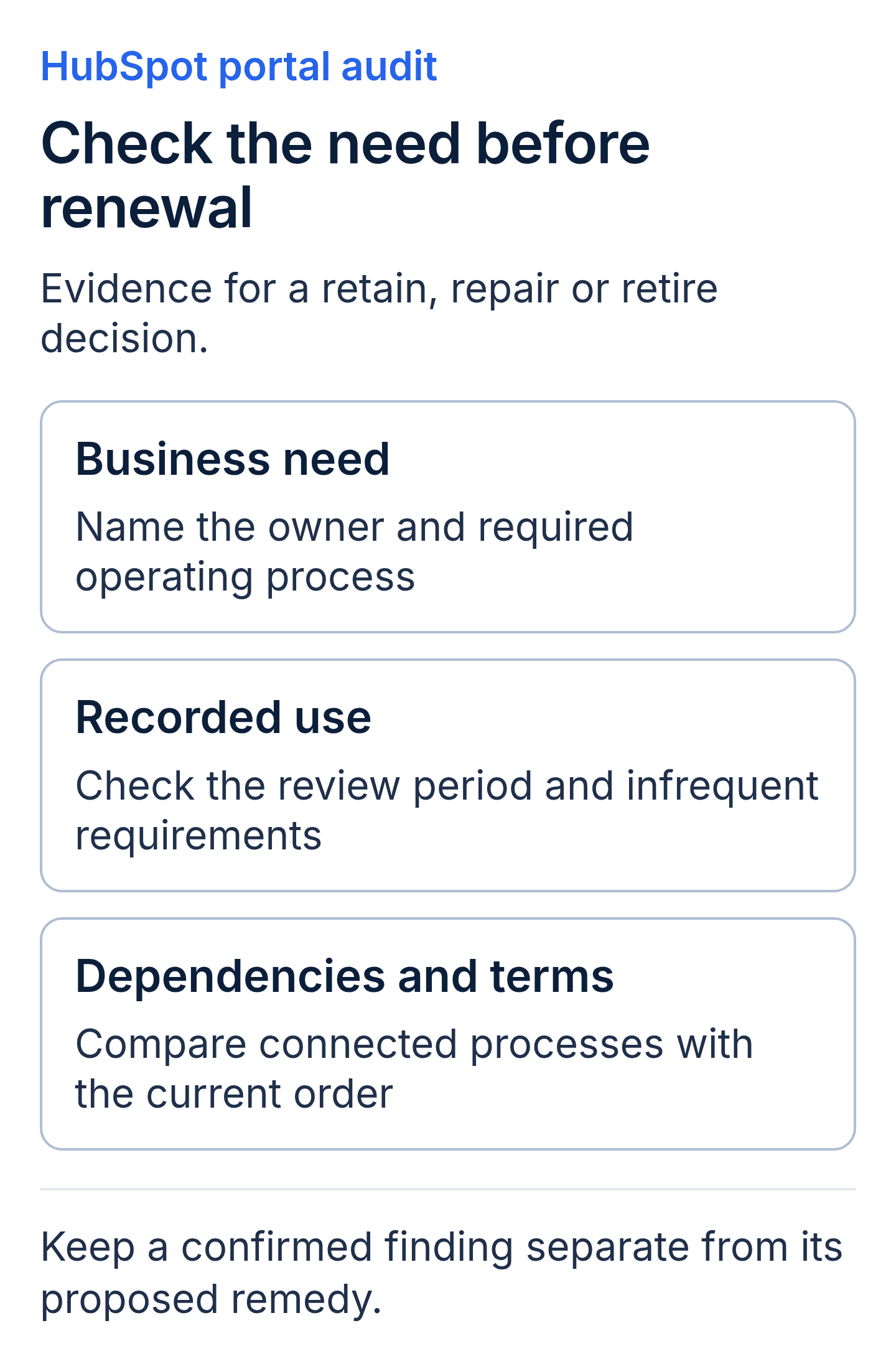
A proposed renewal review. Low recorded use alone does not establish that a capability can be removed or that a subscription change will save money.
Compare proposals by findings quality and handover
Request a sample report structure with confidential details removed. Look for clear references, stated limitations, responsible owners and next decisions. A list of generic recommendations does not demonstrate that the supplier can document your agreed account scope.
Ask how disputed findings are resolved. Your administrator may have context that changes an apparent problem, such as a deliberate exception or a temporary process. The supplier should identify what evidence would confirm, revise or close the finding, without treating every disagreement as extra implementation work.
Define audit acceptance before work begins. Your team should be able to reconcile the report with the quoted scope, locate the supporting evidence and understand which questions remain unanswered. The handover should include a walkthrough with the people authorised to decide next steps.
Compare fees using that same scope. Identify interviews, sample limits, access preparation, report revisions and handover effort. Ask whether repair estimates are included and whether actual remediation needs another agreement. There is no useful universal audit price without those assumptions.
Use the HubSpot partner evaluation guide for broader supplier questions. For this purchase, assess the report and decision process the candidate commits to deliver.
HubSpot portal audit glossary
- Finding: a documented observation linked to evidence, scope and a business consequence.
- Remediation: approved work that corrects an identified issue after diagnosis.
- Sampling limit: the boundary of the records, settings or processes inspected during the review.
- Dependency: a system, configuration or operating process that another process relies on.
- Decision register: the record of findings, accountable owners and choices still requiring approval.
- Acceptance evidence: the material used to establish whether an agreed deliverable has been provided.
Key takeaways
- A HubSpot portal audit needs a defined account scope and a named business decision.
- Audit findings should distinguish observed evidence, tested behaviour and unresolved assumptions.
- Access for investigation and permission to change production settings require separate decisions.
- A renewal recommendation needs purchased terms and process dependencies alongside usage evidence.
HubSpot portal audit buyer FAQs
How is a HubSpot portal audit different from data cleanup?
A portal audit examines the agreed account areas and produces findings. Data cleanup changes records to address defined problems. An audit may identify cleanup work, but access, workflow ownership, product use and reporting can also belong in its scope. State which areas the supplier will review.
Should HubSpot audit services include remediation?
Include remediation only when the agreement defines the work and approval process. An audit-only purchase can be useful when the buyer first needs evidence. If repair follows, request its scope, fee assumptions and acceptance criteria before authorising changes.
What should the final HubSpot audit report contain?
Request the reviewed scope, evidence references, findings, business consequences, sampling limits, accountable owners and recommended next decisions. Include unresolved questions and the basis for priorities. A walkthrough should let responsible stakeholders challenge findings and understand what they are accepting.
Can an audit support a HubSpot renewal decision?
Yes, when it examines purchased capabilities, relevant use and process dependencies. Compare its findings with your actual order and current vendor terms. The report can inform what to retain or investigate; it does not create a right to cancel, downgrade or save a particular amount.
Discuss the audit decision with Twelverays
Bring your renewal timing, current product inventory and the questions your team cannot answer from existing evidence. Include known access, workflow or reporting concerns. Contact Twelverays to discuss a HubSpot audit scope and the findings you need before approving the next purchase or repair.


