

HubSpot revenue attribution assigns credit to recorded interactions under a chosen model. A HubSpot revenue attribution implementation should establish which deals qualify, which interactions are captured and how the report allocates their value. Before buying HubSpot attribution reporting work, agree on the business question and the evidence needed to trust the resulting calculation.
Attribution describes an allocation rule. It does not, by itself, prove that an interaction caused a purchase. A report can help you investigate which recorded activities precede revenue, but its conclusions depend on the records, filters and model used. Start there before asking for a dashboard.
Confirm the HubSpot revenue attribution report you need
HubSpot distinguishes Contact Create Attribution, Deal Create Attribution and Deal Revenue Attribution. They measure different conversion outcomes. A contact-creation report is not a substitute for a deal-revenue report simply because both show marketing channels.
HubSpot's current attribution report creation guidance identifies Deal Revenue Attribution as a Marketing Hub Enterprise capability. Confirm the report in your account and the applicable subscription before approving an implementation quote. A broader reporting entitlement does not establish access to this particular report type.
Write a question that the report can answer. For example: "How does credit for eligible closed-won deal value change when we compare first-touch and linear models for the same period?" This is an illustrative reporting question. It specifies the population and comparison without claiming that either model measures incremental sales caused by marketing.
Record who will use the answer and what decision it supports. A marketing leader comparing channel activity needs different context from a finance team reconciling recognized revenue. The report definition should make that distinction visible.
The marketing attribution primer explains the wider concept. Keep the implementation purchase focused on the HubSpot records and reporting decisions needed here.
Check HubSpot attribution readiness at the deal level
An association is a link between CRM records or activities. Revenue attribution depends on the correct associations, as well as the values on the deal. HubSpot's attribution definitions and revenue requirements state that included deals need a closed-won stage, an associated contact and known Amount, Create date and Close date values.
The report uses the deal's Amount property. Do not tell an implementer to choose any revenue field without checking how that choice relates to the supported report. If your business uses annual recurring revenue, total contract value or a billing-system measure elsewhere, document how it differs from the Amount values being attributed.
Build the readiness review around a sample of deals selected by your team. Include straightforward records and known exceptions, such as a deal with several contacts or a value changed after closing. This tests the reporting definition against cases the business can explain.
| Readiness item | What the implementer should inspect | Evidence to request |
|---|---|---|
| Deal eligibility | Closed-won status and required dates and amount | A list of included and excluded sample deals, with reasons. |
| Contact associations | Contacts connected to the relevant deal | Record links showing the intended relationships. |
| Sales activity associations | Relevant activities connected to contact and deal | Checks of the selected activity types and their associations. |
| Amount definition | Meaning of the value stored in Amount | A written definition and reconciliation to the chosen comparison source. |
| Reporting period | Date properties, filters and boundaries | Saved report settings and a reproducible sample. |
| Tracking coverage | Sources that are captured, missing or incomplete | A coverage register with limitations and owners. |
Company relationships can matter to account reporting, but do not invent a universal requirement that every contact must have a company association for revenue attribution. Check the requirements for the specific report and the account-level analysis you intend to perform.
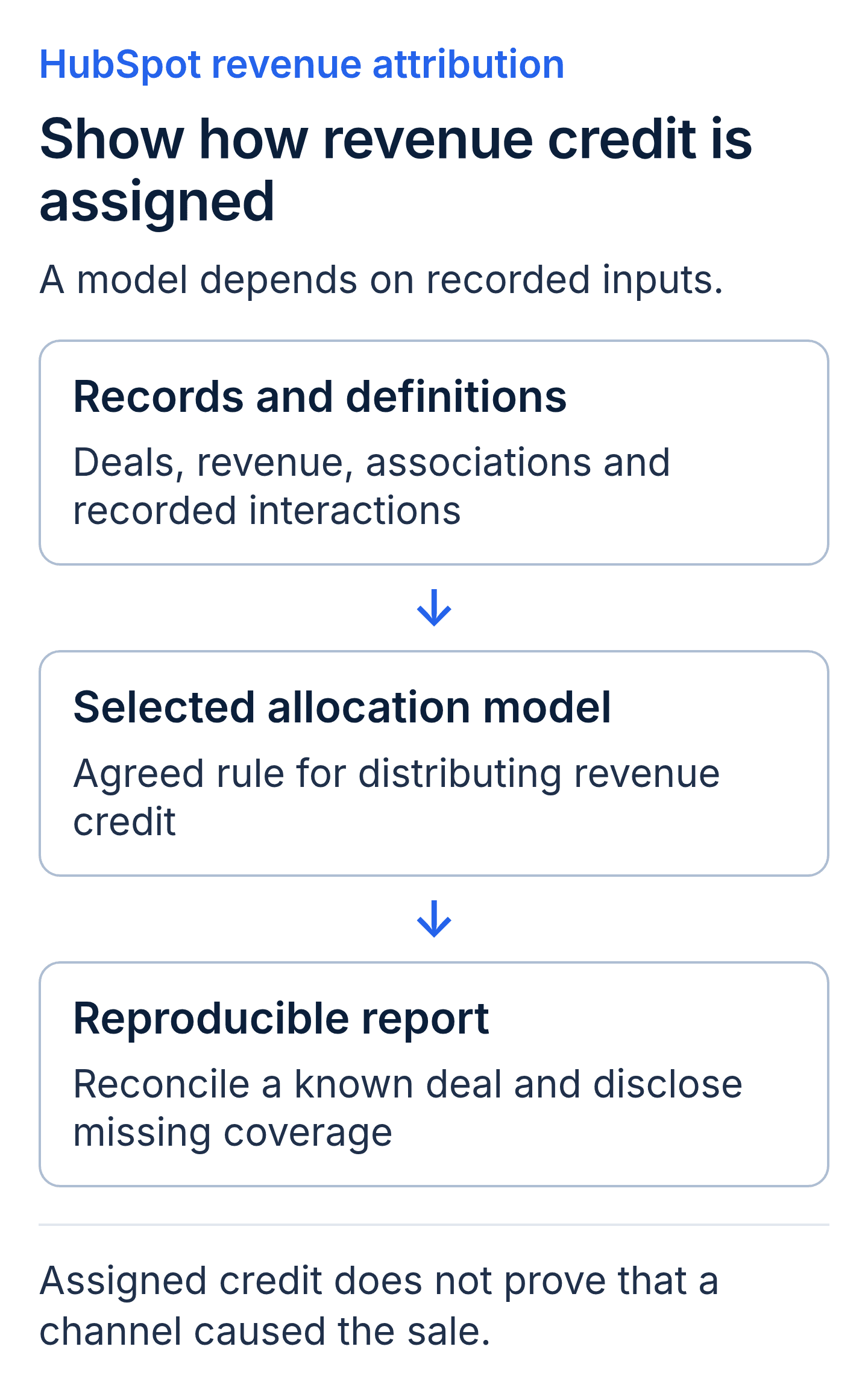
An attribution implementation should connect the data, model and report. Document coverage limits and the distinction between allocated credit and causation.
Define captured interactions without excluding offline activity
An interaction is a recorded event eligible for the selected attribution analysis. HubSpot's documented types include page views, form submissions, marketing email clicks, attended marketing events and connected calls. The required tracking and association conditions differ by type.
Offline activity is not automatically invisible. A recorded marketing-event attendance or eligible logged call can contribute to attribution. An unrecorded conversation cannot be allocated merely because the team remembers it. Ask the implementation partner to distinguish supported recorded activity from missing history.
Sales activity associations deserve explicit testing. HubSpot documents that relevant sales activities must be associated with both a contact and a qualifying deal. Its revenue requirements also exclude one-to-one emails that were sent but received no reply. A sent-email count is therefore not a reliable proxy for eligible attribution interactions. HubSpot's revenue calculation requirements explain these conditions.
For web and campaign tracking, inventory the connected tools, tracked pages and URL-tagging conventions. UTM, short for Urchin Tracking Module, refers to campaign parameters added to URLs, such as source and medium. Agree who maintains those conventions and how the team will test the resulting records.
Do not add fabricated historical interactions to make a report appear complete. Record known gaps and decide whether future tracking changes, documented remediation or a narrower reporting period address the business question. A missing-history note is more useful than an unsupported claim of full journey coverage.
Compare HubSpot attribution reporting with one sample deal
Use a small, explicitly hypothetical example to show the effect of model choice. Assume a US$20,000 deal has four eligible recorded interactions, in this order: a paid-ad click, a page view, marketing-event attendance and a connected call. Assume the same deal population, filters and interaction set in every calculation.
| Allocation model | Paid-ad click | Page view | Event attendance | Connected call |
|---|---|---|---|---|
| First touch | $20,000 | $0 | $0 | $0 |
| Last touch | $0 | $0 | $0 | $20,000 |
| Linear | $5,000 | $5,000 | $5,000 | $5,000 |
These figures illustrate the allocation rules, not a customer result or a tested portal configuration. Each row allocates the same $20,000. The first and last models concentrate credit at different positions; linear gives equal credit to the four included interactions.
First touch does not prove that the first recorded activity created awareness. Last touch does not prove that the final recorded activity closed the sale. The choice changes how you describe credit within the available data, so document the model whenever the numbers are used in a decision.
Confirm the models available in the account during scoping. HubSpot's documentation and interface terminology can change; use the current report builder when agreeing the final configuration. The multi-touch attribution guide provides background without establishing a subscription's current model entitlements.
Specify the HubSpot revenue attribution implementation deliverables
Separate readiness assessment, approved data correction, report configuration and ongoing maintenance in the proposal. They can be part of one engagement, but each needs an output and an owner. Finding a missing association is different work from correcting thousands of records under an approved rule.
Request a definitions register covering the report type, eligible deals, Amount convention, selected interactions, date filters and allocation model. Include the decision owner and the date of approval. If a definition changes later, the team needs to know which reports used the previous version.
Ask for a reproducible report example and an exception log. The example should identify its source records and settings so another authorized analyst can follow the calculation. The exception log should explain exclusions, missing activity and unresolved data questions without implying that every gap has been repaired.
Lifecycle definitions can also matter when leadership combines attribution with funnel reporting. HubSpot's lifecycle-stage guidance describes stages for contacts and companies. These are distinct from deal pipeline stages. Document which property a companion report uses, and avoid treating a contact's current stage as proof of its stage at every historical interaction.
Keep broader portal cleanup outside this article's scope. The guide to HubSpot data quality before a pipeline review covers that wider problem. The attribution engagement should identify only the remediation necessary for the agreed report, plus any separately approved work.
Accept the HubSpot revenue reporting setup with evidence
User acceptance testing, or UAT, checks the delivered report against agreed requirements. Name a business approver who understands the selected deals and a technical reviewer who can inspect the configuration. Give both access to the relevant evidence.
Use these checks before approving the report:
- Confirm that the selected report type and model match the approved definition.
- Trace a known deal from Amount and dates through associated contacts and eligible activity.
- Verify an excluded deal and explain the condition that excludes it.
- Repeat the sample calculation with the same filters and document any difference.
- Reconcile the eligible deal population to the agreed source, with exclusions shown separately.
- Record applicable sampling, tracking and historical-data limitations in the handover.
An attributed total should not be forced to equal all closed-won revenue without examining eligibility and filters. Start with the full comparison population, identify excluded records and then explain the amount eligible for allocation. The reconciliation shows which differences need investigation.
HubSpot documents sampling in high-volume attribution reporting. Ask the implementer to confirm whether it affects the report being accepted and how it limits drilldowns or comparisons. Avoid promising that an attribution report is an exact inventory of every activity in the account.
Assign ownership after the report is delivered
Name the people responsible for deal associations, Amount definitions, campaign tagging, integration failures and report changes. One person can cover several tasks, but an unnamed "operations team" leaves the approval path unclear.
Choose a review schedule based on how frequently the business changes and how the report is used. Include a check after changes to deal stages, tracking tools or integration mappings. A fixed monthly cadence is not a substitute for reviewing a material configuration change.
Keep the model, filters and known limitations near the report or in an accessible reporting guide. When the team changes a definition, record the effective date and assess whether historical comparisons remain meaningful. Ask the support proposal to distinguish routine monitoring from new reporting requests.
Key takeaways
- Confirm Deal Revenue Attribution eligibility and the business question before funding a build.
- Check qualifying deals, required Amount and date properties, and activity associations.
- Distinguish eligible recorded offline activity from interactions that were never captured.
- Compare allocation models using the same data, and avoid causal claims.
- Accept the report through reproducible examples, explained exclusions and documented ownership.
HubSpot revenue attribution buyer FAQs
Does attribution prove marketing caused a sale?
No. It allocates credit among recorded interactions under a model. Establishing incremental causal impact requires a different measurement design. Use the attribution report within its documented scope.
Can calls and events receive credit?
Eligible recorded calls and marketing-event interactions can be included when the relevant requirements are met. Verify the selected interaction types, tracking and associations. A remembered conversation without an eligible record cannot simply be assumed into the calculation.
Should attributed revenue equal our finance report?
Not automatically. HubSpot's deal attribution uses the deal Amount property and qualifying records. Finance can use a different revenue definition or period. Document the reconciliation instead of treating the two totals as interchangeable.
What should an implementation quote contain?
Ask for the readiness review, approved corrections, report configuration, acceptance evidence and handover. State the customer inputs and any support coverage separately so the remaining work is clear.
Terms to define in the report handover
| Term | Meaning |
|---|---|
| Attribution model | A rule for allocating credit across included interactions. |
| Association | A link between a CRM record and another record or activity. |
| Deal Amount | The deal property used as revenue input for the documented report. |
| UTM | Campaign parameters that identify information such as source and medium in a URL. |
| UAT | User acceptance testing against the approved reporting requirements. |
Twelverays' HubSpot consulting services include assessment and reporting guidance. Bring a sample revenue report and the questions leadership needs it to answer to a discovery call to discuss attribution readiness and implementation scope.


