

The Mid-Market AI Dilemma: Beyond the Model
Managed AI services are ongoing engagements where an external expert team operates, governs, and optimizes your production AI systems so they keep delivering as data and business conditions change. An AI managed service provider exists for the gap most mid-market companies actually have: not AI access, AI operations. Signing up for an LLM API or running a proof-of-concept chatbot is straightforward. Turning that experiment into a revenue-generating, production-grade system is an entirely different challenge.
The gap between AI pilot and AI performance is where mid-market ROI goes to die. McKinsey's State of AI research finds that 62% of organizations are at least experimenting with AI agents, yet only 39% report any enterprise-level EBIT impact from AI. The distance between those two numbers is operations.
The shift from experimentation to operations exposes a cluster of hidden costs that rarely appear in initial business cases. Model drift quietly degrades output quality over weeks. Hallucinations slip into customer-facing workflows unchecked. Integrations that worked in staging break against live data. Without a dedicated team monitoring these failure points continuously, what started as a promising automation becomes a liability, and an expensive one.
This is why managed AI services have evolved beyond simple support tiers into continuous-care partnerships. The model isn't "install and forget." It's an ongoing engagement that keeps AI aligned with changing business conditions, data, and goals.
For mid-market firms navigating this complexity, the right AI workflow automation partner can mean the difference between a stalled pilot and a scalable competitive advantage. The next question is why building that capability in-house carries a price tag most mid-market budgets simply can't absorb.
Why an AI Managed Service Provider Makes Financial Sense
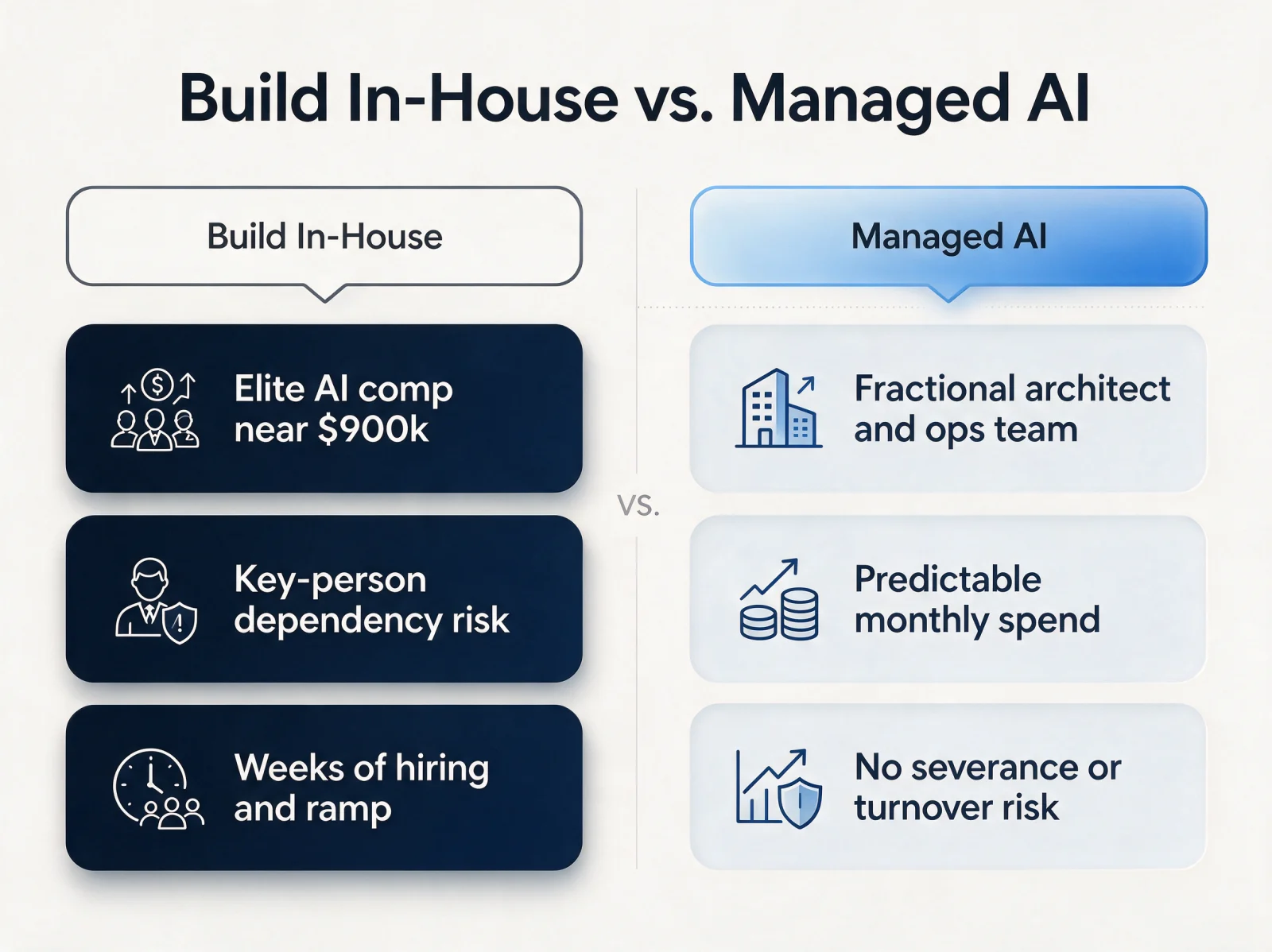
An AI managed service provider replaces volatile specialist hiring with a fractional expert team under predictable monthly pricing. The single biggest barrier to mid-market AI adoption isn't technology. It's the cost of the people who operate it.
Specialized AI roles at major tech firms command total compensation packages that can approach $900,000, creating a talent vacuum that prices out most mid-market companies before the conversation even starts. A single ML engineer, a prompt engineering specialist, and an AI ops lead can collectively cost more than the annual revenue threshold that defines the mid-market segment itself.
The hard truth: hiring one elite AI architect costs more than most mid-market companies budget for their entire technology team.
Key person dependency compounds the problem. When a company's entire AI capability lives inside one or two specialists, every vacation, resignation, or competing offer becomes an operational crisis. That fragility is a strategic liability, not a talent strategy.
This is where managed AI services fundamentally change the economics. Rather than absorbing volatile hiring costs to recruit and retain full-time specialists, companies access a fractional team of architects, prompt engineers, and ops leads under a predictable monthly model. The same structure that powers sophisticated AI agents and workflow automation at enterprise scale becomes accessible without the enterprise payroll. In our scoping work, the first job is usually to clarify which roles genuinely need to sit in-house versus which the buyer should outsource.
The financial logic is straightforward. Predictable monthly spend beats unpredictable hiring cycles, severance risk, and ramp time. That stability is what lets mid-market companies scale AI operations deliberately, which sets up the next question: which infrastructure layers do these managed teams actually operate across?
Managed AI Services vs. Cloud Infrastructure: Understanding the Layers
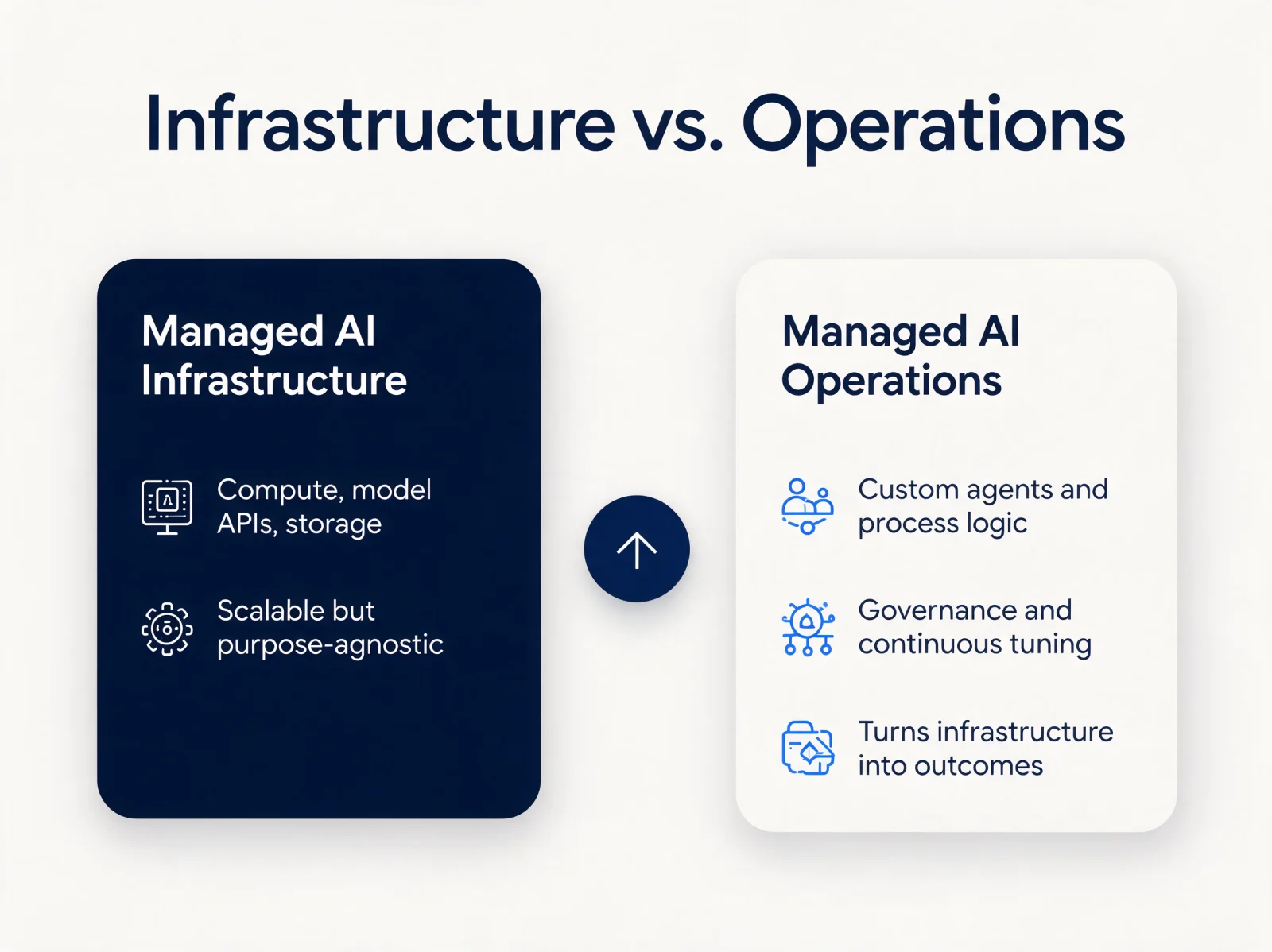
Managed AI infrastructure hosts models. Managed AI operations turns them into business outcomes. Buyers comparing artificial intelligence AI managed services against raw cloud platforms are comparing the water to the plumbing. Confusing the two is one of the most expensive mistakes mid-market companies make.
Cloud AI platforms like AWS SageMaker and Bedrock, Azure, and Google Cloud provide powerful foundations: compute, model hosting, and data pipelines. Access to those tools doesn't automatically produce business outcomes. What happens in practice is that a mid-market team deploys the infrastructure, then realizes they still need someone to configure the models, write the business logic, monitor drift, and connect everything to the systems their revenue teams actually use.
The distinction breaks down into two layers:
| Layer | What it covers | What it doesn't |
|---|---|---|
| Managed AI infrastructure | Cloud-hosted compute, model APIs, storage | Business logic, governance, outcomes |
| Managed AI operations | Custom agents, process logic, governance, continuous optimization | Commodity hosting |
Custom AI agents are where this gap closes. Rather than generic model access, purpose-built agents handle specific revenue workflows: lead scoring, pipeline alerts, or contract summarization. But agents are only as useful as the systems they connect to. Without deep integration into CRMs like Salesforce or HubSpot, even well-designed agents operate in silos, producing outputs that sales and marketing teams can't act on. This is why custom AI agents built around a real revenue stack matter more than raw model access.
That operational layer, the agents, the integrations, and the ongoing tuning, is precisely what the core pillars of managed AI services are designed to deliver.
The Core Pillars of Managed AI Services and Solutions
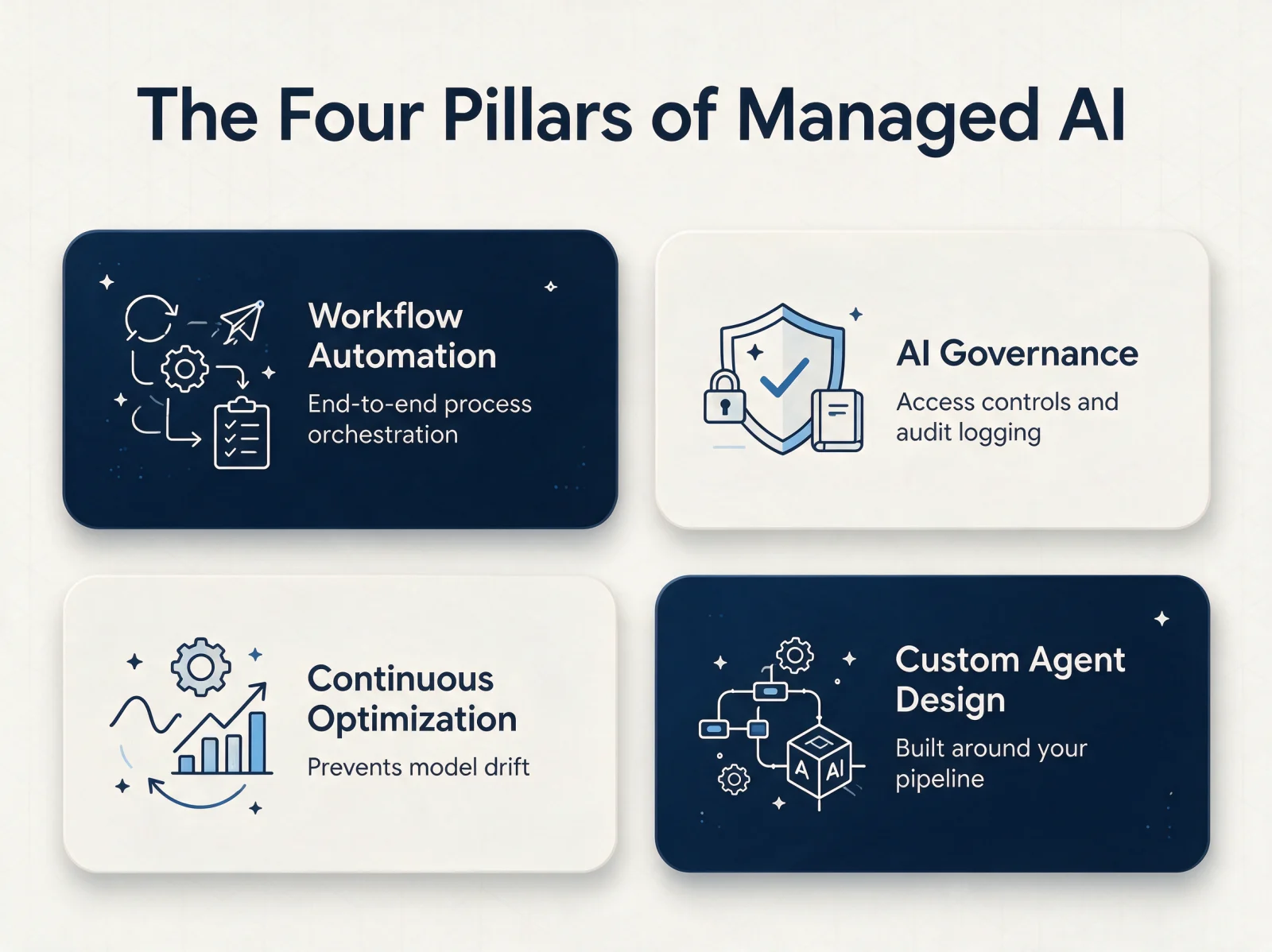
Evaluate managed AI services and solutions on four specific capabilities: workflow automation, AI governance, continuous optimization, and custom agent design. Not on the promise of "AI transformation."
Workflow Automation goes well beyond deploying a chatbot on your support page. End-to-end process automation connects discrete business functions, procurement, fulfillment, and customer onboarding, into a single orchestrated flow. Automated handoffs between systems eliminate manual data entry, reduce error rates, and shrink cycle times without adding headcount.
AI governance is the pillar mid-market leaders most often underestimate until something goes wrong. A credible provider builds in data privacy controls, role-based access, audit logging, and human-in-the-loop checkpoints. Responsible AI deployment requires structured oversight frameworks, not just technical guardrails bolted on after launch.
Continuous Optimization is where ROI is either protected or quietly eroded. Model drift is the gradual degradation that occurs when real-world data patterns diverge from what the model was trained on. Without continuous retraining and performance monitoring, even a well-deployed model becomes a liability.
Custom Agent Design closes the gap between generic AI tools and revenue impact. B2B operations vary significantly by sales motion, deal complexity, and data architecture. Tailored agents, built around your pipeline stages rather than a vendor's template, are what transform AI from a cost center into a growth lever. That's the foundation the next section builds on directly.
Operationalizing Growth: AI Agents in the Revenue Stack
Managed AI agents are becoming the connective tissue of the modern revenue stack, and for mid-market companies, that integration point is where growth either accelerates or stalls.
Sound AI operations design starts with your CRM. When AI agents are properly connected to platforms like Salesforce or HubSpot, they don't just log activity. They surface intent signals, score leads in real time, and trigger personalized outreach based on behavioral data. The result is a demand generation engine that runs continuously, without a full-time operations headcount to manage it. This is the core promise of an AI-powered CRM: outcomes, not just activity logs.
Automation without guardrails creates a different problem: impersonal, robotic interactions that push buyers away. A sound pattern is to deploy AI agents for top-of-funnel qualification while routing high-intent or complex conversations to human reps, preserving the relationship layer where it matters most. The goal is measurable pipeline outcomes without sacrificing the strategic judgment human teams provide.
Generative Engine Optimization is another dimension of a managed AI strategy that mid-market teams are starting to take seriously. As AI-powered search reshapes how buyers discover vendors, managed providers can structure your content architecture to surface in those results, not just traditional search engines.
Web experience is the final integration point worth naming. AI-driven personalization within platforms like Webflow lets your site adapt to visitor behavior, turning anonymous traffic into qualified pipeline. When this sits alongside your automated workflow automation infrastructure, the compounding effect on conversion rates becomes measurable.
That growth potential introduces a question worth examining carefully: what governance structures keep these AI systems operating safely and within compliance boundaries?
AI Governance and Risk Management in Managed AI
AI governance and risk management is the discipline of deciding what AI may touch, who approves its actions, and how every decision is logged and audited. Ungoverned AI adoption is one of the fastest-growing security risks in mid-market B2B companies today, and most executive teams don't see it coming until the damage is done.
Shadow AI is the use of consumer-grade AI tools outside IT oversight. Employees across sales, finance, and operations routinely feed sensitive customer data, contract details, and internal financials into tools that were never designed to meet enterprise compliance standards. Without a managed AI governance framework in place, that exposure compounds quietly, across dozens of tools, hundreds of sessions, and zero audit trails.
The stakes are measurable. Gartner predicts more than 40% of agentic AI projects will be canceled by the end of 2027, driven by escalating costs, unclear business value, and inadequate risk controls. Ungoverned deployment is exactly the failure mode a managed governance layer removes.
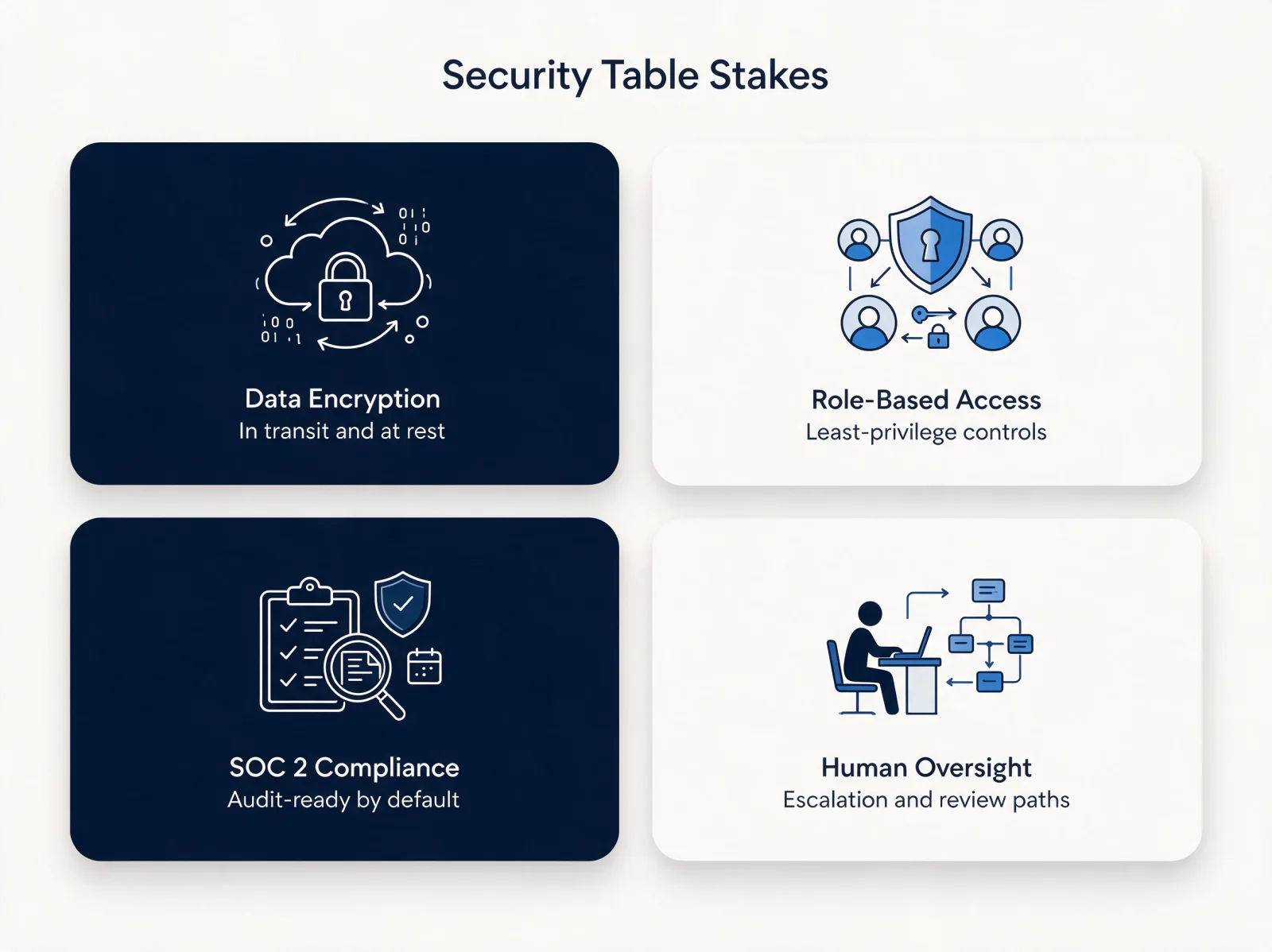
Managed providers address this at the infrastructure level. Enterprise-grade security protocols include data encryption in transit and at rest, role-based access controls, SOC 2 compliance, and integration with existing identity management systems. For B2B firms operating under strict client data agreements, these aren't optional extras. They're table stakes. The right managed services layer provides both the technology and the governance architecture needed to scale AI safely.
One often-overlooked element is human oversight within automated workflows. Even highly reliable automation requires defined escalation paths, exception handling, and periodic human review. Workflow automation built into platforms like Salesforce becomes significantly more defensible when governed by clear accountability structures. That combination of automation and oversight is what separates enterprise-grade managed AI from point solutions, and it's the foundation every ROI conversation should start from.
AI Managed Services ROI: What You Need to Know
AI managed services ROI comes from closing a very specific gap: the distance between what mid-market companies need from AI and what they can realistically build or afford on their own.
Practical AI automates work and scales growth. That's not a tagline. It's the operational logic that should guide every AI investment decision. Four pillars capture everything covered above:
- Managed AI bridges talent gaps. Building a full in-house AI team of data engineers, ML ops specialists, and prompt architects can run into six-figure salary overhead per role. Managed AI services deliver equivalent capability at a fraction of the cost.
- ROI lives in workflow automation and CRM integration. Standalone AI tools generate outputs. Connected AI agents embedded into your revenue operations and CRM workflows generate outcomes that compound over time.
- Governance isn't optional at scale. Ungoverned AI introduces compliance exposure, data leakage risk, and model drift. Continuous oversight is what separates enterprise-grade AI from a departmental experiment.
- Partnering accelerates growth without the overhead. An experienced managed AI partner handles optimization, integration, and iteration, so your leadership team focuses on strategy, not infrastructure.
The right partner doesn't just deploy tools. They align AI infrastructure to your revenue goals, manage risk proactively, and evolve the system as your business scales. That distinction between a vendor relationship and a true operating partner is exactly what separates firms that stall from those that compound their advantage.
Choosing the Right Managed AI Partner
The right managed AI partner doesn't just deploy models. They connect AI to the business systems where revenue is actually generated.
Outputs vs. Outcomes
Most mid-market companies run on a stack of interconnected tools: CRMs, marketing platforms, web infrastructure, and financial systems. A partner who understands only the AI layer will hand you outputs, dashboards, model reports, and usage metrics, without ever moving the needle on what matters. The distinction between outputs and outcomes is the most important line item in any managed AI service contract. Outputs tell you what the system did. Outcomes tell you what the business gained.
Proximity, SLAs, and Contract Language
Team proximity matters more than most buyers expect. A U.S.- or Canada-based team isn't just a communication preference. It's a security and accountability decision. Time zone alignment speeds iteration cycles, and jurisdictional clarity matters when AI systems touch customer data or regulated workflows. If your partner is unavailable during your business hours, governance gaps will follow.
Before signing, pressure-test the contract language. Ask whether SLAs are tied to business metrics like pipeline velocity, response time reduction, and conversion lift, or simply to system uptime. Sustainable ROI requires continuous monitoring and refinement tied to real operating results, not one-time deployment milestones.
See how a B2B SaaS company cut preventable churn 27% with an AI operating layer.
Twelverays is built around exactly that standard. For mid-market leaders ready to stop stalling and start scaling, the next step is straightforward: start with a scoped AI operations design engagement to identify where managed AI operations can generate the fastest, most measurable return for your business.


