

Revenue operations consulting is a scoped effort to assess and improve the processes, data and systems used by sales, marketing and customer success. Compare RevOps consulting services by the operating problem they will address and the evidence they will deliver. A RevOps consulting partner should be able to connect the proposed work to an internal decision owner and a clear acceptance condition.
Revenue operations (RevOps) concerns how sales, marketing and customer success coordinate processes, data and responsibilities across the customer journey. A consulting engagement might address an unowned lead handoff, inconsistent opportunity stages or a report that cannot be reconciled to its source records. Name the problem before asking for a solution.
A usable scope names the operating problem, affected systems, deliverables, decision owners, dependencies and acceptance evidence. A roadmap can be a valid assessment output. If the engagement also includes configuration or implementation, name the changes, implementers and completion tests rather than assuming the roadmap includes delivery.
Define the RevOps consulting scope around one operating problem
Write the problem in terms someone can observe. Instead of asking a provider to improve alignment, describe the current handoff: marketing submits qualified inquiries, sales receives a list without an assigned owner, and nobody records which inquiries were accepted.
Then identify the business decision the engagement should support. In that example, the team needs agreed qualification criteria, assignment rules and an exception process. A dashboard may help monitor those decisions, but it cannot make them on the team's behalf.
List the customer relationship management (CRM) system and other tools, teams and records involved. Identify what is already known and what still needs investigation. A recurring disagreement over a metric could come from inconsistent definitions, missing data or different report filters. The proposal should distinguish diagnosis from the changes it might recommend.
Name an executive sponsor and operational approvers. The sponsor resolves priorities across teams; individual process owners approve the rules they will use. The appropriate titles depend on your organization. Decision authority should be explicit rather than inferred from seniority.
Twelverays' revenue operations service describes work around Salesforce and Dynamics 365, including workflows, integrations, reporting and training. Confirm the particular process and system responsibilities in your proposed engagement.
Write a revenue operations statement of work
A statement of work (SOW) records the agreed services, outputs, responsibilities and commercial boundaries. Connect each activity to a deliverable, the person responsible and the input needed before work can proceed.
| Scope item | Illustrative entry | Owner and prerequisite | Acceptance evidence |
|---|---|---|---|
| Problem | Eligible inquiries have no consistent sales owner | Sponsor supplies examples and selects the affected process | Agreed problem definition |
| Process design | Qualification, assignment and exception rules | Marketing and sales owners approve the business decisions | Approved rules and exception handling |
| Configuration | Implement the approved routing behavior | Named implementer receives access and approved rules | Representative records reach the expected owner |
| Reporting | Show accepted, rejected and unresolved handoffs | Report builder receives definitions and source-data access | Report reconciles to the agreed record population |
| Handover | Train the operational owner and document recovery | Operational owner attends the agreed walkthrough | Owner demonstrates routine and exception handling |
This example is a suggested structure, not a fixed service package. Replace it with your actual workflow, record types and approval conditions.
Add dependencies: access, source data, product entitlements, subject-matter availability and approval dates. State which party supplies each input and how a delay affects the delivery plan. Dependencies can sit with either the customer or the provider.
Also name exclusions and the process for changing them. If compensation design, campaign production or a separate system integration is outside the engagement, say so. Adjacent work should not enter the scope simply because it surfaced during discovery.
For the wider organizational context, the revenue operations alignment guide discusses the relationship between sales, marketing and customer success. The SOW turns the selected part of that relationship into work someone can deliver.
Separate diagnosis, business decisions and implementation
A practical engagement can move through discovery, approved design, implementation and handover. The sequence should reflect the uncertainty and dependencies in your problem.
During discovery, require examples from the current process. Ask which records were inspected, which users were interviewed and what could not be verified. Findings should distinguish observed behavior from a hypothesis that needs more evidence.
During design, settle business definitions before building rules around them. For a handoff, define the qualification event, receiving owner, expected response and exception route. For reporting, define the population, time period and calculation.
According to HubSpot's lifecycle stage documentation, lifecycle stages categorize contacts and companies, while Lead Status describes sub-stages within Sales Qualified Lead. Default automatic lifecycle updates move stages forward, and stages can be customized. Ask the consultant to inspect your actual properties and update rules before defining a handoff. Agree which business event changes each value and what should happen when an enquiry is rejected or returned for more work.
Implementation should follow the approved decisions. Require the provider to identify proposed configuration, data or integration changes and their test method. If discovery reveals a larger problem, review the expanded scope before authorizing the additional work.
A decision log helps preserve the reasoning. Record the decision, approver, date and affected deliverables. Your future administrator should be able to understand why a rule exists without reconstructing a series of meetings.
Specify revenue operations consulting deliverables that can be checked
A deliverable needs a purpose, owner and completion standard. “Pipeline dashboard” is incomplete unless the proposal explains which management decision it supports.
A metric definition sheet specifies the business question, source records, filters, date basis, calculation and known limitations behind a reported measure. Require one for the reports in scope. Name the reviewer and select records that let the team check the calculation against its source.
HubSpot's campaign lifecycle documentation states that its contact lifecycle reports use the contact's current stage, rather than the stage when the campaign influenced that contact. It also excludes deleted or unknown influenced contacts. These rules affect reconciliation: a current-stage count and a historical stage-at-event count can describe different populations. Specify which question the report must answer and require the provider to account for excluded or unclassified records.
For process design, ask for the approved operating rules and exception handling. For configuration, request a change record and test evidence. For data cleanup, define the population, approved transformations and reconciliation method before records are changed.
Avoid arbitrary acceptance targets. A requirement such as zero unexplained discrepancies in a selected reconciliation sample is meaningful only when the sample and expected calculation are specified. A universal duplicate-rate target does not establish whether the records needed for your business process are usable.
Require an open-items list at handover. It should identify incomplete work, accepted limitations and future recommendations without blending them into completed deliverables.
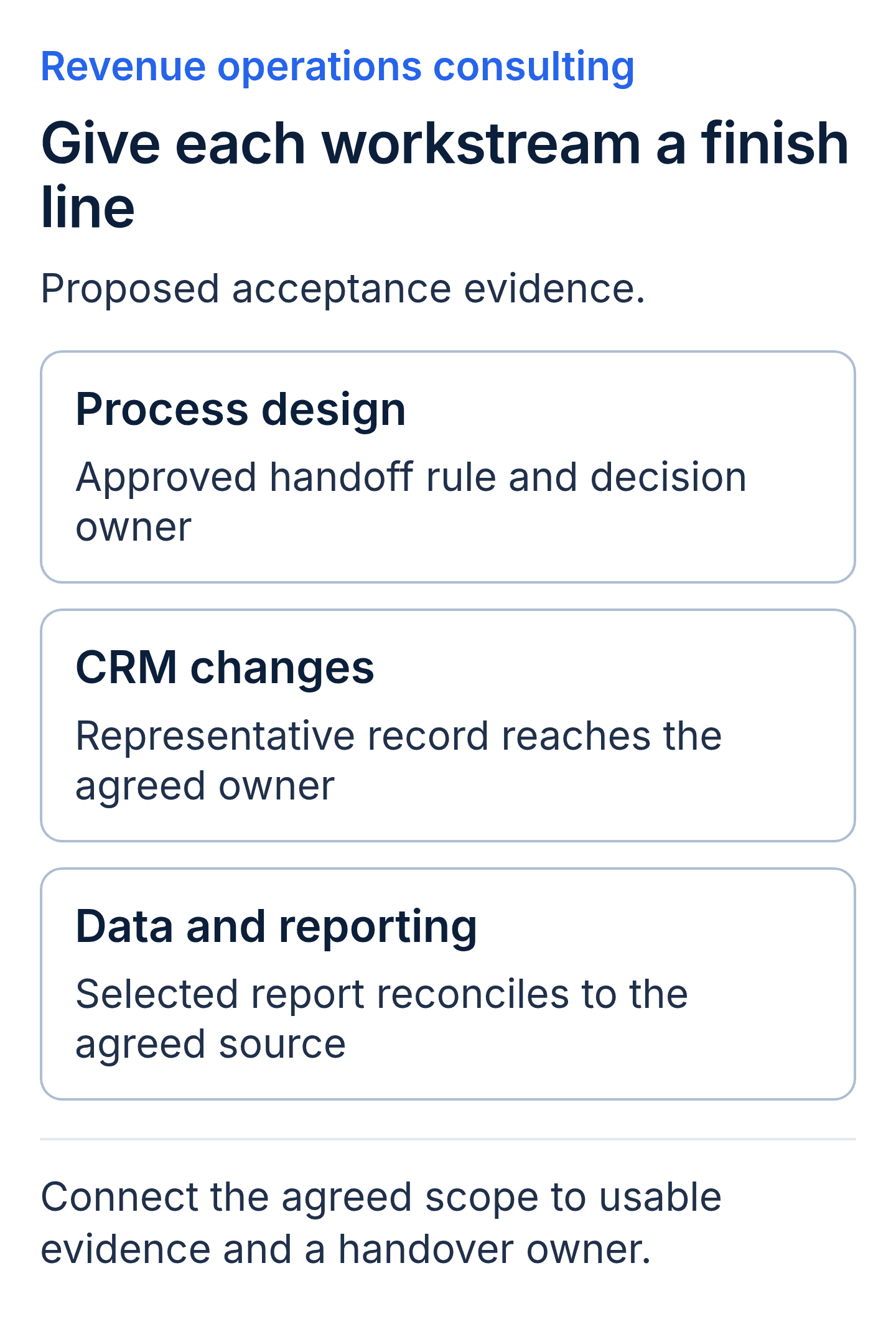
Examples to adapt in the statement of work. Delivery acceptance establishes the agreed behavior, without promising revenue growth.
Evaluate a RevOps consulting partner through a sample decision
Give shortlisted providers the same short scenario. Ask them to explain what they would inspect first, which business decisions they need and what evidence would show that the proposed change works.
For example, present a disagreement between a marketing report and a sales report. A useful response investigates definitions, date filters, record associations and missing values. A promise to replace the dashboard immediately skips the diagnosis.
Ask to see a redacted example of a scope table, test log or handover package. Discuss how the provider records unresolved assumptions and handles a failed acceptance test. These artifacts let you assess the method before your project has produced business results.
Review who will do the work. Confirm the named lead, required specialist involvement, communication arrangements and escalation path. A supplier's broad capabilities do not establish the staffing or availability included in your engagement.
The marketing and sales alignment guide can help your stakeholders prepare a shared problem statement. Bring that statement to each provider so proposals address the same decision.
Check whether the provider can work with your current internal administrators and other suppliers. Assign configuration approval, data ownership and production release responsibilities before work begins.
Compare RevOps consulting services and customer commitments
A fixed project can suit a defined problem with known dependencies. An assessment followed by a separately approved implementation phase can suit a problem that still needs diagnosis. Ongoing operational support may be appropriate when the work recurs after delivery.
Compare proposals over the same scope and planning period. Separate assessment, design, configuration, data work, training and support. Ask which assumptions underpin the estimate and which discoveries could change it.
Your internal workload belongs in the comparison. Business owners need time to explain the process, approve definitions and review tests. Administrators may need to supply access, investigate dependencies and participate in releases. Agree the actual availability required rather than relying on a standard weekly-hours estimate.
Salesforce's org development guidance distinguishes a developer's change list from a deployment run list covering manual steps before and after deployment. Ask the provider to identify both the changes and the release tasks your engagement needs. Confirm the testing environment, customer administrator's workload and production approver. A tested configuration alone does not show that every required release step has been assigned.
Support after handover should specify the period, included work, named contact and response arrangement. Do not leave the treatment of defects and new requests to an informal understanding.
Accept delivery and then monitor business results
Define acceptance around observable work. A routing rule can be tested against approved cases. A report can be reconciled to a defined population. An internal owner can demonstrate the documented recovery process.
User acceptance testing (UAT) is the business-user check that a delivered process meets its agreed requirements. Include normal paths and exceptions such as an ineligible inquiry, missing owner or failed transfer. Record the business decision each test is intended to verify.
Use a short acceptance record with the expected result, observed result, evidence and approver. If a test fails, record the issue and retest the corrected behavior. Identify which unresolved items prevent acceptance and which can be accepted with a documented limitation.
Business results still matter after delivery. Track the agreed measures against a baseline and note other changes that may affect them, such as campaign mix, sales staffing or demand. Do not assume a universal delay before results appear or attribute every movement to the consulting work.
The sales pipeline management guide covers ongoing pipeline practices. Assign ownership of that monitoring so it continues after the project team leaves.
Revenue operations consulting buyer FAQs
What should a consultant deliver?
The agreed output might be a diagnosis, process design, tested configuration, data remediation or reporting work. Ask the proposal to name each deliverable and its acceptance condition. Broad RevOps terminology does not establish a universal list of inclusions.
How does a scoped project differ from fractional RevOps?
A scoped project focuses on defined outputs and a handover point. Fractional RevOps supplies recurring capacity under an agreement. Either arrangement needs explicit responsibilities and approval rights; ongoing involvement does not automatically grant executive authority.
What must our team contribute?
Provide the agreed access, evidence, subject-matter input and decisions. Identify the owners and expected response times during scoping. The provider should also name its dependencies and delivery responsibilities so both sides can plan realistically.
Can we evaluate the work before revenue changes?
Yes. Check the approved process, configuration tests, report reconciliation and operational handover. Continue tracking business outcomes, but do not substitute a revenue forecast for evidence that the contracted work is complete.
Glossary for the revenue operations statement of work
| Term | Meaning for the engagement |
|---|---|
| Acceptance criteria | Observable conditions used to approve a deliverable |
| Reconciliation | Comparing a reported result with the agreed source records and calculation |
| Dependency | An input or decision needed before specified work can proceed |
| Decision owner | The person authorized to approve a business rule or scope choice |
| Implementation owner | The person or team responsible for applying an approved change |
| Exception handling | The agreed response when a record cannot follow the normal process |
| Baseline | A dated measurement with its population, calculation and observation settings recorded |
| Change request | A proposed scope alteration with its effect on cost, timing and responsibilities |
Key takeaways
- Fund a named handoff, data or reporting problem, with an owner authorized to approve the business rules.
- Tie each deliverable to its implementer, required inputs and acceptance evidence.
- Check actual platform stage and reporting behavior before approving the design.
- Compare provider work, customer workload and support over the same scope and period.
- Accept tested delivery separately from later business results, using a defined baseline for ongoing monitoring.
Bring one operating problem to the scope discussion
Gather a few examples of the handoff, data or reporting issue you need to resolve. Contact Twelverays to discuss the process, affected systems and evidence your team would need before accepting the work.


