

An SEO RFP template is a document that gives providers shared business priorities, scope questions, and evidence requirements. Pair it with an SEO agency questionnaire for written responses and an SEO proposal scoring matrix for comparing them. A request for proposal (RFP) for search engine optimization (SEO) should define the work, customer responsibilities, and evidence needed to approve the purchase.
Adapt this questionnaire and scoring sheet to your business-to-business (B2B) engagement in the United States or Canada. Choose priorities and reviewers first.
Twelverays provides SEO services. Apply the same questions to its proposed scope and to other candidates, with each provider responsible for explaining its own work, assumptions, and commercial terms.
Key takeaways
- Give each vendor the same dated site inventory, business priorities, and evidence gaps.
- Name who produces, approves, implements, and verifies each deliverable.
- Compare search observations using stated report settings, and collect sales qualification separately.
- Choose weights before reading proposals; mandatory scope and access requirements remain conditions of award.
- Require suppliers to explain their recommendations and reject unsupported promises of first-place rankings.
Define the terms in your SEO request for proposal
Procurement glossary
Use these definitions to make responses comparable:
- Request for proposal is the document describing the business need, response questions, evidence requests, and commercial information you want from candidates.
- Scope of work is the proposed set of deliverables, responsibilities, exclusions, and delivery conditions for the engagement.
- Deliverable is a specified output the supplier agrees to provide, such as a content brief or implemented page change.
- Mandatory requirement is a condition a proposal must meet to qualify for award, regardless of its total score.
- Baseline is a dated record of the site and relevant measurements, with sources and observation settings identified.
- Search intent is the need behind a query that a page is intended to address. Ask vendors to explain their interpretation using the evidence available.
- Acceptance evidence is the artifact used to confirm that an agreed deliverable meets its description, such as a reviewed draft or verified change record.
- Implementation owner is the person or team responsible for applying an approved recommendation to the site or connected system.
- Change control is the agreed process for proposing, approving, recording, and reviewing changes to work or scope.
- Qualified opportunity is a sales-stage outcome defined by your business. It is distinct from a search click, submitted form, or unreviewed inquiry.
Give every B2B SEO RFP the same business context
Describe the customers you want to reach, the services or products in scope, and the markets you serve. Name the pages and buying decisions that matter to the engagement. Include the constraints your team already knows, such as limited review capacity or a planned website change.
Separate observed problems from desired outcomes. In a hypothetical brief, a decline in clicks to a specified service page is an observation when accompanied by its source and date range. Increasing relevant sales inquiries is a business objective. Ask the provider what it can investigate from the available evidence and what further information it needs.
Provide a summary of current search reporting, analytics, and customer relationship management (CRM) definitions where relevant. Identify missing information explicitly. The RFP can request an initial assessment without pretending that the business already has complete attribution or a finished technical audit.
According to Google Search Central's guidance on hiring an SEO, buyers should check previous work and business references, and ask how changes will be communicated. Google recommends granting only read access to Search Console for the initial audit. Put evaluation access and later change authorization in separate parts of the RFP.
Ask candidates to state the limits of a public-site review. An estimate based on public pages should identify assumptions that require verification after access is granted.
Include a site inventory with the SEO RFP template
Give all candidates the same version of the inventory. Record when it was prepared and identify the person who can answer questions about each area.
| Inventory area | Information to supply | Responsibility to identify |
|---|---|---|
| Priority URLs | Services, product pages, and existing articles in scope | Business owner of each section |
| Content and intent | Current purpose, intended buyer, and known overlap | Person approving page priorities |
| Site platform | Content management system (CMS), publishing access, and constraints | Administrator and implementation team |
| Technical changes | Known findings, planned releases, and dependencies | Person reviewing and applying changes |
| Internal links | Important destinations and existing linking conventions | Content reviewer and publishing owner |
| Reporting | Available sources, date ranges, and business definitions | Analytics contact and sales-outcome owner |
Ask how the vendor checks a proposed page against existing coverage. Require an explanation before accepting a new page, consolidation, redirect, or deletion. An RFP should not grant open permission for mass location-page expansion or removal of existing URLs.
Keep findings and applied changes separate. A finding records a condition; a recommendation proposes a response; an applied change has an implementation record and verification. The existing SEO audit services guide explains the assessment stage. Your RFP should specify which later stages the engagement includes.
Use this SEO agency questionnaire for written responses
Ask each candidate to answer the same questions and identify assumptions beside each answer:
- Which business priorities and pages would you address first, and what evidence supports that sequence?
- What can you assess with the information supplied, and what requires additional access or discovery?
- Which outputs will you deliver, with what proposed dates or recurring schedule?
- Who produces, approves, and implements each output on the provider and customer sides?
- How will you check new content against existing page intent and decide between an edit and a new page?
- What acceptance evidence accompanies findings, content changes, internal links, and technical recommendations?
- How will reports distinguish completed work, search observations, and customer-validated business outcomes?
- What requires separate authorization, and how are changes to fees, scope, or delivery dates recorded?
- Which work files and reports are available during the engagement and at handover, under what terms?
- What assumptions, exclusions, customer dependencies, and outside costs affect the proposed fee?
Request a sample deliverable relevant to the proposed work. Have the provider explain what it produced, what the customer supplied, and how corrections were handled. Treat an illustrative sample separately from evidence of a customer's results.
Collect follow-up answers in the same response record. When a clarification changes the requested scope, share the relevant update with every candidate still being evaluated.
Define SEO scope of work acceptance evidence
Attach an evidence requirement to each deliverable you choose. Use the following examples to discuss the proposed engagement, rather than assuming every row belongs in it.
| Deliverable | Evidence for acceptance | Boundary to resolve |
|---|---|---|
| Findings register | Affected page, observed condition, priority rationale, and proposed action | Assessment versus implementation |
| Content brief | Buyer question, intended page, sources, and review criteria | Customer information and approval |
| Draft or page edit | Reviewable text and a record of accepted changes | Draft delivery versus publication |
| Internal-link work | Source page, destination, link text, and implementation status | Recommendation versus applied change |
| Implementation task | Approved action, responsible person, and completion evidence | Provider work versus customer delivery |
| Work report | Completed items, unresolved dependencies, and next proposed actions | Delivery evidence versus business results |
According to Google Search Central's internal-link guidance, each important page should receive a link from at least one other page on the site. Google also recommends descriptive, concise link text relevant to both pages. For acceptance, request the source page, destination, and link text so a reviewer can inspect the applied change.
For a hypothetical redirect task, acceptance could include the approved source and destination, an observed response check, and confirmation that the destination is accessible. Do not claim that a successful check measures transferred ranking value. Describe the observable result the implementation owner can verify.
Record the acceptance owner for each artifact. Keep separate statuses for delivered recommendations and completed implementation.
Specify reporting and change control before award
Request a baseline with its date ranges, sources, and measurement definitions. The provider should explain which pages or queries it reports and how it handles unavailable data. If lead generation is a priority, name the person supplying validated sales outcomes.
According to Google's Search performance documentation, the report supports date and search-type filters, with groupings such as queries, pages, and countries. Click-through rate (CTR) is clicks divided by impressions. Average position is the mean position of the topmost result within the selected report grouping. Require those settings and definitions in the reporting handover.
Google also distinguishes property-level chart totals from table groupings. Its documented example counts two results from the same site for one query as one chart impression. Specify that basis when reconciling reports.
Search impressions, clicks, form submissions, and qualified opportunities need separate labels. Have vendors explain what their data can support and where customer validation is required. The SEO for B2B lead generation article provides broader pipeline context; the RFP should assign the reporting responsibilities.
Ask how changes are proposed and who may publish them. Identify any staging review, implementation checks, and recovery plan appropriate to the work. Require a log of approved actions and outcomes without promising that a reversal will restore prior search performance.
Build an SEO proposal scoring matrix before responses arrive
Set the criteria and weights before reviewing vendors. The following weights are illustrative, not an industry benchmark. Change them to fit the funded work, then apply the same version to each response.
| Criterion | Illustrative weight | Evidence to score |
|---|---|---|
| Diagnosis | 20% | Priorities tied to the supplied evidence and stated unknowns |
| Scope clarity | 20% | Specific outputs, exclusions, and delivery conditions |
| Implementation responsibility | 15% | Named owners and customer dependencies |
| Measurement | 15% | Definitions, sources, observation settings, and limits |
| Acceptance evidence | 15% | Relevant artifacts and a workable review process |
| Access and handover | 5% | Available records, permissions, and exit arrangements |
| Total cost | 10% | Itemized charges, assumptions, and separately required work |
A weighted score is a proposal rating scaled to the points assigned to that criterion. Use this documented rating scale: zero for a missing answer; one for an unsupported assertion; two for a partial answer with unresolved responsibilities; three for a clear answer with supporting evidence; and four for an evidenced answer that also addresses the relevant constraints and dependencies.
Treat each percentage weight as that many available points. Calculate weighted points as the available points multiplied by the rating, divided by four. For example, a hypothetical rating of three on a 20-point criterion contributes 15 points. With the illustrative weights above, the maximum total is 100 points. Keep the written reasoning beside each rating.
Identify mandatory requirements separately. A high total should not override an unresolved requirement for account access, implementation ownership, or a necessary deliverable. Request clarification before choosing a provider whose offer leaves a required item unanswered.
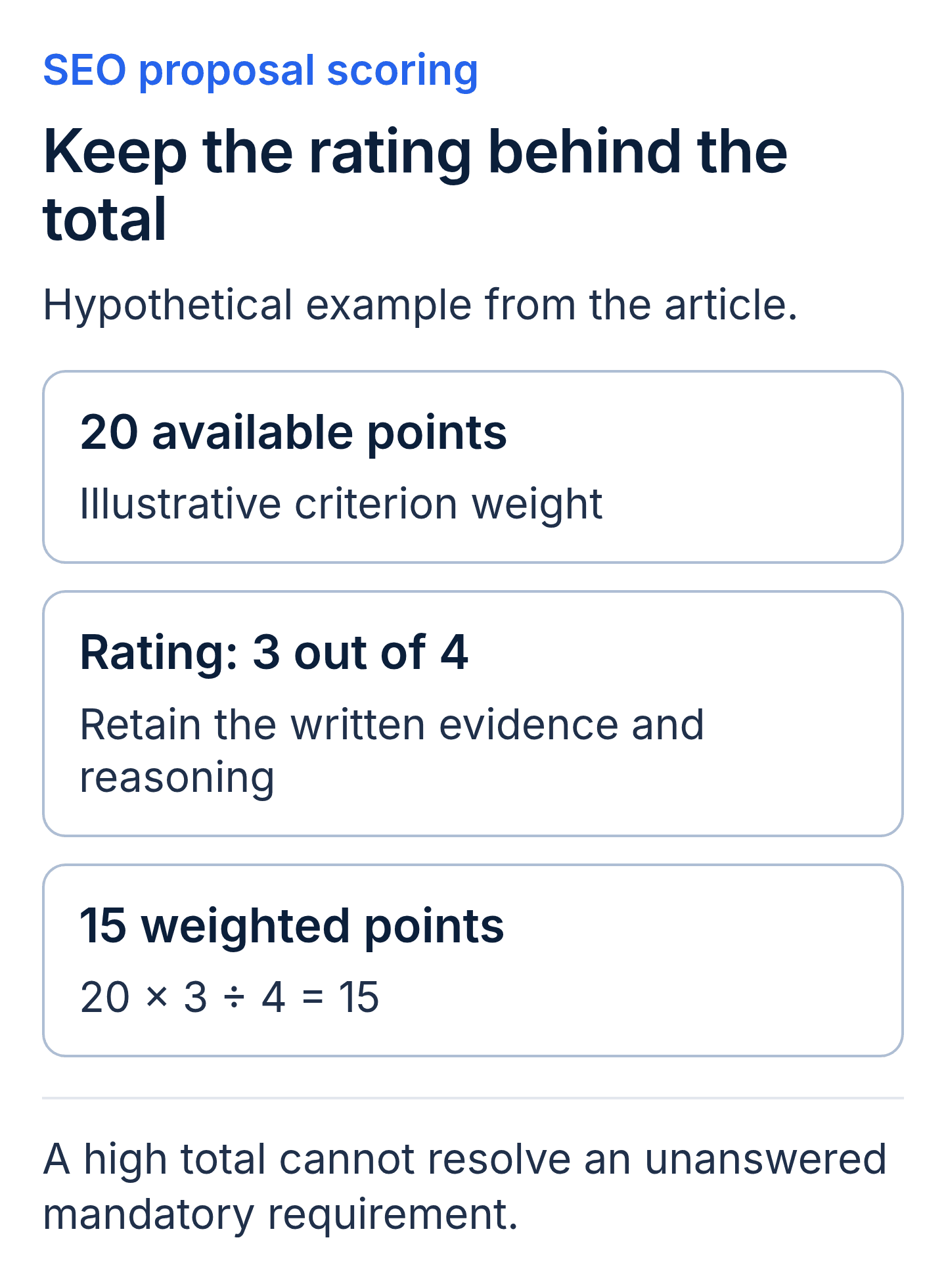
Illustrative arithmetic using the article’s rating scale. Choose weights before reading proposals and preserve the reasoning; total points do not override a missing required deliverable or access commitment.
Reconcile commercial terms and prepare the handoff
Compare quoted fees after identifying the work included. Ask for the billing schedule, proposed team capacity, customer inputs, and any separate content, development, or tool costs. Have vendors explain how additional work is priced and approved.
Read the actual commitment, renewal, notice, and exit provisions. Ask which charges remain due and which unfinished outputs are supplied if the engagement ends. Resolve legal interpretation with the appropriate adviser instead of treating the RFP as a contract template.
Before award, carry the accepted response into the proposed scope. Preserve its assumptions, responsible people, evidence requirements, and open items. Confirm that the delivery team has reviewed the commitments used to score the proposal.
SEO RFP buyer FAQs
Do we need an audit before issuing the RFP?
Supply the evidence you have and identify the gaps. Ask vendors to separate an initial assessment from later implementation and explain what they can estimate before additional access.
Should we request a page count?
Connect any requested volume to page purpose, buyer questions, and review capacity. Require a check against existing coverage. The mid-market SEO planning article examines the broader planning tradeoff.
Who should implement technical work?
Name the responsible party in the proposal. It can be the vendor, your team, or another provider under the agreed scope. Specify who approves and verifies the change.
How do we compare proposals without promised rankings?
Score the proposed work, responsibilities, costs, and supporting evidence against the same criteria. Google Search Central states: "No one can guarantee a #1 ranking on Google." Ask suppliers to explain the expected effect of each recommendation and the assumptions behind it, while keeping acceptance tied to the work they agree to deliver.
What should the handover include?
Request the available research, approved content, reports, change history, and unfinished tasks. Confirm formats, access arrangements, and restrictions in writing. Transfer access through the business's approved process rather than including credentials in shared notes.
Review your SEO RFP
Bring your business priorities, current site inventory, draft questionnaire, and proposed scoring weights to discuss your scope with Twelverays. Use the discovery call to define the SEO engagement your team needs to evaluate.


