

A CRM database is the operational core of your customer relationship strategy, a centralized, organized repository where every piece of customer information resides. Think of it as the single source of truth for every interaction, from initial contact details and purchase histories to service tickets and online behavior.
Your Business's Central Nervous System
It's easy to mistake a CRM database for a sophisticated digital Rolodex or a powerful spreadsheet, but this comparison misses its fundamental purpose. A more accurate analogy is to view it as your business’s central nervous system. It's a dynamic hub that connects, records, and interprets every touchpoint along the customer journey.
Much like a nervous system relays signals between the brain and the body, a CRM database provides sales, marketing, and service teams with a unified view of the customer. Without this central hub, departments operate in silos, leading to disjointed customer conversations and preventable missed opportunities. A shared, cohesive intelligence system simply performs better.
Beyond a Simple Contact List
While a basic spreadsheet can store names and email addresses, a CRM database is engineered for a much deeper function: understanding and managing relationships over time.
It's specifically designed to capture the complete context of every customer interaction, including:
- Interaction History: Every email opened, phone call made, and meeting held.
- Purchase Records: What customers bought, when they bought it, and their total spending.
- Service Inquiries: Support tickets, complaints, and feedback that offer a direct pulse on customer satisfaction.
- Behavioral Data: Pages visited on your website, content downloaded, and engagement with marketing campaigns.
In essence, a CRM database is built from the ground up to manage dynamic customer relationships, whereas a standard database or spreadsheet serves as a static container for data points.
Here’s a concise comparison to illustrate the difference.
CRM Database vs. Standard Database at a Glance
This purpose-built structure enables a CRM database to do more than just store information, it empowers you to use that information strategically.
The Foundation for Strategic Decisions
This rich collection of data isn't just for retrospective analysis; it's the essential material for building an intelligent, forward-thinking business strategy. The first CRM systems, which appeared in the mid-1990s, have evolved from simple contact managers into incredibly powerful databases, now predominantly fueled by cloud technology. It's no surprise the global CRM market reached USD 126.17 billion in 2026, it has become an indispensable tool for modern business. You can explore more data on the CRM market growth to see just how critical its role has become.
A well-structured CRM database does more than organize data; it transforms scattered, individual data points into a cohesive, strategic asset. It allows you to stop guessing what your customers want and start knowing what they need, often before they do.
By analyzing this data, businesses can identify trends, forecast sales with greater accuracy, and segment audiences with precision. This capability marks the difference between a company that merely collects information and one that actively uses it to drive measurable growth. Of course, the database is just the foundation; it's also important to understand the bigger picture of what CRM systems are and how they leverage this data to power your business.
The Anatomy of a Modern CRM Database
To truly grasp what a CRM database is, you must look beyond its function as a digital filing cabinet and examine its underlying structure. A modern CRM database is designed to organize information into distinct but interconnected objects, mapping out the entire customer journey. The result is a clear, chronological narrative for every relationship.
Let’s consider a B2B service firm as an example. When a potential client completes a form on your website, they aren't just added as another row in a spreadsheet. Instead, they enter the CRM as a Lead: an unvetted prospect who has shown initial interest. This is where their data journey begins.
This image provides a simple visual of how a CRM database connects a customer's identity, their interaction history, and their sales potential into one cohesive framework.
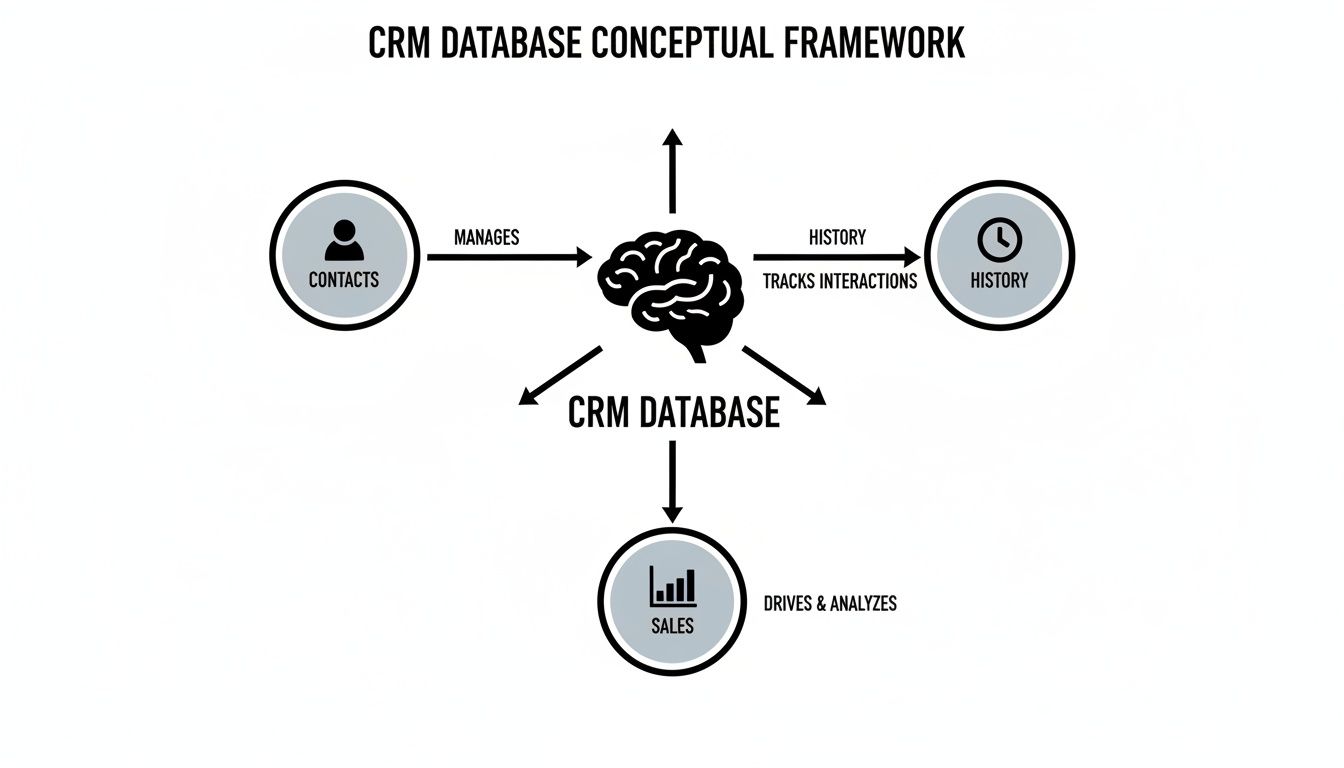
As you can see, contacts, interaction history, and sales data aren't siloed. They are deeply linked, forming the core of your business's customer intelligence.
From Initial Contact to Closed Deal
Once your sales team qualifies the Lead, confirming they are a good fit, their status changes. The system converts the single Lead record into three distinct, interconnected records:
- Account: This represents the client’s company. It acts as the parent record, holding key business information like industry, company size, and location.
- Contact: This is the individual person you are communicating with at that company. A single Account can have multiple Contacts associated with it.
- Opportunity: This represents the potential deal itself. It’s where your team tracks the deal's value, its current stage in the sales pipeline, and its expected close date.
This intentional separation is crucial. It allows you to manage your relationship with the company as a whole and with the specific decision-makers, all while tracking the progress of a potential sale independently. This structural sophistication is a key differentiator between a true CRM database and a simple contact list. For a deeper look at a related technology, check out our guide on what is a customer data platform, which also centers on unifying customer information.
Creating the 360-Degree Customer View
As the Opportunity moves through your sales pipeline, from the initial pitch to the final negotiation, every interaction is logged as an Activity. Each email sent, call made, and meeting held is attached to the relevant Contact, Account, and Opportunity records.
This interconnected data flow is what creates the coveted 360-degree customer view. It’s not just a buzzword; it’s the ability for anyone in your organization to instantly understand the complete history and current status of any customer relationship.
This comprehensive view prevents critical details from being lost. A customer service agent can see the original sales notes. A marketer can review recent support tickets. This ensures every interaction is informed and personalized. Ultimately, this structure transforms isolated data points into a powerful, actionable narrative that fuels smarter decisions and builds stronger, more profitable relationships.
Connecting CRM Data to Tangible Business Growth
Having a well-organized CRM database is an excellent start, but its true value is realized when you translate that data into measurable business outcomes. The power of a CRM lies not just in storing information but in its ability to directly drive revenue, improve client retention, and enhance operational efficiency.
Think of it as the engine that converts raw information into a genuine competitive advantage. A CRM database enables your business to shift from speculation to data-driven decision-making. Instead of launching broad campaigns and hoping for results, you can pinpoint your most profitable customer segments and focus your resources where they will deliver the greatest impact.
From Data Points to Strategic Actions
The strategic value of a CRM database is most evident in its daily applications. The rich data provides the context needed to personalize every interaction, anticipate customer needs, and uncover new revenue opportunities within your existing client base.
Consider these real-world scenarios:
- For a SaaS Company: By analyzing a customer's usage patterns and purchase history, the sales team can identify the perfect moment to offer a timely upgrade. This proactive, informed approach to upselling is far more effective than a generic email blast.
- For a Marketing Team: Instead of sending the same newsletter to an entire list, marketers can use behavioral data, such as which pages a lead visited, to create hyper-personalized email sequences that speak directly to their interests, dramatically increasing engagement.
- For a B2B Service Firm: Imagine a key contact at a major account leaves the company. The CRM can trigger an immediate alert, prompting the account manager to connect with the new contact right away, ensuring relationship continuity and preventing potential churn.
These examples illustrate how a CRM database doesn't just store data; it equips teams with the insights needed to act intelligently and effectively.
Boosting Revenue and Productivity
The link between a well-managed CRM database and business growth is not just theoretical, it’s supported by solid data. For marketing leaders, these databases are delivering 29% revenue increases and 34% productivity boosts by enabling precise lead segmentation and ROI tracking.
Without a robust CRM database, companies risk creating information silos and falling behind the 65% of businesses that adopt CRM within their first five years. Whether using integrations for Dynamics 365 or Salesforce, a properly tailored CRM database is what unlocks actionable insights, turning raw data into sustained growth. You can read more about these impactful CRM statistics and see the clear business case for yourself.
A CRM database isn't a cost center; it's a revenue generator. It provides the single source of truth needed to align sales and marketing efforts, ensuring everyone is working from the same playbook to achieve the common goal of growth.
This alignment is fundamental. It means marketing can deliver higher-quality leads, and sales can engage them with a full understanding of their journey. This synergy is a cornerstone of any successful digital marketing and customer relationship management strategies. Ultimately, the database is the foundation that makes these powerful, collaborative efforts possible.
Understanding the System vs. the Database
One of the most common points of confusion in the CRM world is the distinction between the system and the database. The terms are often used interchangeably, but they represent two sides of the same coin, distinct, yet completely interdependent. Understanding this difference is key for any leader making a technology investment or any marketer aiming to maximize the value of their tools.
Think of it this way: the CRM database is the library's entire collection of books. It’s the raw information, every customer's name, every email they've opened, every support ticket, and every sales figure. This data is organized, structured, and stored, serving as your single source of truth.
The CRM system (like Salesforce or HubSpot) is the library building itself. It provides the infrastructure that makes the information useful: the search catalog to find what you need, the librarians to help you access it, and the checkout desk that enables you to take action.
The Engine and the Fuel
Let’s use another analogy.
The CRM database is the fuel. It's the valuable, structured data that holds all the potential. The CRM system is the engine that consumes that fuel to generate power. The system provides the user interface, automation workflows, and analytics dashboards that transform raw data into something actionable.
Without the database, the system is an empty shell, an engine with no fuel. And without the system, the database is an inaccessible vault of information, nearly impossible for your team to use effectively.
The database stores the customer story. The system tells that story in a way your teams can understand and act upon.
This symbiotic relationship is the foundation of modern customer management. A system's advanced features, email automation, pipeline tracking, reporting, are entirely dependent on the quality and structure of the data within the CRM database.
Why This Distinction Matters
Understanding this separation helps clarify roles and responsibilities within your organization.
Your IT and data teams are typically focused on the health of the database. They are the guardians of the fuel, ensuring data integrity, managing backups, and handling complex integrations.
Meanwhile, your sales, marketing, and customer service teams operate within the CRM system daily. They are the drivers of the engine, using its interface and tools to communicate with customers and close deals.
Choosing the right components for both is critical. You can learn more about how to choose a CRM system that fits your specific business needs. A winning strategy demands both a high-quality database and a powerful, user-friendly system working in perfect harmony.
The Future of CRM Is Intelligent and Automated
The era of CRM databases as passive digital filing cabinets is ending. The future is active, intelligent, and predictive. Instead of merely storing customer history, tomorrow’s CRMs are evolving into proactive partners that anticipate needs and recommend the next best action, transforming how businesses engage with their clients.
This evolution is driven by artificial intelligence (AI) and machine learning. These technologies analyze the vast amounts of data in your CRM to identify patterns that a human might miss. This transforms your database from a simple system of record into a powerful system of intelligence. This isn't a distant concept, it's happening now, providing a significant competitive edge to companies that embrace it.

Practical Applications of AI in CRM
This isn't about abstract algorithms; it's about real-world tools that drive tangible results. AI is already making CRM databases smarter and more automated in several key ways.
- Predictive Lead Scoring: AI analyzes the attributes and behaviors of past successful deals to score new leads in real time. This helps sales teams focus their efforts on prospects with the highest likelihood of converting.
- Customer Sentiment Analysis: By scanning the language in emails, support tickets, and call transcripts, AI can gauge customer sentiment. This acts as an early warning system for at-risk accounts, providing an opportunity to intervene before it's too late.
- Automated Journey Mapping: AI can analyze communication patterns and engagement metrics to automatically determine a customer's stage in their journey. It can then trigger personalized actions at the optimal moment, ensuring no one is overlooked.
The core idea is simple: let the machine handle the heavy lifting of data analysis so your team can focus on what they do best, building relationships. An AI might flag a client as a churn risk based on declining email engagement, freeing up an account manager to make a proactive, strategic phone call.
The financial impact is significant. The market for AI in CRM is projected to grow from USD 4.1 billion in 2023 to an astounding USD 48.4 billion by 2033. This growth is fueled by massive productivity gains, with companies reporting a 34% increase in output after implementation. You can discover more insights about these CRM statistics and see how they are reshaping business performance.
Ultimately, embedding intelligence directly into the CRM database empowers teams to move faster and make smarter, data-backed decisions. To see more of how this works in practice, explore our guide on what is CRM automation. This forward-thinking approach is no longer a luxury; it's a necessity for maintaining a strong market position.
Best Practices for a Successful CRM Database
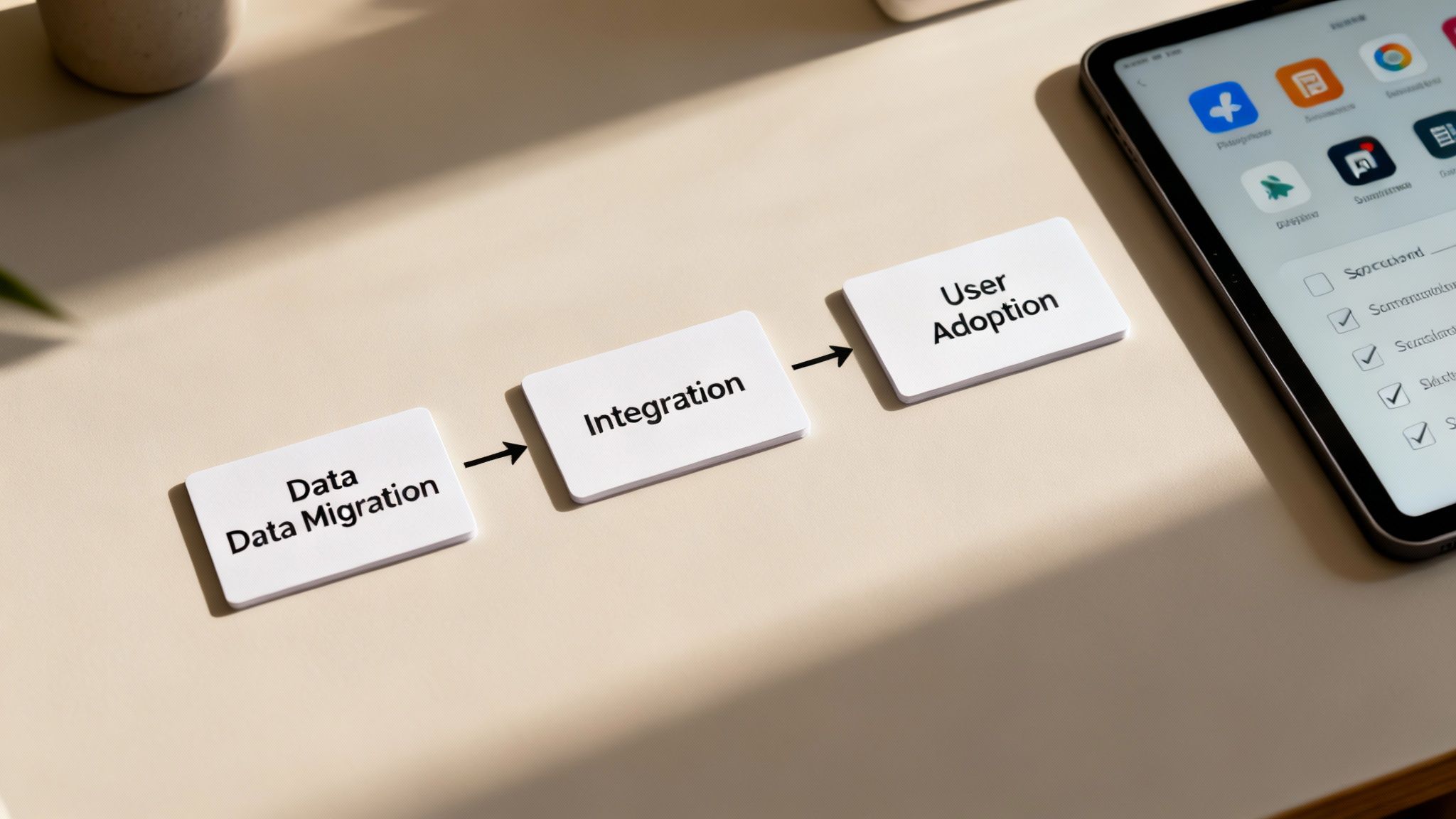
Implementing a new CRM database, or revitalizing an existing one, is more than a technology upgrade; it's a fundamental shift in business operations. A successful rollout requires a clear strategy that extends beyond initial setup to focus on data quality, system integration, and, most importantly, user adoption.
Think of it as constructing a central highway for your company's data. You wouldn't just pour asphalt and hope for the best. You would need to plan the on-ramps, establish traffic rules, and ensure everyone knows how to use it. Without proper planning, you risk creating a data traffic jam.
Establish a Single Source of Truth
One of the most common mistakes is allowing a new CRM to become another data silo. To avoid this, integration is non-negotiable. Your CRM must communicate seamlessly with all your other critical business systems.
- Marketing Automation Platforms: Connecting with tools like HubSpot or Marketo ensures lead data flows directly into the CRM, providing sales with a 360-degree view of every marketing touchpoint.
- Email and Calendar Systems: Integrating with Outlook or Google Workspace automatically logs emails and meetings, saving your team from hours of manual data entry.
- ERP and Accounting Software: Linking these systems provides a complete financial history for each client, from the initial sales opportunity to the final invoice.
This network of connections creates a true single source of truth, where every team member accesses the same complete, up-to-date information. Anything less means you're managing isolated pools of data instead of a powerful, unified river.
The goal is to make your CRM database the undisputed hub of all customer information. When anyone in the organization has a question about a client, the first and only place they need to look is the CRM.
Drive User Adoption and Data Quality
A state-of-the-art CRM database is useless if it isn't used correctly. Securing team buy-in isn't about enforcing a new tool; it's about demonstrating its value and integrating it so seamlessly into their daily routines that they can't imagine working without it. In fact, 74% of users report that their CRM system provides them with better access to customer data.
Start by defining simple, clear workflows for common tasks. Document the exact steps for entering a new lead, updating a deal stage, or logging a service call. Consistent processes are the foundation of high-quality data.
Finally, remember that a CRM is a living system, it's never truly "finished." Regularly audit your data for inaccuracies, duplicates, and outdated information. By setting clear standards for data migration, system integration, and user adoption from the outset, you elevate your CRM from a simple piece of software to the operational DNA of your organization.
Frequently Asked Questions
Even with a solid understanding of a CRM database, several common questions often arise as businesses consider its practical application. Here are answers to some of the most frequent inquiries.
What Is the Main Difference Between a CRM and an ERP?
While both CRM and ERP systems are vital to business operations, they serve fundamentally different purposes. A CRM database is externally focused, centered on the customer. It manages interactions, tracks sales pipelines, and optimizes marketing efforts.
In contrast, an ERP (Enterprise Resource Planning) system is internally focused, concentrating on core business operations. This includes areas like finance, accounting, supply chain logistics, and human resources.
Can a Small Business Use a CRM Database?
Absolutely. A CRM database is not exclusively for large corporations. Many leading CRM platforms offer scalable and affordable plans tailored specifically for small businesses.
Implementing a CRM early helps organize contacts, track leads, and deliver excellent service from the beginning. More importantly, it establishes a solid foundation for future growth.
How Secure Is Customer Data in a CRM?
Data security is a top priority for reputable CRM providers, who implement multiple layers of protection. These typically include:
- Encryption: Data is scrambled and protected both when stored on servers (at rest) and when being transmitted between systems (in transit).
- Access Controls: These features ensure that users can only view the information necessary for their roles, preventing unauthorized access to sensitive data.
- Regular Audits: Providers conduct frequent security audits to identify vulnerabilities and ensure compliance with strict data protection regulations like GDPR.
How Often Should I Clean My CRM Database?
Maintaining data hygiene is an ongoing process, not a one-time task. People change jobs, companies are acquired, and contact information becomes outdated.
As a best practice, schedule a comprehensive data quality review at least quarterly. This provides an opportunity to merge duplicates, update old information, and ensure all records are complete and accurate.
Ultimately, the health of your CRM database directly impacts the effectiveness of your sales and marketing. A clean, well-maintained database ensures your teams are working with reliable information, leading to better decisions and stronger customer relationships.
Ready to transform your customer data into a powerful growth engine? Twelverays specializes in integrating and optimizing CRM solutions like Dynamics 365 and Salesforce to give you a clear, actionable view of your customer journey. Learn how our data-driven strategies can fuel your success.


