Key Takeaways
- Power Automate is Microsoft's cloud-based workflow automation platform that connects apps, moves data between systems, and runs approvals without manual busywork.
- What is Power Automate used for? Repetitive data entry, multi-step approvals, cross-app data sync, and turning ad hoc processes into governed, auditable business process automation.
- Microsoft Power Automate grew out of Microsoft Flow and now anchors the Power Platform alongside Power BI and Power Apps.
- Microsoft Flow is the retired product name Microsoft replaced in 2019 to reflect the platform's broader automation scope.
- Power Automate Desktop is the robotic process automation (RPA) engine Microsoft includes with Windows 11 for local, no-license automation on legacy applications.
- What can Power Automate do? Cloud flows, desktop flows, and preview generative actions cover event-driven triggers, on-machine automation, and AI-directed task sequencing, feeding clean data into workflow automation and AI Operations.
From Microsoft Flow to Microsoft Power Automate: The Platform's Evolution
Microsoft Power Automate is Microsoft's flagship workflow automation platform, and its history explains why it now sits at the center of enterprise operations. Microsoft launched the tool as Microsoft Flow in 2016, then renamed it Power Automate in 2019 to signal a broader ambition beyond simple app-to-app triggers.
The rebrand was structural, not cosmetic. Power Automate connects to the products you already use, and it anchors the Microsoft Power Platform alongside Power BI for analytics and Power Apps for custom application development. A workflow built in Power Automate can push results into a Power Apps dashboard or trigger a Power BI refresh, so the three tools compound instead of operating in isolation.
The low-code value proposition is the real draw. Business users in HR, finance, and operations build multi-stage workflows through a visual designer, without waiting on a developer queue. That accessibility separates Power Automate from the IT-only automation tools it replaced, and it is why workflow automation keeps expanding inside mid-market companies.
What Is Power Automate Used For in Daily Operations
What is Power Automate used for? In practice, it replaces four categories of manual work that quietly cost teams hours every week.
- Repetitive task automation. Data entry, file routing, and document sync run on defined rules instead of a person's inbox discipline.
- Multi-step approval management. HR onboarding, finance purchase orders, and sales contract sign-offs move through structured chains with reminders and audit trails built in.
- Cross-application data consistency. Power Automate connects Microsoft tools and thousands of third-party services, so a record updated in one system propagates everywhere else, with no manual re-entry.
- Trigger-based alerts. A missed deadline, a submitted form, or a crossed threshold notifies the right person immediately instead of hours later.
Each of these is a form of business process automation, not a single script. A script breaks the moment an edge case appears. A governed flow escalates to a human instead.
Cloud Flows, Power Automate Desktop, and Business Process Flows Explained
Not every automation problem looks the same. Microsoft built three flow types to match that reality, and picking the right one determines whether an automation survives its first edge case.
Cloud Flows and Business Process Flows
A Cloud Flow is an event-driven automation that runs across connected cloud services. A new email, a SharePoint update, or a form submission triggers the flow with no local software required, which makes Cloud Flows the default starting point for most digital-operations work.
A Business Process Flow is a guided, step-by-step data-entry sequence, not an automation that removes the human. It stops a user from skipping a required field or entering data out of order, which matters most in regulated industries where data quality drives downstream decisions.
Power Automate Desktop and Robotic Process Automation (RPA)
Power Automate Desktop is Microsoft's robotic process automation (RPA) tool for software that predates modern APIs. It clicks buttons, reads screen output, and enters data exactly as a person would. Microsoft includes Power Automate for desktop with Windows 11 for local automation at no added license cost, so any Windows 10 or 11 user can build local RPA flows without a separate purchase.
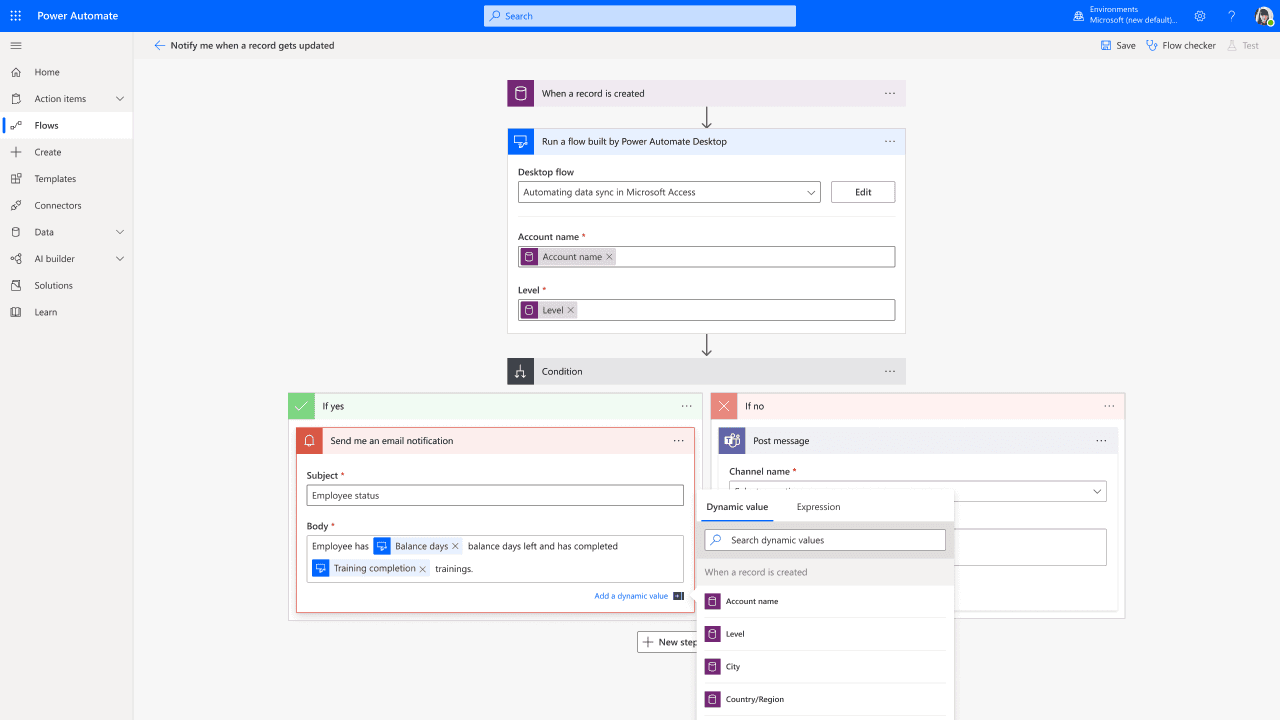
The screenshot above is a real Power Automate Desktop flow: a condition branch that emails a manager or posts to Teams depending on whether a record clears a threshold, exactly the legacy-system bridge Desktop flows are built for. Read more on Dynamics 365 customer insights implementation for how this pattern extends into CRM.
What Can Power Automate Do for CRM and AI Operations
What can Power Automate do for revenue teams? It is the connective layer between CRM platforms and AI systems. Whether an organization runs Dynamics 365, HubSpot, or Salesforce, Power Automate synchronizes records, triggers follow-up actions, and removes the manual hand-offs that introduce errors and delay. A contact captured in one system appears in another, enriched, without anyone touching a keyboard. What is Dynamics 365 covers the CRM side of that same stack in more depth.
That clean, structured data matters once AI enters the picture. AI agents and predictive models are only as reliable as the data fed into them. Workflow automation enforces consistency at ingestion, normalizing fields, routing records by qualification criteria, and flagging anomalies before they reach a downstream model.
Automation does not replace AI judgment. It prepares the environment where AI judgment becomes trustworthy: clean inputs, structured triggers, and a governed handoff. Treating AI Operations as a discipline, with human checkpoints and clear ownership on every flow, is what separates a resilient automation program from one that quietly accumulates technical debt.
Real-World Business Process Automation Use Cases
Power Automate turns abstract automation concepts into outcomes teams feel every week. Four scenarios show up constantly:
- Email attachment management. A flow detects incoming invoices or contracts, identifies the sender or subject line, and files the attachment into the right SharePoint or OneDrive folder with no human step.
- CRM lead syncing. When a prospect completes a website form, Power Automate pushes that record into a CRM in real time, so sales responds while interest is highest.
- Approval and time-off management. Holiday requests, expense reports, and purchase orders route through an approval chain automatically, with reminders and an audit trail.
- Consolidated weekly reporting. Power Automate desktop pulls figures from spreadsheets, databases, and cloud apps on a schedule and compiles one report instead of five.
Power Automate offers more than 1,500 connectors across Microsoft and third-party services, plus a custom connector and an HTTP action for anything not on the list, according to Microsoft. That connector breadth is what lets one platform touch a legacy on-premises system and a modern SaaS tool in the same flow.
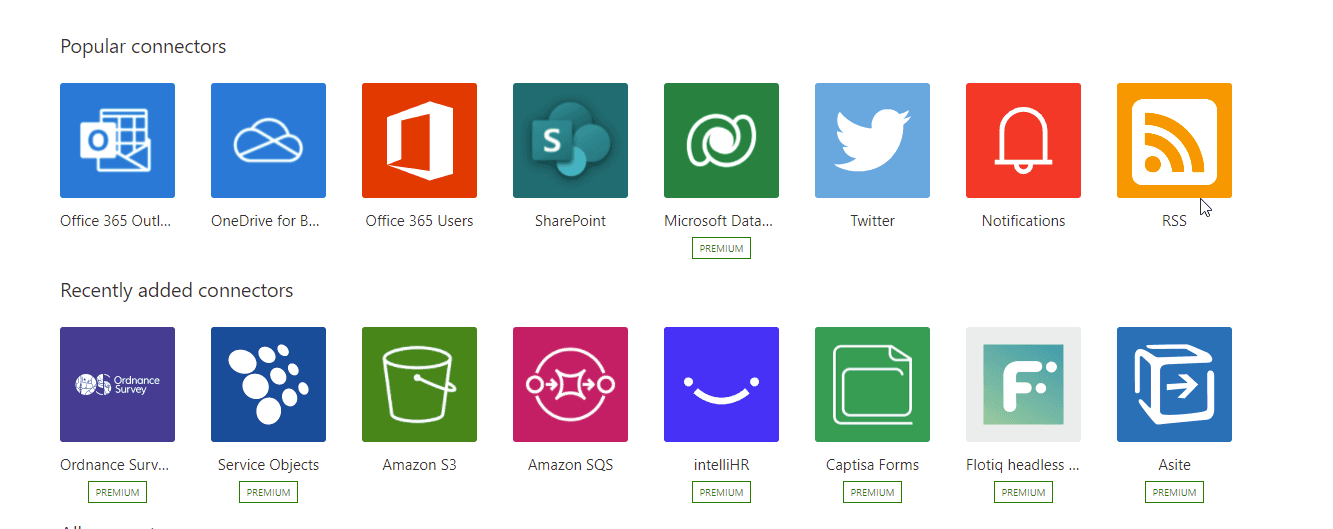
See 10 ways Dynamics 365 can streamline your business processes for how these same connector patterns plug into a CRM rollout, and becoming a Dynamics 365 consultant for the skill set behind building them.
Is Power Automate Free? Workflow Automation Pricing and Licensing
Licensing is where most teams get tripped up. Microsoft's current pricing breaks down into four tiers:
| Plan | Cost | Best for | Included |
|---|---|---|---|
| Free trial | Free for 30 days | Testing before you buy | Cloud flows with standard connectors |
| Power Automate Premium | $15 per user/month, billed yearly | Individual power users | Cloud flows, attended desktop flows, premium connectors, AI Builder, process mining |
| Power Automate Process | $150 per bot/month, billed yearly | One unattended business process | Cloud flows, unattended desktop flows |
| Power Automate Hosted Process | $215 per bot/month, billed yearly | Same as Process, no VM to manage | Adds a Microsoft-hosted virtual machine |
Power Automate for desktop is included with Windows 11 for local, attended automation at no additional license cost, which makes it an accessible entry point for individuals and small teams automating personal tasks. Cloud-triggered and unattended desktop flows, along with premium connectors and AI Builder credits, require an upgrade to Power Automate Premium or Process.
The free tier carries a hidden cost: without governance guardrails, ungoverned flows accumulate technical debt fast, the same challenge that shows up once workflow automation scales past a handful of flows.
The ROI Case for Power Automate
The financial case is not theoretical. A Forrester Total Economic Impact study commissioned by Microsoft found a composite organization built from real Power Automate customers realized a 248% return on investment over three years, a payback period under six months, and $9.5 million in cost savings from consolidating automation onto one platform.
That scale of return tracks with the broader automation trend. McKinsey estimates that by 2030, activities accounting for up to 30 percent of hours currently worked across the US economy could be automated, a trend generative AI is accelerating. Workflow automation is the operational layer that makes that shift usable instead of chaotic.
Turning Power Automate Into an AI Operations Advantage
Knowing what Power Automate is and knowing how to win with it are different challenges. DIY automation hits a ceiling fast: a flow built by one motivated employee rarely survives a team change, a CRM migration, or a shift in process. Without architectural oversight, a productivity win quietly becomes a liability, fragile, undocumented, and hard to scale.
Twelverays' AI Operations Design practice closes that gap. The approach treats automation as infrastructure, not a side project: CRM integration that reflects how a team actually sells, human oversight built into every workflow, and governance that holds up as flows multiply. The question shifts from "what is Power Automate?" to how workflow automation becomes a durable operating advantage, and that shift needs a strategic partner, not just a platform.