

Conversational BI: Chat With Your Data Instead of Building Dashboards
Conversational BI lets people ask questions of their data in plain language and get answers back, instead of building or hunting through dashboards. You type "how did enterprise renewals trend last quarter" and get the number, not a blank canvas and a modeling task.
Traditional business intelligence puts a build step between the question and the answer. Someone has to design the dashboard, and someone technical usually has to build it. Conversational BI removes that step. The interface is a chat box, the output is a direct answer, and the data team stops being a reporting help desk. For mid-market teams without a dedicated analytics function, that difference decides whether reporting scales or stalls.
How Is Conversational BI Different From a Dashboard?
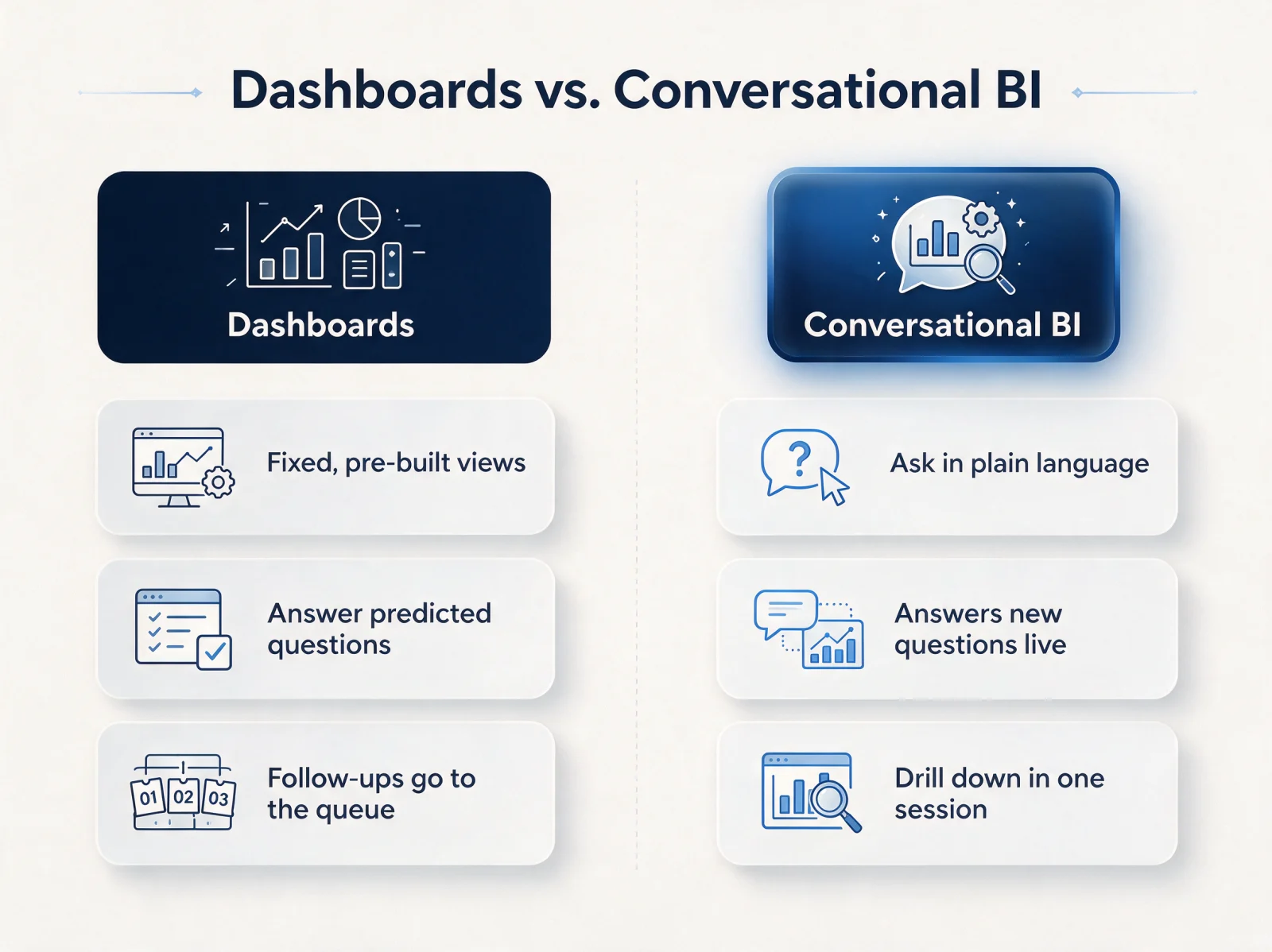
A dashboard answers questions you predicted in advance. Conversational BI answers the question you have right now, including the ones nobody built a chart for.
Dashboards are fixed. They show the metrics someone anticipated, in the layout someone chose. The moment a leader asks a follow-up the dashboard did not plan for, the request goes back to the queue. Conversational BI is dynamic. It interprets a new question, runs the query, and returns the answer in the same session. The same shift is happening across AI-powered CRM and support: static tools are giving way to systems you can simply ask.
That flexibility is the whole point. Real decisions rarely fit a pre-built view.
What Does It Take to Make the Answers Trustworthy?
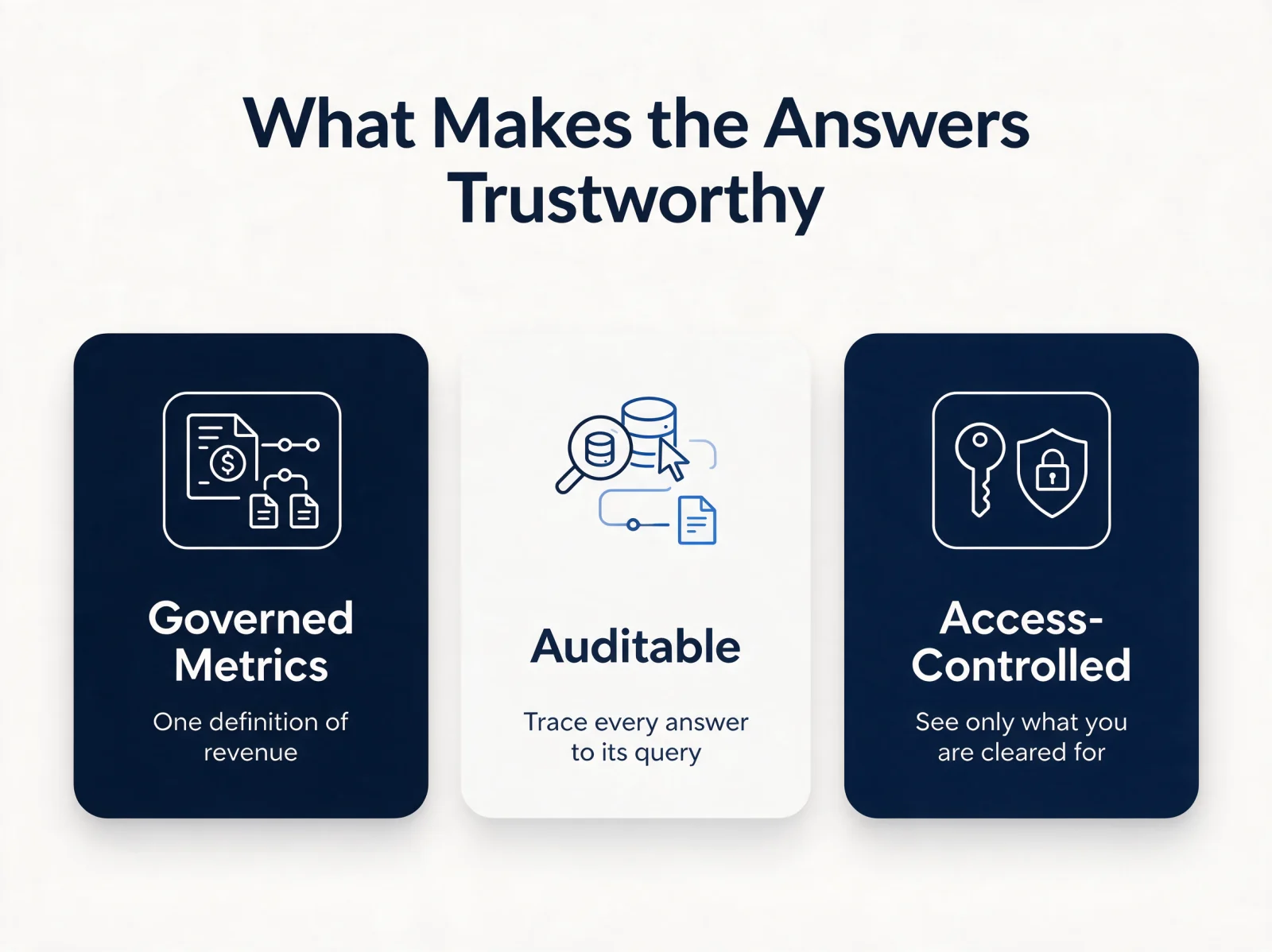
Trustworthy conversational BI needs a governed semantic layer underneath it. The chat is only as reliable as the data model it queries.
This is where most "chat with your data" demos fall apart in production. A language model pointed at a raw database will guess at joins and metric definitions, and it will guess confidently. When "active customer" or "revenue" is defined inconsistently across systems, the agent returns a plausible number that is quietly wrong.
The fix is a semantic layer: metrics defined once, in a governed model the agent must use. With it, "revenue" means the same thing every time, and the answer is auditable. Without it, conversational BI is a fast way to spread bad numbers. Building that layer well is an AI operations design problem, not a plug-in.
Who Gets the Most Value From Conversational BI?
Mid-market teams with real data across several systems and no room to hire an analytics team gain the most. They have the questions and the data, but not the reporting capacity.
The pattern is consistent. A company running a CRM, a finance system, and a few operational tools generates plenty of data, but every cross-system question needs a person to assemble it. Conversational BI turns those questions into self-serve answers, so leaders stop waiting on reports and start acting on them. The bigger the company and the more systems in play, the sharper the payoff.
What Can You Actually Ask Conversational BI?
Anything your data can answer, phrased the way you would ask a colleague. The strength is follow-up questions, not just the first one.
The real value shows up in a chain of questions. A sales leader starts with "how did we close last quarter versus target," then follows with "which regions missed," then "what were the biggest lost deals in those regions." A finance manager asks "what drove the jump in costs last month," then drills into the vendor behind it. Each answer sets up the next, and none of it required a pre-built report.
That conversational drill-down is what a static dashboard cannot do. It turns reporting from a monthly artifact into a live discussion with your data.
What Should You Look for When Evaluating Conversational BI?
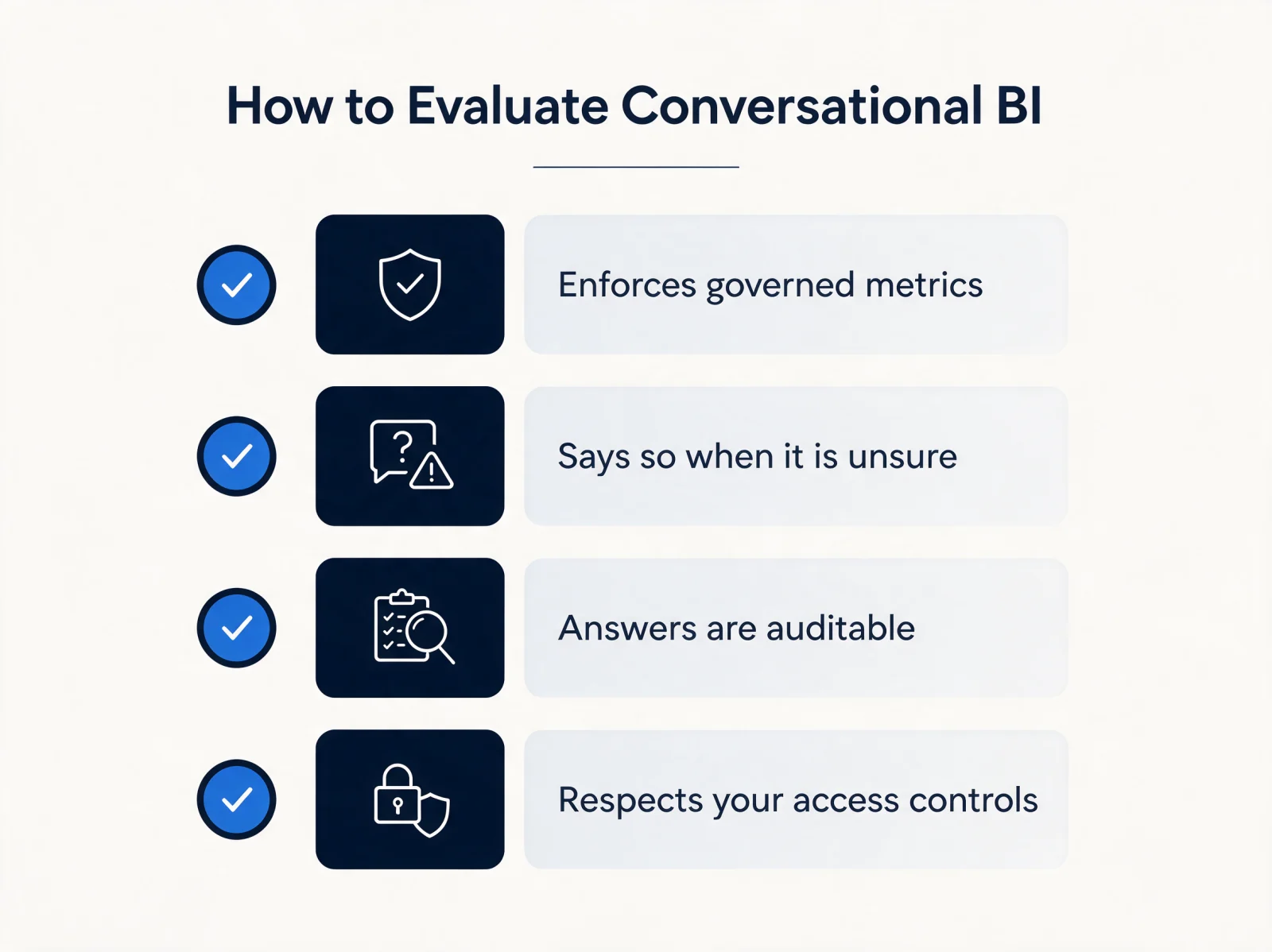
Judge it on accuracy and governance, not on how clever the chat feels. Ask how it defines metrics, how it handles a question it cannot answer, and how you audit a result.
A serious evaluation asks hard questions. Does the tool enforce governed metric definitions, or does it improvise? When it is unsure, does it say so or guess? Can you trace any answer back to the query and the source? Does it respect your existing access controls, so people only see data they are cleared to see?
Tools that answer these well are built on a semantic layer and real governance. Tools that dodge them are demos. The same discipline separates durable workflow automation from brittle scripts: the value is in the reliability, not the interface.
Where Does Conversational BI Fit in Your Existing Stack?
On top of the data you already have, not as a replacement for it. It connects to your CRM, finance, and operational systems rather than asking you to migrate.
The strongest deployments sit on the systems already in place. Your data stays where it lives. The agent reads across those sources through a governed layer and answers questions that span them. That is why conversational BI pairs naturally with an AI-powered CRM and a modern data stack: it adds a question-and-answer layer over what you run, instead of forcing a rip-and-replace nobody has budget for.
How Long Does It Take to Deploy Conversational BI?
A focused first deployment on one governed domain takes weeks, not months. Trying to cover every system at once takes forever and usually stalls.
Timeline follows scope. Point a conversational BI agent at one well-understood area, such as sales pipeline or support volume, and a working, trusted deployment is a matter of weeks: connect the source, define the metrics, validate against known reports, then open it up. Trying to model every system at once is what turns these projects into multi-quarter efforts that stall before launch. The disciplined path ships value early on a narrow slice, earns trust with correct answers, and expands from there. Speed comes from controlling scope, not from cutting the governance that makes the answers reliable. A partner who has run this sequence before will resist the temptation to launch broad, because they know a single early wrong answer sets the whole rollout back weeks.
Key Takeaways
- Conversational BI replaces dashboard-building with a plain-language question and a direct answer.
- Unlike fixed dashboards, it answers the follow-up questions nobody built a chart for.
- Reliability depends on a governed semantic layer, not the chat interface.
- Mid-market teams with multi-system data and no analytics headcount see the fastest return.
Making Conversational BI Real on Your Stack
The concept is simple to describe and hard to deploy well, because the value lives in the connection and the governance, not the conversation. Done right, anyone in the business can ask a question and trust the answer. Done carelessly, it produces confident, unverifiable numbers that erode trust faster than a slow dashboard ever did.
See how a B2B SaaS company cut preventable churn 27% with an AI operating layer.
Twelverays connects your data sources, builds the governed semantic layer, and stands up a conversational BI agent on the systems you already run. If your team spends more time requesting reports than reading them, book a discovery call and we will scope where conversational BI fits.


