

The Shift from Passive Databases to Active Revenue Agents
AI agents for CRM intelligence are turning a decades-old data problem into a real-time revenue advantage, and agentic CRM platforms that capture it now will set the pace for the rest of the market in 2026.
For most sales organizations, the CRM has been a glorified spreadsheet. Reps log calls reluctantly, managers chase pipeline accuracy, and the promise of a "single source of truth" quietly became a data graveyard no one trusts.
A Copilot is a tool that waits for a human to ask a question. An Agent is a system that perceives signals across your data, reasons about what they mean, and acts on its own, updating records, drafting follow-ups, flagging churn risk, without anyone clicking a button first. That autonomy is the whole difference, and it's turning CRM from a passive system of record into an active sales partner.
For mid-market firms, 2026 is a genuine tipping point. Gartner projects that 40% of enterprise applications will carry task-specific AI agents by the end of 2026, up from under 5% in 2025, per Gartner's research. Tooling that once required enterprise budgets now runs on platforms built for mid-market scale. The open question isn't whether agents belong in the CRM. It's what a true agent actually is, which is exactly where we start next.
AI Agents for CRM: The Three Pillars of True Agency
An AI agent is a system that perceives its environment, reasons toward a goal, and acts, without waiting for a human to press a button. That's what separates a genuine agent from a chatbot or an automation rule.
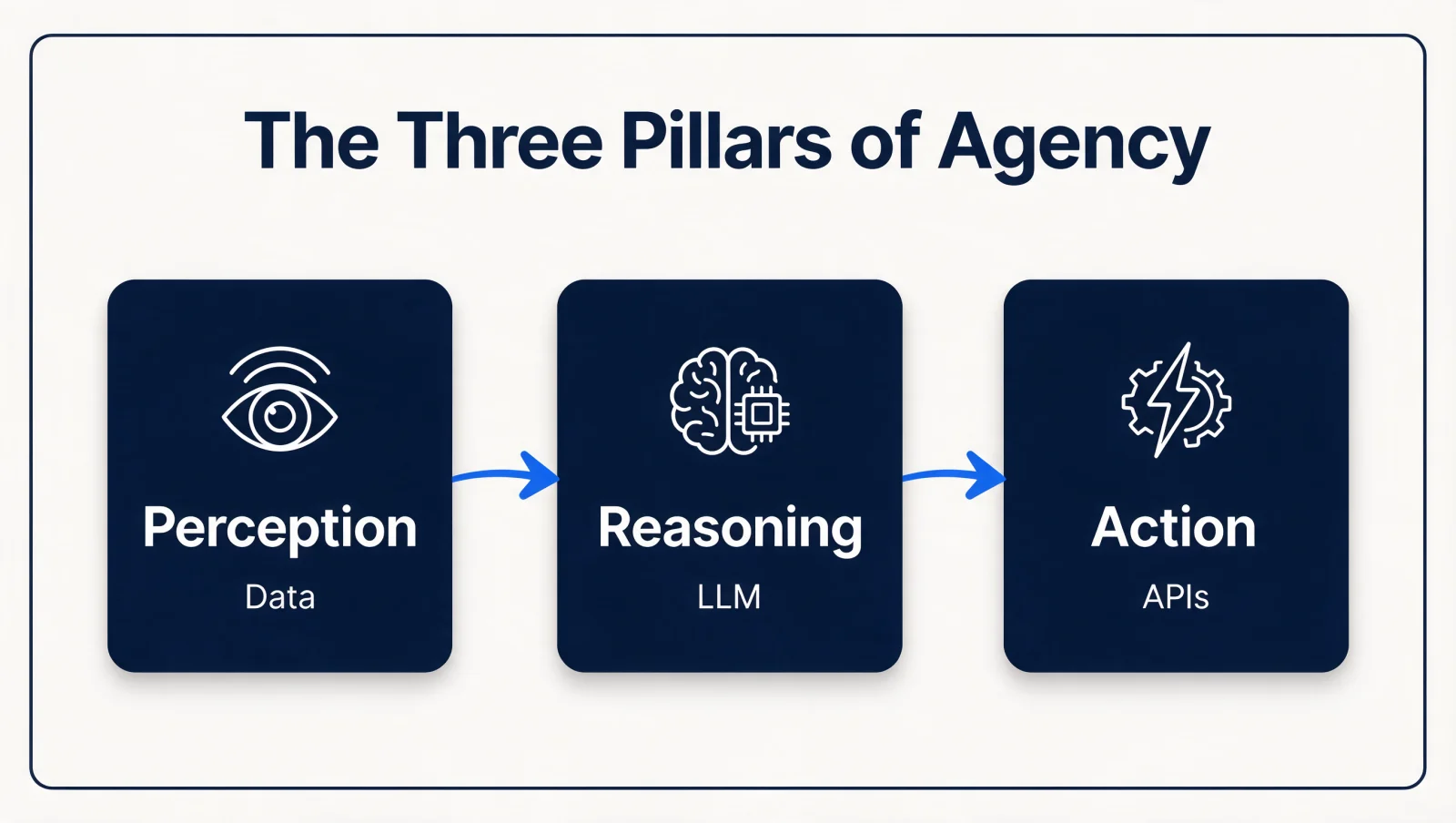
Three pillars define agency:
- Perception (Data): the agent ingests signals from your CRM, email threads, call transcripts, and third-party enrichment sources to build a live picture of each account.
- Reasoning (LLM): a large language model weighs context and priority to determine the right next step.
- Action (APIs): the agent executes, logging activity, sending outreach, updating records, or escalating alerts, across connected tools automatically.
What makes this powerful for CRM intelligence specifically is memory. Unlike one-shot automations, agents carry context across interactions, so a follow-up email references a concern raised three calls ago. That continuity lets a mid-market team operate at enterprise scale without an army of specialists. Real-world examples make that advantage concrete.
AI Agents Examples: High-Impact Use Cases for B2B Teams
AI agents aren't abstract technology. They're reshaping the specific, high-friction workflows that revenue teams deal with every day.
Agents That Win Pipeline
The Autonomous SDR handles lead qualification and personalized outreach at scale. New leads are scored against ICP criteria and enrolled in tailored sequences within minutes.
The Data Hygiene Agent runs real-time deduplication in the background, so duplicate contacts stop silently corrupting forecasts.
Agents That Protect Revenue
The Customer Success Agent flags usage drops and sentiment shifts before churn becomes visible, triggering outreach automatically.
The Revenue Forecaster analyzes call sentiment and deal engagement to predict close probability more accurately than static pipeline stages.
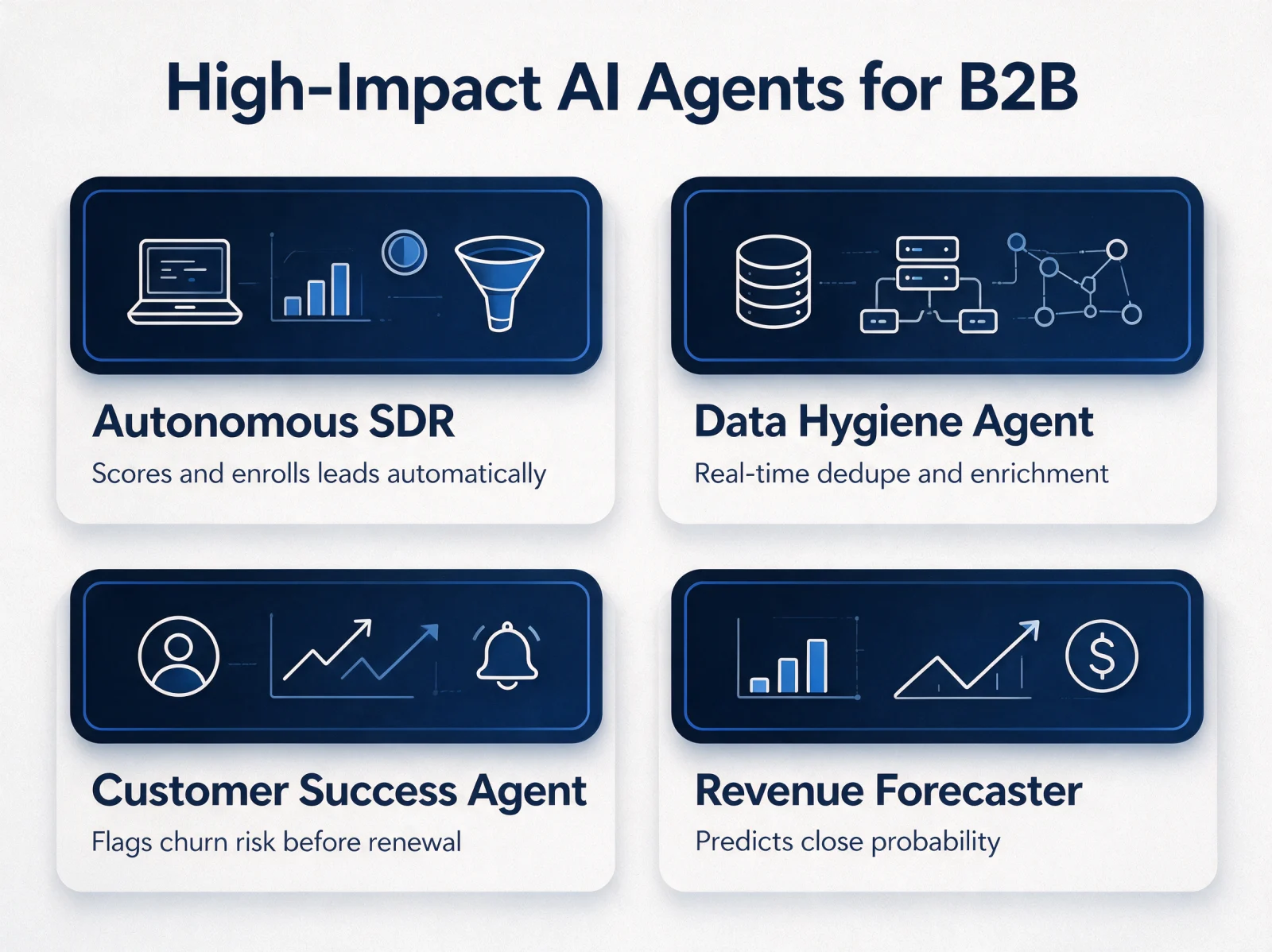
Each of these AI agents examples maps to a distinct platform capability, which is exactly why evaluating the 2026 agentic CRM landscape means looking past feature lists to actual agent architecture.
Agentic CRM Platforms Compared for 2026
Choosing the right agentic CRM platform isn't a minor decision. It's an architectural choice that shapes how your revenue operation scales.
CRM agent technology is consolidating fast around a few dominant players.
Salesforce Agentforce is the enterprise-grade standard for teams that need deep customization. Positioned as a dedicated platform for building and managing autonomous agents, Salesforce Agentforce AI features let revenue ops configure multi-step agents across sales, service, and marketing clouds. On Salesforce's own Help site, Agentforce resolves 76% of inquiries without a human and cuts response time 65% for most users. The tradeoff: licensing costs that scale quickly suit organizations with dedicated CRM admin capacity.
HubSpot Smart CRM takes the opposite approach: agent capabilities built into an interface most mid-market teams already know, with pre-built workflows and no developer required. Speed to value is real, but the ceiling shows up as use cases grow complex.
Microsoft Dynamics 365 earns its place through ecosystem depth. For organizations already running Microsoft 365, Azure, and Teams, native Copilot integrations create a coherent agent layer with minimal friction.
| Platform | Best For | Key Agent Feature |
|---|---|---|
| Salesforce Agentforce | Custom, enterprise-scale agents | Multi-cloud autonomous workflows |
| HubSpot Smart CRM | Mid-market ease of deployment | Pre-built agent templates |
| Microsoft Dynamics 365 | Deep Microsoft ecosystem integration | Native Copilot and Azure AI layer |
| Open-source frameworks | Technical teams, niche workflows | Full customization, no licensing lock-in |
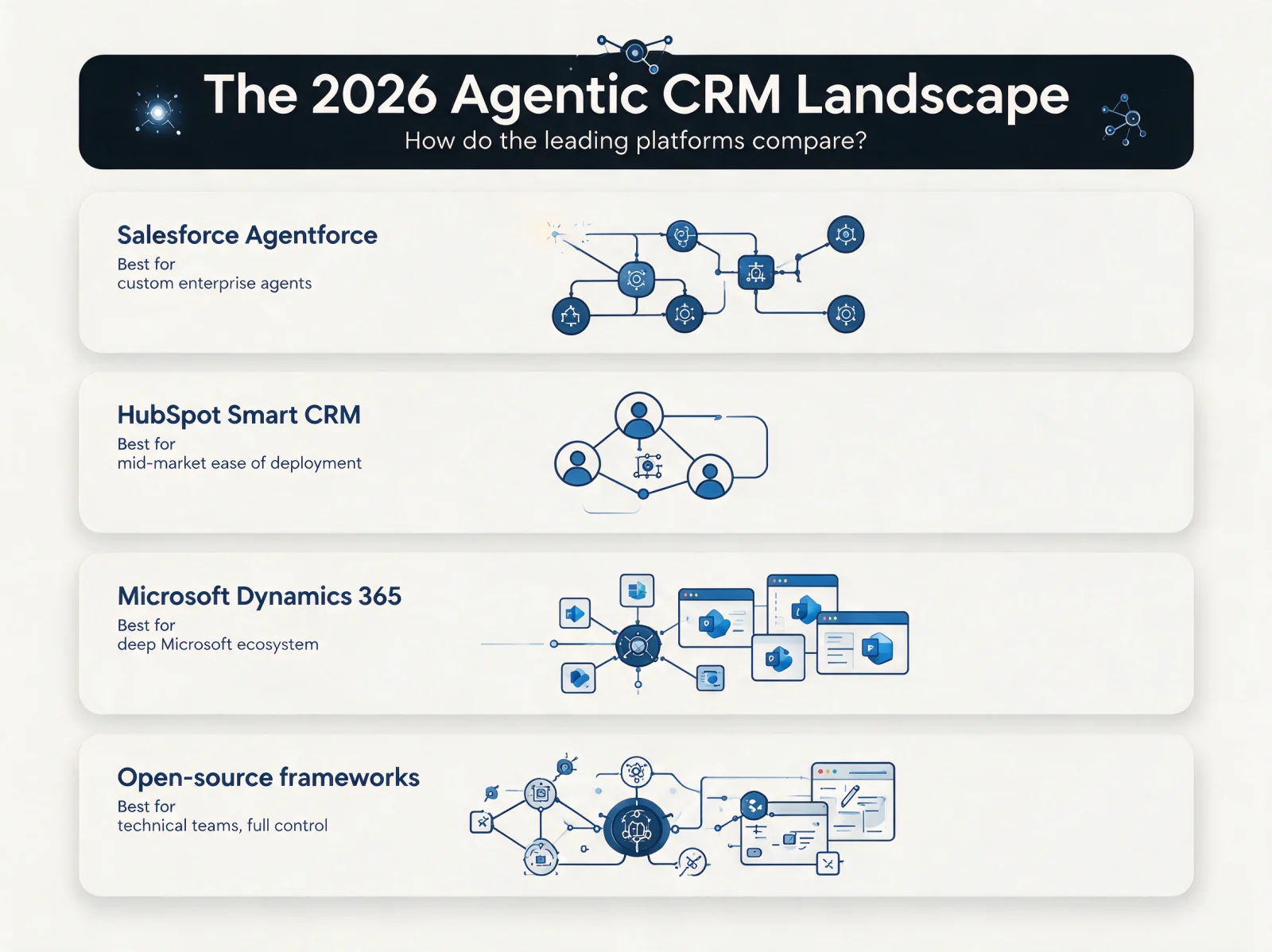
Which platform is right depends less on features and more on your team's internal readiness, a tension the next section addresses directly.
Native vs. Custom: Finding the Best AI Agent for CRM in Your Stack
Choosing whether to deploy native platform agents or build a custom AI agent for CRM intelligence is one of the highest-stakes decisions mid-market revenue leaders face.
The right answer depends less on budget and more on your data architecture. Any AI agent CRM integration lives or dies on two fundamentals: how cleanly your CRM data is structured, and whether your stack exposes reliable APIs. Fragmented, inconsistent data undermines even the most sophisticated agent, native or custom.
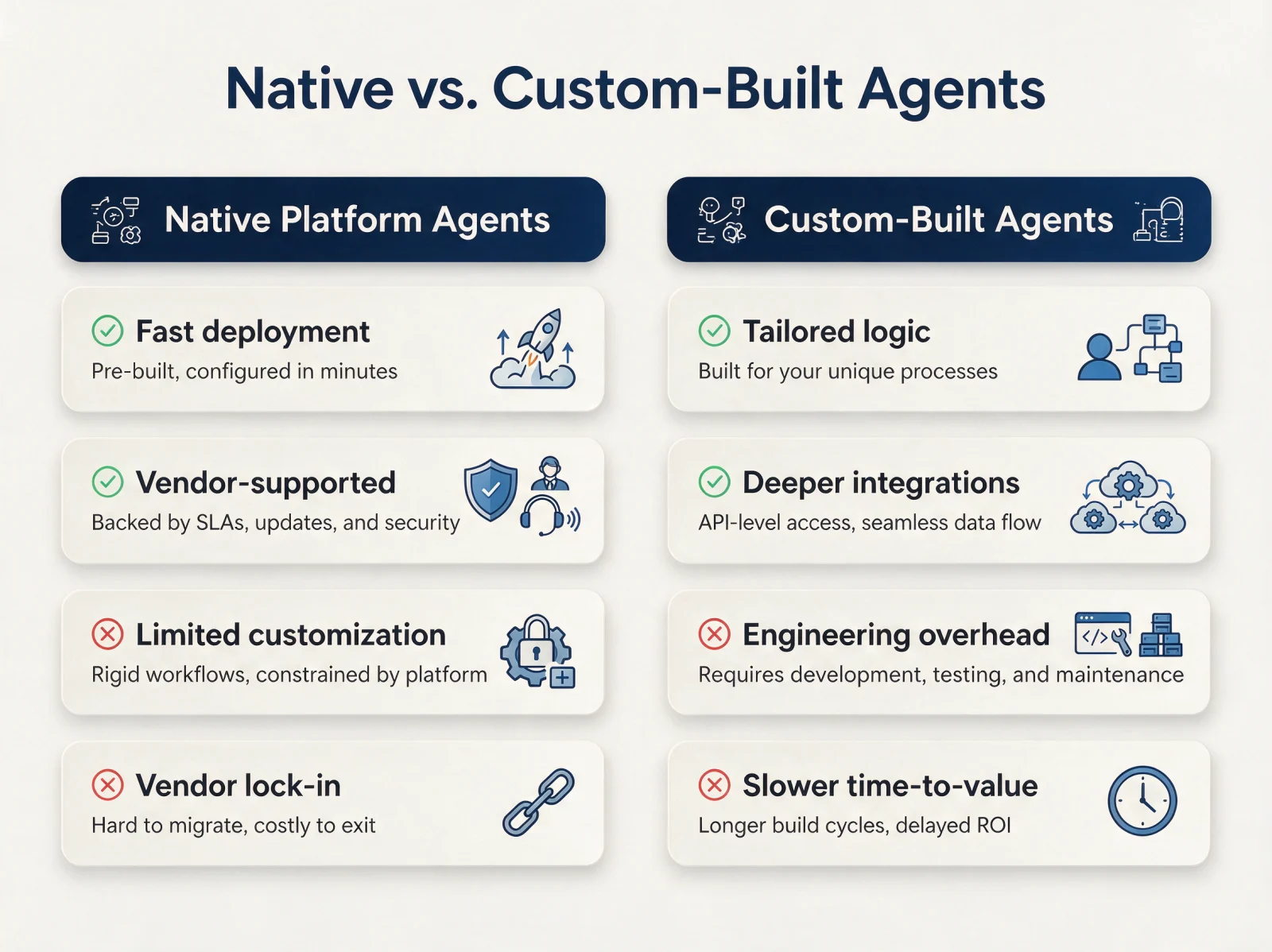
Native platform agents offer the fastest path to value: pre-integrated, minimal configuration, predictable pricing. What's often undersold is the hidden cost: token usage fees that scale with conversation volume, rigid customization ceilings, and vendor dependency.
Custom builds offer real control, but real overhead too: engineering resources, ongoing maintenance, and governance from day one.
- Native agents, pros: fast deployment, lower initial cost, vendor supported.
- Native agents, cons: limited customization, token cost exposure, vendor lock-in.
- Custom agents, pros: tailored logic, deeper integrations, long-term flexibility.
- Custom agents, cons: engineering overhead, slower time-to-value, governance burden.
Risk management isn't optional. Human-in-the-loop checkpoints, where agents flag decisions for review before acting, belong in the design from day one.
Unlocking Hidden Value: The ROI of Agentic Workflows
Agentic CRM workflows don't just cut cost. They restructure where human effort creates value at real scale. McKinsey estimates generative AI could add $2.6 trillion to $4.4 trillion in value annually across the use cases it analyzed, with customer operations and sales among the four functions capturing roughly 75% of that potential.
The clearest early win is cost per lead. Agents screen, score, and route inbound leads without a human touching the queue, disqualifying low-fit prospects before they consume a rep's calendar.
Sales velocity accelerates when administrative friction disappears. Agents update records, draft follow-ups, and log meeting outcomes, tasks that consume hours per rep per week. Returned to selling, that time compresses deal cycles.
The retention angle matters too: reps freed from data entry report higher job satisfaction and stay longer.
Implementation Roadblocks: Why Most AI Agent Projects Fail
Deploying an AI agent for CRM isn't plug-and-play. Most projects stall because of preventable operational gaps.
Dirty data is the single biggest killer of agent effectiveness. An agent is only as good as the records it reasons over. Duplicate contacts, inconsistent field values, and missing lifecycle stages produce confident output that's factually wrong.
Lack of clear guardrails is the second failure point. Without defined boundaries, agents can send off-brand messaging, misrepresent pricing, or hallucinate directly to prospects.
Integration silos compound both problems. An agent that can't read your marketing platform, billing system, or support tickets is operating blind.
The "black box" problem rounds out the pattern. When sales managers can't trace or audit an agent's decisions, adoption collapses.
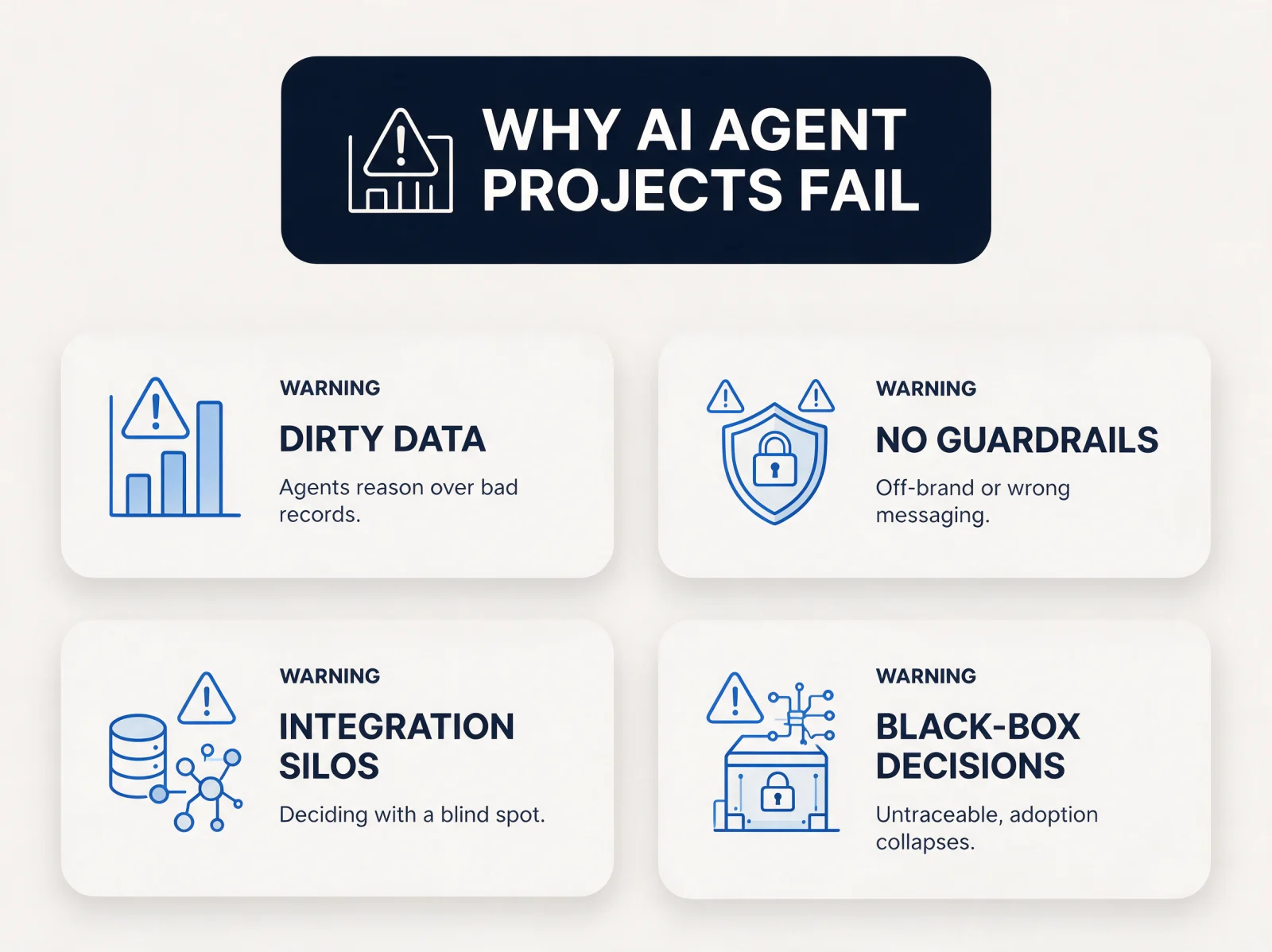
These roadblocks are real, but solvable with the right foundation.
The Bottom Line: Preparing Your CRM for the Agentic Era
AI agents represent the most significant shift in CRM since cloud deployment, moving the system from a record-keeper into an active driver of revenue decisions.
The core shift is straightforward: CRM platforms are evolving from data storage to data action. Where yesterday's system logged what happened, today's agentic layer decides what should happen next.
Key takeaways:
- AI agents perceive, reason, and act without a human prompt; a Copilot only responds when asked.
- Gartner projects 40% of enterprise apps will run task-specific agents by the end of 2026, up from under 5% today.
- Native platforms (Salesforce Agentforce, HubSpot Smart CRM, Microsoft Dynamics 365) trade customization ceiling for speed to value.
- Dirty data, not platform choice, is the single biggest reason AI agent projects fail.
- Start narrow: one agent, one use case, measurable output, inside a 60 to 90 day pilot.
Turning CRM Strategy into Operating Results
The companies that win the next decade won't be the ones that bought AI licenses. They'll be the ones that built a strategy before buying anything.
Mid-market organizations face a specific trap: licensing an AI-powered CRM platform before mapping the data flows and governance rules that make agents useful. Audit your CRM state, pick the two or three highest-value automation opportunities, and define success metrics before a single agent goes live.
A consulting partner changes the trajectory here. Designing custom AI agents isn't purely a technical exercise. It's an operational design problem. Firms that specialize in AI operations design, like Twelverays, combine CRM implementation expertise with agent architecture and governance design, so the pilot is built to scale rather than rebuilt every quarter.
See how a wealth advisory firm cut client-review prep 68% with governed, CRM-connected AI agents.
If you're scoping a CRM-connected agent, Twelverays designs and runs AI agents built on Salesforce, HubSpot, and Dynamics 365. Start with a scoped AI readiness assessment and a 60 to 90 day pilot.


