

Flodesk is better if you want beautiful emails, a short learning curve, and unlimited sends on every paid plan. Mailchimp is better if you need deep automation, granular reporting, and a large integration catalog. That is the short answer in the Flodesk vs Mailchimp decision. The longer answer depends on your list size, your stack, and how much marketing depth you actually use. Flodesk is the design-first platform built for creators and small brands. Mailchimp is the established all-in-one marketing platform owned by Intuit. This comparison breaks down 2026 pricing, ease of use, design, automation, integrations, and deliverability so you can pick the right fit for your business.
The biggest 2026 change is on the Flodesk side. Flodesk built its reputation on a single flat-rate plan with unlimited subscribers. On December 2, 2025, Flodesk retired that flat-rate unlimited plan for new members and moved to tiered pricing that scales with your active subscriber count. Members who subscribed before that date keep their legacy unlimited pricing for now. Everything below reflects the current pricing both platforms charge new customers.
Key takeaways
- Flodesk retired its flat-rate unlimited plan on December 2, 2025. New members now pay by active subscriber count across Lite, Pro, and Everything tiers.
- Flodesk paid plans start at $19 per month on annual billing with unlimited sends. Mailchimp Essentials starts around $13 per month with sends capped at 10 to 15 times your contact count.
- Flodesk wins on design, templates, and ease of use. Mailchimp wins on automation depth, reporting, and integrations.
- There is no native Mailchimp Flodesk integration. Connect the two through Zapier or migrate with a CSV export and import.
Flodesk vs Mailchimp at a glance
Here is the honest side-by-side before the detail.
| Dimension | Flodesk | Mailchimp |
|---|---|---|
| Starting paid price | $19/mo on annual billing, up to 1,000 subscribers | Essentials from about $13/mo at the entry contact tier |
| Free plan | No subscriber cap; forms and landing pages, no campaign sends | 250 contacts, 500 sends per month |
| Pricing model | Active subscriber count; unlimited sends | Contact count; sends capped at 10 to 15x contacts |
| Design and templates | Design-first, premium out of the box | Large library, more functional look |
| Automation | Visual workflows; unlimited on Pro and above | Multi-step journeys with branching and event triggers |
| Integrations | Focused native set plus Zapier | Hundreds of direct integrations |
| Best for | Creators and small design-led brands | Businesses running lifecycle marketing at scale |
Flodesk Pricing
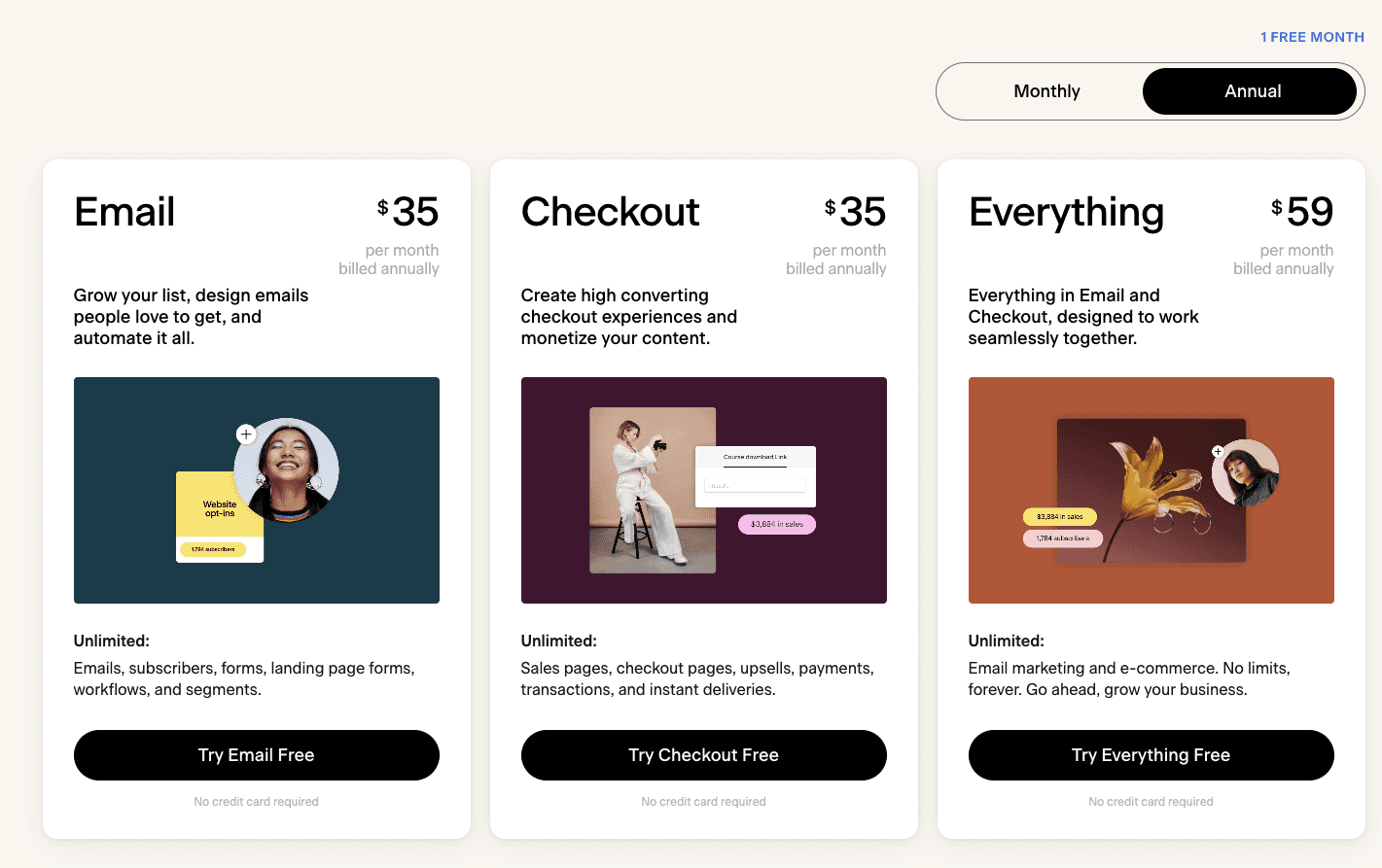
Flodesk now runs a free plan plus three paid tiers: Lite, Pro, and Everything. The free plan has no subscriber cap, but it is built for lead capture, not sending. It covers forms, landing pages, and link-in-bio pages so you can grow a list, and you upgrade to a paid plan to send campaigns. Paid plans start at $19 per month on annual billing for up to 1,000 active subscribers, and the price climbs as your list grows. Lite tops out at 25,000 subscribers. Pro and Everything scale up to 255,000. Every paid plan still includes unlimited email sends with no per-email charge. The Everything plan adds checkout, sales pages, and subscription billing on top of Pro's unlimited workflows and advanced reporting. The flat-rate unlimited deal that made Flodesk famous is gone for anyone signing up today.
Mailchimp Pricing
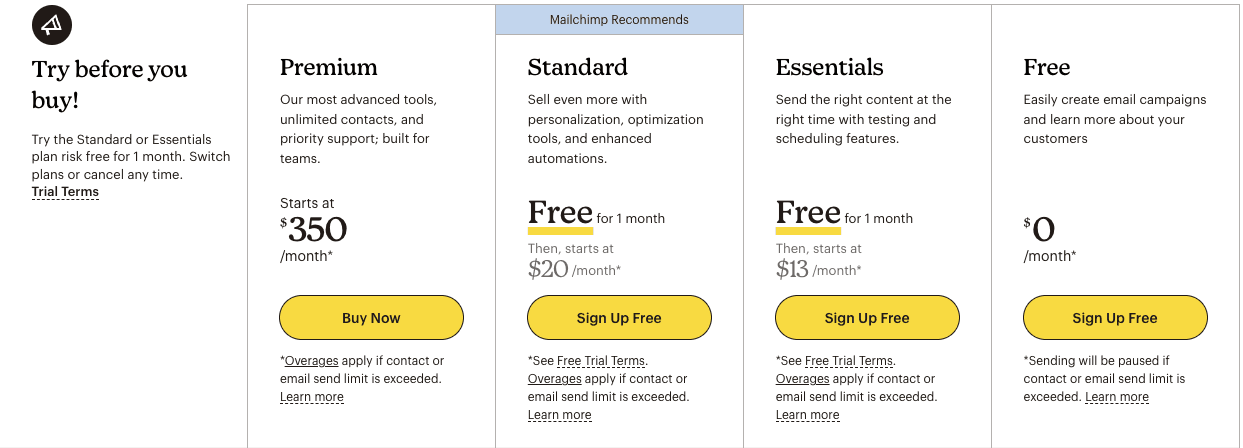
Mailchimp has always priced by contact count, and it still does. The free plan covers 250 contacts and 500 sends per month, capped at 250 per day. Paid plans scale with your list. Essentials starts around $13 per month, Standard around $20 per month, and Premium around $350 per month at their entry contact tiers, each rising as contacts increase. Sending limits run from 10 to 15 times your contact count depending on plan. New users get a 14-day free trial on Essentials and Standard with no credit card required. Premium offers a roughly 1-month trial for qualified customers through Mailchimp sales, and there is no flat-rate option. The list size you carry drives the bill.
RELATED: 10 Best Zapier Alternatives for Workflow Automation
Flodesk vs Mailchimp: how the two platforms compare
Flodesk and Mailchimp solve the same problem from different angles. Flodesk targets creators, coaches, and small product brands who want striking emails without a steep learning curve. Mailchimp targets businesses that want one platform for email, automation, audience data, and reporting at scale. Both offer a free entry point, a drag-and-drop email builder, ready-made templates, segmentation, and automation. Both let you send personalized, plain-text, or fully designed emails and capture subscribers with forms and pop-ups.
The core difference is the pricing model. Flodesk now charges by active subscriber count across three tiers, with unlimited sends on every paid plan. Mailchimp charges by contact count across four tiers, with send limits tied to that count. Flodesk leads on design polish and simplicity. Mailchimp leads on depth: deeper automation, richer reporting, and a wider integration catalog built over two decades in the market.
Ease of use comparison between the two platforms
Ease of use is where Flodesk wins clearly. Its editor is clean, the template library is curated, and the learning curve is short. A new user can build and send a polished campaign in an afternoon. The interface stays out of the way, which is exactly what time-pressed founders and creators want.
Mailchimp packs far more into its interface, and that breadth comes at a cost. The dashboard can feel dense, and finding a specific setting takes more clicks. The trade-off is power. Once you learn the layout, Mailchimp gives you automation flows, audience insights, and reporting that Flodesk does not match. Pick Flodesk if you value speed and simplicity. Pick Mailchimp if you are willing to climb a steeper curve for more capability.
RELATED: What is Salesforce & What is it Used For?
Mailchimp vs Flodesk: which has the best design and templates?
Design is Flodesk's signature strength. Its templates are modern, its layout controls are precise, and its emails look custom-built without custom work. Brands that care about visual identity reach for Flodesk because the output looks designed, not assembled. The editor makes it easy to match fonts, colors, and spacing to your brand.
Mailchimp gives you a capable editor and a large template set, but the default output reads more functional than premium. You can produce a great-looking email in Mailchimp, yet it takes more effort to hit the polish Flodesk delivers out of the box. If a designed look is a priority and you do not want a designer on retainer, Flodesk gets you there faster.
Email automation features and capabilities of both platforms
Automation is where Mailchimp pulls ahead. Standard and Premium plans support multi-step customer journeys, branching logic, and event-based triggers, with Standard allowing up to 200 journey points per automation. You can build behavior-driven sequences that react to opens, clicks, purchases, and site activity. That depth suits businesses running real lifecycle marketing.
Flodesk covers the essentials well. Its visual workflow builder handles welcome sequences, nurture series, and time-based automations, and the Pro plan unlocks unlimited workflows. It is more than enough for most creators and small brands. It is not built for the complex, data-driven journeys that larger marketing teams run in Mailchimp. Match the tool to the complexity you actually need.
RELATED: Salesforce Marketing Cloud: Features & Pricing
A/B testing options and insights in Flodesk vs. Mailchimp
Both platforms support A/B testing, and the depth differs. Mailchimp lets you test subject lines, content, send times, and from-names, then reports detailed performance across variants. Standard and Premium plans extend testing and reporting further, including custom reports and comparative analytics. For teams that optimize campaigns by the numbers, Mailchimp gives you more to work with.
Flodesk added analytics and reporting to its paid plans, with advanced reporting on Pro and above. You get open rates, click rates, and campaign performance in a clean view. The reporting is lighter than Mailchimp's, which fits Flodesk's simpler positioning. If granular testing and custom reports drive your decisions, Mailchimp is the stronger choice.
Integration options with other marketing tools and platforms
Mailchimp owns this category. Two decades in the market built a large integration catalog covering e-commerce platforms, CRMs, CMSs, ad tools, and hundreds of third-party apps. If you run a connected stack, Mailchimp likely plugs into it directly. Its ownership under Intuit also ties it into a broader business-software ecosystem.
Flodesk offers a focused set of native integrations plus connections through tools like Zapier, and the Everything plan adds built-in checkout and payment features that reduce the need for some external tools. It covers common use cases for creators and small brands. For complex, multi-tool operations, Mailchimp's catalog is the deeper bench.
RELATED: Salesforce Costs & Pricing Plans
Mailchimp Flodesk integration: how to connect or switch
There is no native Mailchimp Flodesk integration. To make the two platforms talk to each other, connect them through Zapier, which supports triggers and actions in both directions: add a new Mailchimp contact to a Flodesk segment, or push new Flodesk signups into a Mailchimp audience. That covers teams running both tools during a transition.
Most people searching for this integration are switching platforms. That migration is a CSV job: export your audience from Mailchimp, create matching segments in Flodesk, and upload each file to its segment. Flodesk removes duplicates and invalid addresses automatically during import. Export each Mailchimp tag or segment as its own CSV to keep your structure intact. After the move, send consistently for a few weeks to establish sender reputation on the new platform.
Pricing model comparison between Flodesk and Mailchimp
Pricing is the clearest dividing line in 2026, and both models now scale with list size. Flodesk charges by active subscriber count across Lite, Pro, and Everything, starting at $19 per month on annual billing for up to 1,000 subscribers, with unlimited email sends on every paid plan. The old flat-rate unlimited plan is no longer available to new members as of December 2, 2025.
Mailchimp charges by contact count across Free, Essentials, Standard, and Premium, with send limits set at 10 to 15 times your contact total. Entry prices run from free up to roughly $13, $20, and $350 per month for the paid tiers at their starting contact levels, climbing as your list grows. For small, design-led senders, Flodesk usually costs less and stays simpler. For businesses that need deep automation, reporting, and integrations, Mailchimp's higher cost buys more capability.
Deliverability rates and inbox placement comparison
Deliverability decides whether your emails reach the inbox or the spam folder, and both platforms perform well when you follow list-hygiene basics. Mailchimp has a long track record at scale, mature sending infrastructure, and built-in tools to manage reputation, authentication, and bounce handling. That maturity is a real advantage for high-volume senders.
Flodesk also delivers solid inbox placement and handles authentication and list management cleanly. For typical creator and small-business volumes, the practical difference is small. Deliverability depends far more on your own habits, sender reputation, list quality, consistent sending, and clean opt-ins, than on the platform you choose. Both give you the tools to protect placement; the rest is on you.
RELATED: Salesforce NPSP: Features & Pricing
Customer support and resources for Flodesk and Mailchimp users
Both platforms back users with documentation, tutorials, and active communities. Flodesk is known for responsive support and a friendly, approachable knowledge base that matches its beginner-friendly product. You can start with its free plan and learn the editor before paying anything.
Mailchimp offers tiered support that deepens with your plan, including priority support and dedicated onboarding on Premium. Its help center is extensive, reflecting more than 20 years of accumulated resources, and its larger user base means more third-party guides and courses. Both serve their audiences well. Flodesk's support fits a simpler product; Mailchimp's fits a deeper one.
Is Mailchimp or Flodesk better?
Flodesk is better for creators, coaches, and small brands that sell on design and want predictable pricing with unlimited sends. You get a premium look without hiring a designer and an editor you master in a day. At 1,000 subscribers you pay $19 per month on annual billing, close to Mailchimp's entry price with a far stronger template library.
Mailchimp is better for businesses that run real lifecycle marketing: branching customer journeys, event-based triggers, custom reports, and hundreds of direct integrations. It costs more as your list grows, and the depth pays for itself once revenue depends on segmentation and testing. Choose by the work you do, not by brand recognition. Designed newsletters point to Flodesk. Data-driven journeys point to Mailchimp.
Conclusion
The right choice comes down to what you sell, how big your list is, and how much marketing depth you need. Flodesk wins on design, simplicity, and predictable value for creators and small brands, especially if unlimited sends and a clean editor matter more than advanced automation. Mailchimp wins on automation depth, reporting, integrations, and scale, which suits businesses running real lifecycle marketing across a connected stack.
Pricing now scales with list size on both platforms, so model your real subscriber or contact count before deciding. Flodesk's retirement of its flat-rate unlimited plan narrows its old cost advantage at larger list sizes, while Mailchimp's deeper feature set justifies its higher tiers for teams that use them. Try both free entry points, map each one to your actual workflow, and pick the platform that fits the way you market. Whichever you choose, the platform should serve your goals and strengthen the connection with your audience.


