

Fractional RevOps is recurring, part-time revenue operations capacity supplied under an agreed scope. Fractional revenue operations can cover selected reporting, process and system work without filling every responsibility of a permanent role. Define the fractional RevOps responsibilities you need before comparing a provider with a full-time hire.
Revenue operations (RevOps) coordinates the processes, data and systems connecting sales, marketing and customer success. The work might include maintaining customer relationship management (CRM) rules, resolving reporting questions or coordinating improvements across teams.
The decision starts with the gap. You may need more capacity, specialist knowledge, delegated decision-making or a permanent leader. These needs can overlap. A hiring model should match the responsibilities and availability you require, with a clear internal owner for decisions that remain with the business.
Compare fractional RevOps vs full time against the same work
Write a short responsibility list before evaluating candidates or proposals. Separate recurring operations from a defined project, then identify which tasks require daily presence, specialist skills or authority across teams.
A full-time hire can provide continuing internal capacity, but the role still needs a defined remit and support. A fractional provider can supply recurring capacity under agreed availability and scope. A project engagement focuses on specified outputs and a completion point. None of these labels establishes quality, seniority or decision authority by itself.
| Question | Fractional arrangement | Full-time hire | Scoped project |
|---|---|---|---|
| What are you buying? | Agreed recurring capacity and responsibilities | An internal role with assigned duties | Defined deliverables |
| What availability applies? | Contracted schedule and response arrangements | Role expectations and organizational coverage | Project schedule and support terms |
| Who approves changes? | Named business or delegated approver | Named approver under internal policy | Approver identified in project scope |
| How is continuity handled? | Documentation, coverage and transition terms | Internal documentation and backup coverage | Accepted handover package |
| How do you review fit? | Compare delivered coverage with recurring demand | Review role workload and capability needs | Check delivery against acceptance criteria |
Use the same work inventory in each column. Comparing an advisory retainer with a full-time administrator produces a price comparison between different services.
For cross-team context, the marketing and sales alignment guide can help identify where ownership is unclear. Resolve that responsibility question before treating more hours as the solution.
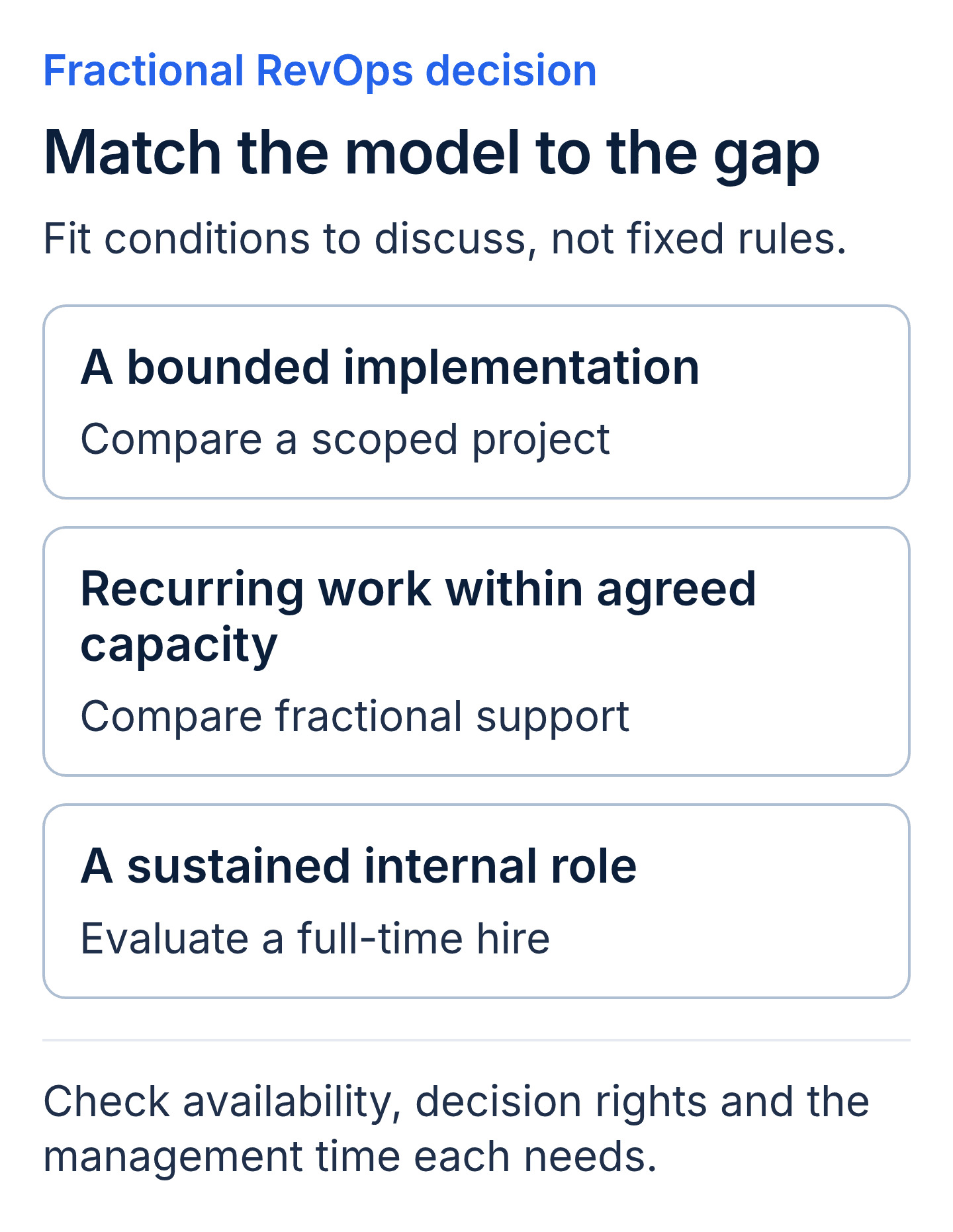
Use the workload and authority required to compare engagement models. Verify the availability and responsibilities in the actual proposal or role.
Define fractional RevOps responsibilities and decision rights
Turn the inventory into a responsibility map. For each task, name the person who performs it, the business owner who approves the result and the person who takes over if the primary contributor is unavailable.
Useful categories include backlog prioritization, CRM administration, report definitions, data quality review, release coordination and process documentation. Include meetings and stakeholder support if they consume the capacity you expect to buy.
Distinguish permission to access a system from authority to change the business process. A provider might have the technical ability to edit a field while still needing approval to change its meaning.
According to Salesforce's data security guidance, access can be controlled at organization, object, field and record levels. For a proposed field edit, identify the required permissions and the business approver separately. The permission allows a system action; the responsibility map records who may authorize the change to the business process.
HubSpot's lifecycle stage documentation explains that lifecycle stages track contacts and companies through a process. It places lead status sub-stages within the Sales Qualified Lead stage. For reporting ownership, name who defines the stages, who configures them and who approves changes. Review the account's existing definitions before editing a report or handoff that depends on them.
The revenue operations alignment guide provides broader context. Your agreement should still assign each responsibility to an actual person or team.
Evaluate fractional RevOps services by availability and coverage
Ask who will do the work and when that person is available. Specify routine working sessions, expected response windows and how urgent requests are handled. Identify which time zones and business hours the arrangement covers.
A response commitment should explain what the response means. Acknowledging a request, starting investigation and resolving the issue are different events. Confirm the intended meaning before relying on it for a critical operational process.
Ask about absences and competing commitments without assuming a particular staffing model. A provider may use one named contributor, a shared team or specialists brought in for agreed work. Confirm which arrangement applies and how handoffs between contributors are documented.
Separate planned improvement work from operational interruptions. If urgent reporting requests consume the available capacity, decide who reprioritizes the backlog and how unfinished work moves to the next period.
A provider and an internal administrator can work together. Define their actual division of work rather than assuming one owns strategy and the other performs routine tasks. Either party may hold specialist knowledge or decision authority, depending on the agreement.
Twelverays' revenue operations service describes Salesforce and Dynamics 365 work across implementation, integrations, workflows, reporting and training. Discuss the recurring responsibilities you need and confirm the availability and engagement model in the proposal.
Compare fractional RevOps cost using your own inputs
Use actual provider quotes and internal hiring estimates over the same planning period. Keep confirmed amounts separate from assumptions. The result should show the cash commitment, internal time and coverage each option provides.
The U.S. Bureau of Labor Statistics reported that benefits accounted for 30.1% of total employer compensation costs for U.S. private industry workers in March 2026. Its June 12, 2026 release covers many occupations. This aggregate is background for including benefits in the comparison; it does not estimate the cost of a RevOps hire or a Canadian role. Request the actual wages, employer-paid benefits and payroll costs for your proposed position instead of applying that percentage as a standard salary markup.
| Cost input | Fractional arrangement | Full-time hire |
|---|---|---|
| Direct compensation or fees | Quoted recurring fees and separately scoped work | Planned compensation and employer costs |
| Recruitment and onboarding | Provider selection, access and context transfer | Recruiting, onboarding and training |
| Internal coordination | Sponsor, approvals and working-session time | Management, approvals and cross-team coordination |
| Tools and access | Required seats and services, with payer identified | Required seats and services, with payer identified |
| Coverage gaps | Work excluded from schedule or capability | Work outside role capacity or capability |
| Transition | Contracted notice and handover work | Internal transition and replacement planning |
Do not assume a fractional provider starts sooner or costs less. Verify the proposed start date, onboarding needs and actual scope. A full-time hire may cover work that a narrow retainer excludes; a provider may supply specialist capacity that your planned role does not include.
Estimate the cost of leaving work uncovered separately. For example, measure the internal hours spent rebuilding a report or handling repeated assignment errors. Label these as your observations or estimates, not guaranteed savings from either option.
Avoid double-counting. If an internal employee's time appears in coordination costs, do not count the same hours again as an independent overhead item. If a fee includes tool access, verify that before adding another license line.
Review the comparison when the workload or quote changes. You are comparing a defined set of responsibilities at a particular point in time, not establishing a permanent winner.
Run a first operating cycle with acceptance evidence
Agree the first review period and the work that fits within it. The duration should follow the agreement and your operating needs; there is no universal cycle length.
Start with an inventory of systems, existing documentation and recurring obligations. Rank the backlog with an internal sponsor. Select a manageable set of tasks and record what completion means for each.
For example, a reporting task might be complete when the owner approves the metric definition and the report reconciles to an agreed sample. A routing task might require normal and exception cases to reach the correct destination. A documentation task might require the internal administrator to follow the instructions without assistance.
Salesforce's change-planning guidance describes a deployment run list as recording "any manual changes required in the org pre- and post-deployment." When the engagement includes Salesforce releases, request the applicable run list and identify who performs its steps, verifies completion and authorizes production changes. These responsibilities should appear in the proposed scope.
Keep a decision log alongside the backlog. Record why priorities changed and who approved the change. This helps explain the use of capacity when urgent work displaces planned improvements.
At the review, compare the accepted work with the agreed responsibilities and available capacity. Discuss unresolved issues, internal dependencies and the next period's priorities. A productive review can lead to more capacity, a narrower scope, a specialist project or a different staffing model.
Plan continuity and a usable exit
Agree where documentation, approved process definitions and work records will live. Your organization should be able to access the material it needs to operate the delivered work, subject to the ownership terms you negotiate.
List the accounts, connections and scheduled processes that depend on the contributor. Avoid leaving an important workflow undocumented or tied to an identity that will disappear without a transfer plan.
Include an exit checklist covering open work, current risks, operating instructions, access changes and the receiving owner. Specify the handover period and any associated fees in the agreement.
Test continuity while the engagement is active. Ask an internal owner to locate a metric definition, explain a recent configuration decision and follow the documented exception process. Gaps found during that exercise can be repaired before a transition becomes urgent.
The CRM adoption guide can help prepare the people who inherit routine responsibilities. Documentation and training should match those tasks, not simply describe the tools.
Fractional RevOps buyer FAQs
When does fractional support fit?
It can fit recurring work that can be covered within the proposed capacity, skills and availability. Confirm how decisions and urgent requests will be handled. A defined one-time build may be easier to buy as a project, while extensive continuing duties may justify evaluating a permanent role.
Can a fractional provider act as a leader?
Yes, where the agreement and your organization grant appropriate responsibilities and authority. The word fractional does not automatically provide or exclude leadership. State which decisions are delegated and which remain with an internal sponsor.
Can the provider work with our administrator?
Yes. Map configuration, data, reporting and approval responsibilities explicitly. Agree how both contributors share documentation and communicate changes. Do not assign work based on assumptions about which role is more strategic or technical.
What should the agreement contain?
Name the scope, contributors, availability, fees, dependencies, approval rights, support arrangements and review cadence. Include how new work is estimated and how the engagement ends. Ask for examples of the evidence you will receive for completed work.
When should we revisit a full-time hire?
Revisit the decision when recurring demand, required availability or leadership needs materially change. Use the actual backlog, internal coordination effort and coverage gaps. The decision should follow the work and your organizational needs rather than a generic headcount threshold.
How should we compare cost without salary benchmarks?
Use the provider's quote and your internal hiring estimate over the same planning period. Include employer costs, tools, coordination and transition work once each. Show excluded responsibilities alongside the totals so the cheaper option does not appear to cover work it leaves unassigned.
Terms to agree before you sign
Buyer glossary
Capacity: The time and capability available for the agreed responsibilities.
Availability: The agreed hours, working windows and response arrangements during which that capacity can be used.
Coverage: The responsibilities and situations assigned to a contributor or backup, including what happens during absences and urgent requests.
Response commitment: The agreed timing and content of a provider's reply, such as acknowledgement or an initial assessment.
Resolution: The point at which a reported issue meets agreed closure conditions. Receiving an initial reply does not establish resolution.
Decision rights: Authority to approve a process, priority, expenditure or system change.
Backlog: The prioritized list of requested work, including owners and completion conditions.
Acceptance evidence: The artifact or observed check used to confirm that a deliverable meets its agreed completion conditions.
Review cadence: The agreed schedule for assessing completed work, unresolved dependencies and the next set of priorities.
Handover: Transfer of the documentation, access and operational knowledge needed for another owner to continue the work.
Key takeaways
- Compare hiring models against the same responsibility list.
- Confirm the contributor, schedule, coverage and approval rights.
- Calculate costs using actual quotes and internal estimates.
- Review completed work against explicit acceptance evidence.
- Keep documentation and transition arrangements usable throughout the engagement.
Discuss the recurring work you need covered
Bring your backlog, current team responsibilities and availability requirements when you contact Twelverays. Use them to assess whether recurring support, a scoped project or another staffing arrangement fits the work.


