What an AI Automation Agency Does (and How to Choose One)
An AI automation agency is a firm that designs and builds systems using AI to run your repetitive work, not just move data between apps, but read, decide, and act inside your processes. Unlike a traditional business automation agency, it handles judgment, which is the difference between a rule-based script and a workflow that adapts.
AI automation is the use of AI models to read, decide, and act inside business processes. Traditional automation follows fixed rules: if this, then that. It breaks the moment reality gets messy. AI automation adds judgment, so the system can read an unstructured email, decide what it means, and route it correctly, the kind of work that used to need a person. An AI automation agency builds those systems on your stack and, crucially, keeps a human in control of what matters.
What Is an AI Automation Agency?
Asking "what is an AI automation agency" gets you a simple answer: a firm that builds AI-driven workflow systems for businesses. It combines process design, AI models, and integration to automate work that rule-based tools cannot handle alone.
An AI automation agency is a specialist firm, and the category is new, so the label is loose. Process design is the discipline of mapping how work actually flows before any tool touches it. The real ones do three things together: they map your actual process, they apply AI where judgment is needed, and they integrate the result into the tools you already run. A shop that only does one of those, just the AI, or just the integration, leaves you with a piece instead of a working system. The strongest engagements treat automation as an operations problem first and a technology problem second, which is the core of AI operations design.
What Do AI Automation Agency Services Cover?
AI automation agency services span a process audit, workflow design, AI integration into your existing tools, and the guardrails that decide what runs automatically versus what a human approves.
AI automation agency services are the audit, design, integration, and guardrail work that turns AI into running operations. In practice the work starts with a process audit, not a tool. Where does your team spend hours on repetitive tasks that still need a bit of thought: triaging support tickets, processing invoices, qualifying leads, routing documents. Those are the targets. The agency designs an AI workflow for each, connects it to your CRM, inbox, or finance system, and defines the guardrails. Guardrails are the rules that decide what runs automatically and what a human approves, so the AI acts within limits and escalates the edge cases. That governed handoff between automatic and human is the whole point, and it is what separates real workflow automation from a bot that goes rogue on the first unusual input. An automation marketing agency is a firm focused on campaign plumbing; an AI automation agency covers operations end to end.
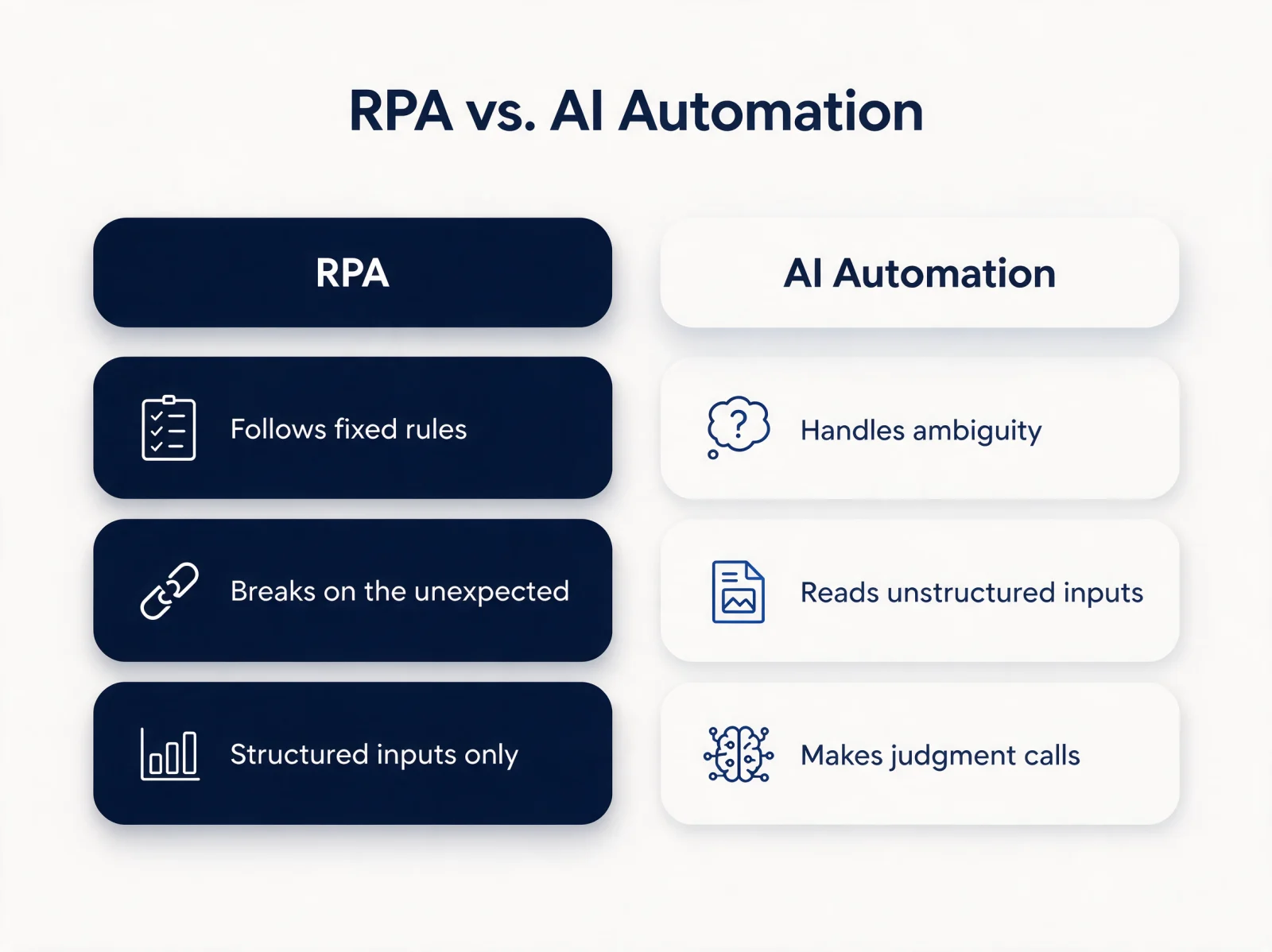
RPA follows fixed rules. AI automation handles judgment.
How Is It Different From RPA or a Traditional Automation Vendor?
RPA follows fixed rules and breaks on anything unexpected. AI automation handles ambiguity, reading unstructured inputs and making judgment calls, so it covers the work RPA never could.
Robotic process automation is scripted software that clicks through screens on fixed rules. Desktop RPA tools, like Power Automate's desktop flows, are powerful for stable, structured tasks and brittle everywhere else, because it cannot handle a form that changed or an email phrased a new way. AI automation reads the messy input, interprets it, and decides, which is exactly the work that used to require a person and defeated older tools. The scale of that opportunity is why the category exists at all: McKinsey's foundational automation research estimated that roughly 50% of current work activities could technically be automated with existing technology. A good agency knows when plain RPA is still the right, cheaper answer and when AI earns its place. The same judgment shows up in AI agents for CRM: the value is matching the technique to the task, not applying AI to everything.
Approach | Handles | Breaks on |
|---|---|---|
RPA scripts | Stable, structured tasks | Anything unexpected |
Business automation agency stack | Rule-based workflows across apps | Judgment calls, messy inputs |
AI automation | Unstructured inputs, decisions | Nothing silently: it escalates |
What Should You Automate First?
Start with high-volume, repetitive work that still needs light judgment and has a clear right answer. Support triage, invoice processing, and lead qualification are common first wins because the value is obvious and the risk is contained.
The right first automation is a boring one, on purpose. You want a process that runs constantly, wastes real hours, and has a definition of "done right" you can check against. The math is simple: 20 people spending 5 hours a week on manual routing is 100 lost hours, every week. That combination makes the payoff easy to prove and the risk easy to contain. Avoid starting with your most complex, highest-stakes process, that is where a wrong call is expensive and trust is hardest to earn. Prove the model on a contained win, then move up. If you are weighing where AI fits across the business, an AI operations audit surfaces the ranked shortlist.
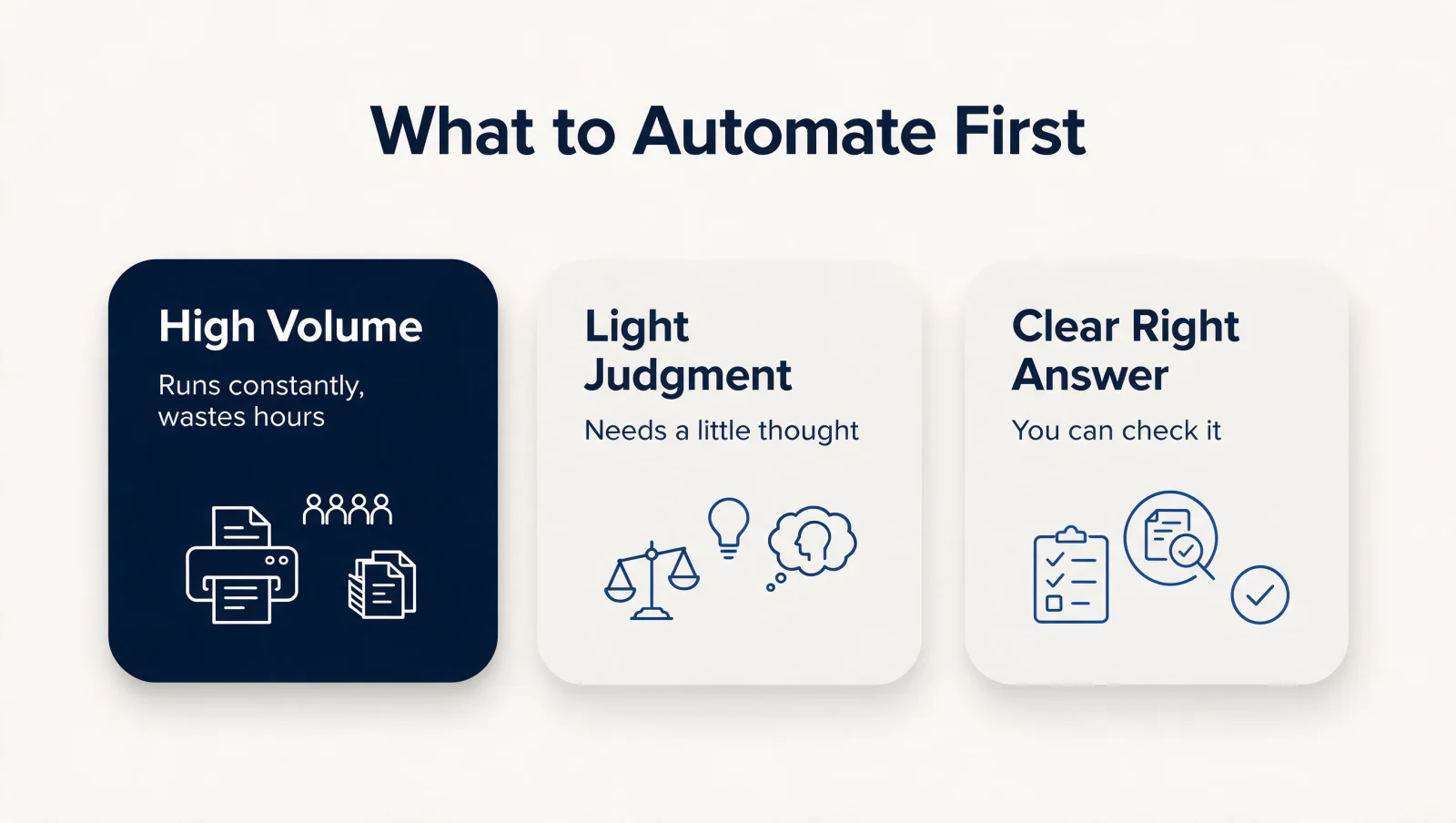
Automate high-volume, judgment-light work with a clear right answer.
How Do You Choose an AI Automation Agency?
Judge them on process understanding, integration depth, and governance, not on the AI demo. Ask how they decide what to automate, how they connect to your systems, and how they keep a human in control.
The demo is the least useful signal. Any agency can show a slick automation on a clean example. The questions that matter:
How do you decide what is worth automating, and what is not?
How do you connect to the tools we actually run?
What happens when the AI is unsure: does it guess or escalate?
How do we measure that it is working?
Agencies that answer these with specifics understand that automation is an operations discipline. The ones that only want to talk about the model are selling the easy 20%. The same filter applies when you choose an AI consulting company of any kind, and it applies double to an AI automation agency for small businesses, where there is no slack budget for a failed build.
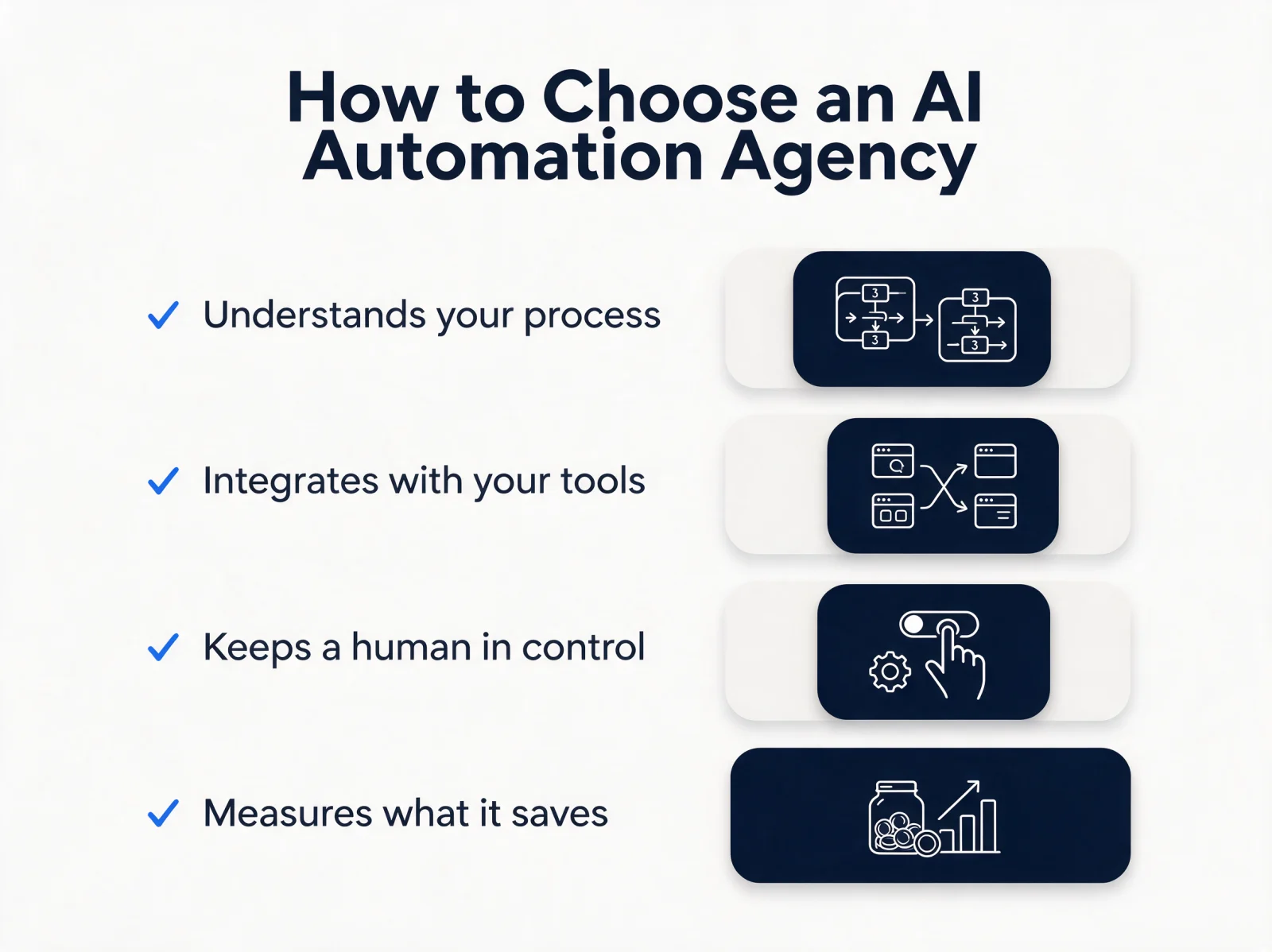
Judge on process, integration, and governance, not the demo.
What Does a Good Engagement Look Like?
Narrow first, measured throughout, expanding on proof. A good agency ships one governed automation, shows the hours and errors it saved, then widens the scope one process at a time.
The healthy shape
The engagement opens with an audit that ranks opportunities by value and risk. It ships the first automation on a contained process, with clear metrics for time saved and accuracy. It proves that number, earns trust, then expands. In our own engagements at Twelverays, the automations that stuck were the ones that shipped a measurable first win inside the first month.
The failure shape
What it does not do is try to automate everything at once or disappear into a six-month build with nothing running. Speed comes from controlling scope, not from cutting the governance that keeps the automation safe. As an OpenAI and Anthropic partner, Twelverays builds these systems on the models that fit each task, on the stack you already run, the same discipline that governs our broader generative AI consulting work.
How Long Does an AI Automation Project Take?
A first, focused automation on one process takes weeks, not months. Trying to automate everything at once is what turns these projects into open-ended builds that stall before anything runs.
Timeline follows scope, and scope is a choice. A single well-understood process, connect the source, design the workflow, set the guardrails, validate the output, is a matter of weeks to a working deployment. What blows the timeline is ambition without discipline: trying to model every process at once, which produces a long build with nothing live to show for it. The disciplined path ships one automation early, proves the hours it saves, and expands from there.
Key Takeaways
An AI automation agency builds systems that read, decide, and act on judgment-heavy work, beyond rule-based scripts.
AI automation agency services cover process audit, workflow design, integration, and human-in-control guardrails.
Unlike RPA or a traditional business automation agency, AI automation handles unstructured inputs and ambiguity.
Choose on process understanding, integration depth, and governance, not the demo.
Start with one contained, high-volume process and expand on proof.
Automating the Right Work on Your Stack
AI automation is not about replacing your team with bots. It is about handing the repetitive, judgment-light work to a governed system so your people do the work that needs them. The wins come from picking the right processes, integrating cleanly, and keeping humans in control of what matters.
Twelverays designs and builds AI automation on the systems you already run, through our workflow automation and AI operations design practices. If your team is drowning in repetitive work, book a discovery call and we will map the first automation worth building.