

n8n consulting is professional work to assess, implement or repair automated business workflows using n8n. An n8n consultant should translate an agreed process into a working flow, explain its limitations and provide evidence your team can use to accept it. Compare n8n implementation services against those responsibilities, including the decisions about hosting, connected systems and operation after handover.
Choose one process to discuss first. A qualified enquiry might enter from a form, be checked against an existing customer record, reach the correct salesperson and receive an approved acknowledgement. Name the person responsible for that result and the conditions under which the process should pause for review.
Keep the platform decision separate. The n8n, Make and Zapier comparison provides broader context; this hiring decision concerns the delivery evidence and responsibilities for your selected workflow.
Give the n8n consultant a complete process boundary
Write down the trigger, source information, required checks, destination and confirmation of success. Identify each system owner and the actions their team must approve. Include the manual steps that should remain manual.
A customer relationship management (CRM) system may hold the destination record, but the workflow's outcome is the usable handoff. A successful technical response does not establish that the enquiry has the right owner or contains enough information for follow-up.
Prepare representative inputs under your organisation's approved data procedures. Include a routine enquiry, an existing customer, missing information and an intentionally excluded record. Agree what should happen for each before the consultant demonstrates a build.
Ask which requirements fit the proposed nodes and which need custom code, another service or a human decision. A node is a configured step in an n8n workflow. Its presence on a canvas does not establish that the connected system permits every action your process requires.
Discuss this process map when evaluating Twelverays workflow automation services. If the existing process is unclear, an automation audit can help define a separate assessment scope before implementation is estimated.
Compare n8n implementation services through acceptance tests
Give candidates the same test scenarios and ask what result they will record. Include the destination system in those checks. A completed n8n execution and an accepted business result are related, but they are not interchangeable evidence.
| Proposed test | Expected behaviour to agree | Evidence to inspect |
|---|---|---|
| Valid new enquiry | Required destination record and intended owner | Source reference, destination record and observed values |
| Repeated event | Approved handling without a duplicate business action | Matched event reference and resulting record count |
| Missing required value | Documented review or rejection path | Visible reason and accountable reviewer |
| Temporary destination failure | Bounded recovery or escalation | Failure record, attempted recovery and final status |
| Partly completed workflow | Previously completed actions identified before replay | Destination checks and authorised next action |
| Access failure | Appropriate error and escalation | Failure notice reaching the agreed owner |
Treat these as proposed acceptance cases. They are not a claim that n8n automatically supplies every safeguard or that every connected application supports the same recovery method.
For each scenario, identify the starting state, expected result, tester and approver. Use controlled failures that the system owners have authorised. Avoid disabling production credentials or sending customer communications merely to make a demonstration more realistic.
Include an operator in the review. Some failures can be handled through a documented business procedure; others need technical support. The contract should identify which tasks each role is expected and equipped to perform.
Ask n8n workflow automation consulting candidates about retries
A retry attempts an operation again after a failure. Before approving it, establish what the destination actually did. A request can time out after the receiving system has accepted the action, so blindly repeating it may create an unwanted second result.
Idempotency means that repeating the same intended operation has the same business effect as performing it once. For an enquiry handoff, ask how the design identifies the same event across repeated deliveries and prevents an unwanted duplicate destination action. The consultant should demonstrate the actual mechanism and its limits.
Distinguish a business event reference from an execution reference. A newly started run may have a new execution identity even when it processes the same enquiry again. Ask which identifier the design uses, how long the relevant record is kept and what happens when that lookup is unavailable.
Agree which errors merit another attempt, how attempts are bounded and when a person must investigate. A missing required field needs a different response from a temporary unavailable service. Repeating the same invalid input does not resolve the missing business information.
Define reconciliation after partial completion. If the customer record was created but the acknowledgement failed, the operator needs to confirm the first action before deciding how to retry the second. Ask for a safe recovery procedure and evidence that it was tested with the agreed destination system.
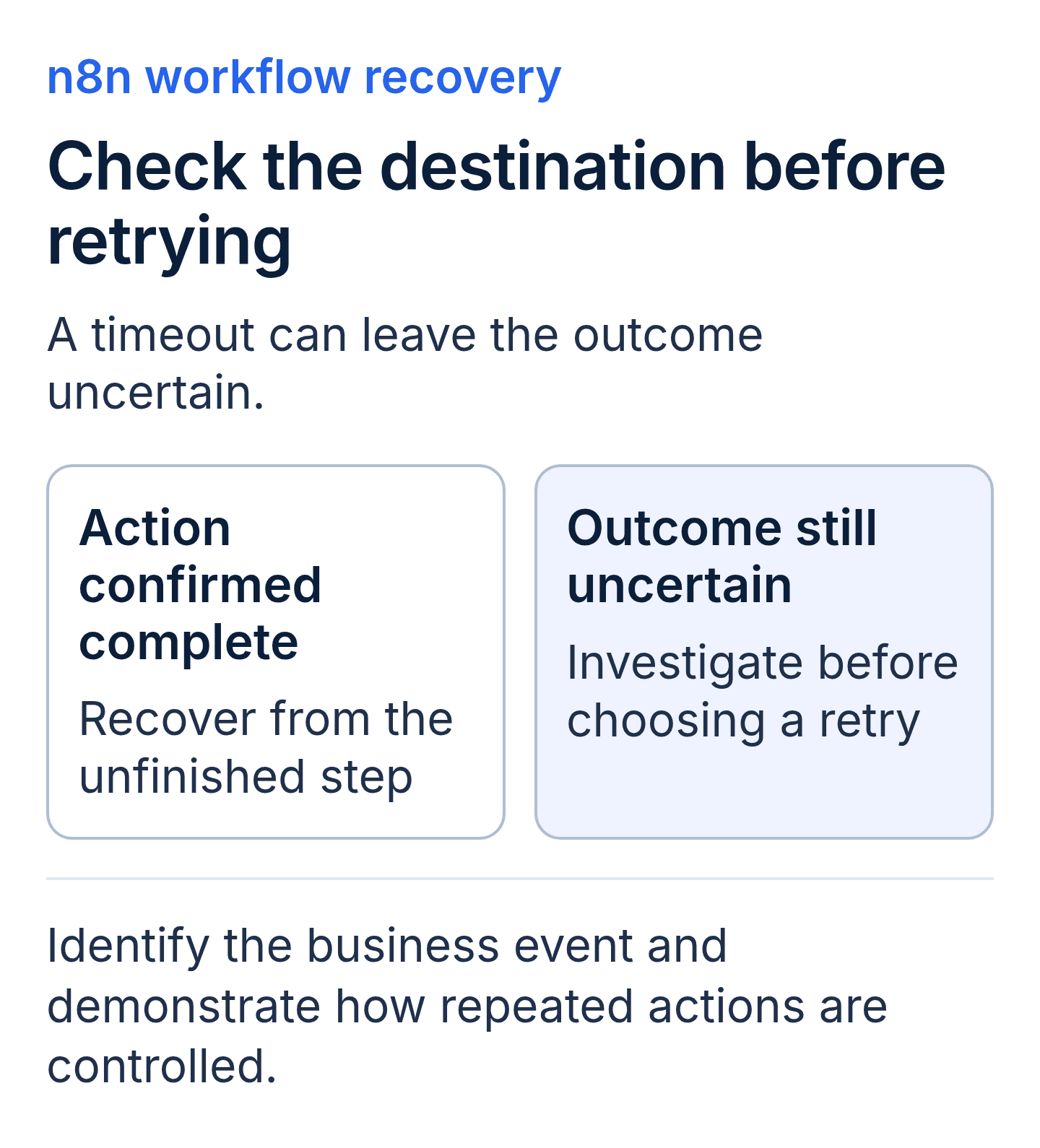
Proposed recovery questions for the consultant. Confirm completed destination actions before retrying, and require a tested procedure with bounded attempts.
Require n8n automation support to demonstrate the alert path
According to n8n's error handling documentation, a workflow can use a configured error workflow to respond when an execution fails. The documented error information differs when failure occurs in the trigger rather than a later step. Ask the consultant which failures the proposed monitoring covers and what information the operator will receive.
The Error Trigger documentation states that the Error Trigger runs when an automatic workflow errors, not when workflows are run manually. A manual failure demonstration therefore does not prove that the automatic alert path works. Include an authorised automatic test with controlled inputs and recipients in the acceptance plan.
Name the alert recipient, backup contact and route for technical escalation. Confirm who notices if the alert destination itself is unavailable. Set response expectations in the proposed support agreement according to the business need; do not infer a response commitment from the existence of an alert.
Ask which execution information is retained and how operators find affected records. Reconciliation compares the expected business actions with the results actually present in the connected systems. It should include missing actions, which may not appear as a convenient error message.
Name hosting, credentials and recovery owners
Ask the consultant to compare n8n Cloud with the proposed self-hosted arrangement against your requirements. According to n8n's hosting documentation, n8n can run on your infrastructure, on premises or in a private cloud. Self-hosted editions have different licensing arrangements. Verify the selected edition and capabilities rather than assuming self-hosting includes every available feature.
List the responsibilities that remain with the customer, consultant and hosting provider. Include account administration, infrastructure updates, backups, restoration, monitoring and connections to other systems. These tasks can be allocated through one agreement or several, but their owners should be clear.
An application programming interface (API) lets software exchange requests and data. Each connected application's permissions and limits still apply to the workflow. Have its owner approve the required access and confirm who handles a changed permission, expired authorization or replaced account.
For self-hosted recovery, include the credentials and their encryption configuration in the review. According to n8n's encryption key documentation, n8n uses an encryption key to encrypt credentials before storing them in its database. A recovery plan should account for that key as well as the required application data.
Request a restoration test appropriate to the proposed setup. Identify the material needed, who can access it and what the test proves. Store secret values through the customer's approved process. The operating guide should describe ownership and recovery steps without placing keys in an ordinary shared document.
Inspect the n8n workflow handover before closing the project
Request the approved process map, workflow files, configuration notes, test results, open exceptions and operating instructions. Record the n8n version and any custom nodes or external dependencies the delivered flow needs. Ask the intended support owner to review the package before acceptance.
According to n8n's export and import guidance, workflows can be exported as JavaScript Object Notation (JSON) files. The exported JSON includes credential names and identifiers, and HTTP Request nodes imported from cURL may contain authentication headers. Review the export before sharing it, and arrange any required credentials separately through approved access procedures.
A workflow file is therefore one handover artifact. It does not, by itself, prove that another environment has the required permissions, credentials or dependencies. If portability is part of the purchase, request a controlled import and test under the intended arrangement.
Have the operator use the guide to locate a failed run, identify its business impact and decide whether to retry or escalate. Document tasks that need a developer instead of assuming every nontechnical user should repair every failure.
Agree access removal when the engagement ends. Confirm which customer roles retain the ability to operate the workflow and how a replacement provider receives approved access. Avoid making ordinary operation dependent on an individual consultant's personal account.
Separate delivery scope from ongoing changes
A build and its ongoing operation need distinct responsibilities, even when both are covered by one agreement. Identify what the initial fee includes, any support period and the process for approving later changes.
Compare quotes using the same workflow boundary, tests and handover requirements. Ask what depends on discovery, customer decisions or access from another system owner. Show platform charges, infrastructure, third-party usage and internal effort separately from the consultant's delivery fee.
Distinguish a defect against the approved requirements from a new business request or an external application change. Ask how each is investigated, priced and approved. A support arrangement may include some categories and exclude others.
If the workflow includes an AI component, define that component's task, reviewed output and fallback separately. The AI workflow automation consulting guide covers that broader scope. Do not add an AI step simply because the selected platform can support one.
n8n consulting glossary
- Trigger: the event or schedule that starts the agreed workflow.
- Process boundary: the defined beginning, end and responsibilities of the work being automated.
- Acceptance test: a documented scenario comparing delivered behaviour with an approved requirement.
- Error workflow: a configured n8n workflow that responds to a linked workflow's qualifying failure.
- Runbook: the operating instructions for routine work, failures, escalation and recovery.
- Handover artifact: a file, record or access arrangement needed by the next operating owner.
Key takeaways
- An n8n consulting scope should define one complete business process and its accountable owner.
- Acceptance tests need to cover repeated events, partial completion and safely simulated failures.
- Automatic error alerts require an appropriate automatic test; a manual run alone is insufficient.
- Hosting, credentials, recovery and workflow handover need named owners and inspectable evidence.
n8n consulting buyer FAQs
Does an n8n consultant need to recommend self-hosting?
No. Ask for a recommendation based on the required capabilities, operating capacity and intended data flows. Compare the responsibilities and purchased features for each proposed arrangement. Self-hosting is a deployment choice that still needs funded administration and recovery ownership.
Can existing n8n workflows be repaired instead of rebuilt?
Ask the consultant to assess the current logic, dependencies, failures and documentation. A bounded repair may be appropriate when the required behaviour can be restored and tested. Request the evidence behind any rebuild recommendation and the acceptance criteria for either option.
What should n8n automation support cover?
Specify monitoring, investigation, safe retries, credential changes, updates and escalation as applicable. Assign each task to an owner and identify exclusions. The support agreement should state its coverage and charging basis; a platform feature does not establish a consultant's response promise.
What should we receive in an n8n workflow handover?
Request workflow files, dependency and configuration records, test results, open exceptions and an operating guide. Confirm the necessary account access and credential arrangements separately. Have the intended operator demonstrate the agreed tasks before treating the package as accepted.
Discuss one workflow with Twelverays
Bring a process map, representative inputs and examples of the handoffs or failures you need to resolve. Include the connected system owners and your intended support arrangement. Contact Twelverays to discuss n8n implementation scope, acceptance tests and the operating handover your team needs.


