

Salesforce managed services is an ongoing agreement for an external team to administer, support and improve your customer relationship management (CRM) environment. Choose a Salesforce managed services provider by comparing scope, support hours, change controls and total cost. For Salesforce admin managed services, ask each candidate to assess the same permissions request, automation change and reporting problem. Their proposal should name who does the work, how changes are tested and what your team must approve.
Define the Salesforce admin managed services scope
An org is your company's Salesforce environment. Its configuration, users and connected systems determine the skills your support team needs. Record the products you use, existing custom code, integrations and the internal staff available to review changes.
A backlog is the prioritized list of unresolved requests and proposed improvements. Turn those requests into a scope matrix. For each category, record the provider's role, your internal owner and the evidence required to accept the work:
| Work category | Provider work to specify | Buyer acceptance evidence |
|---|---|---|
| User administration | Authorized access changes and removals | Approval record and a check of the resulting permissions |
| Reporting | Agreed calculations, filters and report revisions | A business user's check against an agreed test case |
| Automation | Documented Flow changes and testing | Test results and approval before deployment |
| Backlog management | Estimates, priorities and dependencies | Accepted work and a named next action for open requests |
| Release preparation | Relevant change reviews and assigned testing | Completed checks, unresolved issues and follow-up owners |
These are categories to negotiate. They are not automatic inclusions in every contract.
Make the acceptance criteria specific. For a report revision, specify the filters, calculation and expected result for an agreed test case. Name the person who will check that result.
Define larger work explicitly too. A migration, integration or new application can be included, separately priced or handled under another statement of work. A statement of work is the document that specifies deliverables, responsibilities and acceptance conditions. The label "managed services" does not settle that boundary.
For a first deployment, use the Salesforce implementation guide to identify project milestones. Then agree how responsibility transfers into ongoing support.
Choose a Salesforce managed services provider for your backlog
Compare staffing choices against the work you have identified. A recurring external team can supplement an internal administrator; it does not require you to remove that role.
| Delivery model | Work to assign | Questions that establish fit |
|---|---|---|
| Internal administrator | User support, configuration and ownership of business context | Who covers absences and requests requiring specialist skills? |
| Project engagement | A defined migration, build or rollout | What are the acceptance milestones and post-launch responsibilities? |
| Recurring managed services | Agreed support capacity and continuing backlog delivery | Who prioritizes requests, performs the work and reports progress? |
| Internal admin plus external specialists | A split between daily administration and selected technical work | How are requests routed and conflicting changes prevented? |
Ask who will work on your account, which skills they bring and how substitutes receive context. Request a sample change record and support report with client information removed. Those artifacts help you assess the delivery process without relying on a sales presentation.
Agree how progress will be reviewed. A useful report distinguishes accepted changes, unresolved incidents and requests waiting for a decision. For each open item, ask for its age, owner and next step. Review reopened requests as well as completed ones. These records let you examine delivery quality and capacity before renewal without treating ticket volume as evidence of business value.
If requests involve lead ownership, lifecycle definitions or pipeline reporting, include the business decision owner. These are revenue operations decisions as well as configuration tasks. Your provider needs an approved process to implement, and your staff need a clear way to resolve disagreements.
Compare Salesforce managed services pricing on the same basis
First identify what the quoted fee purchases: a block of hours, named capacity, defined recurring deliverables or a combination. Record any limits attached to a support subscription. Do not assume every provider uses retained hours.
Retained hours are an agreed allocation of time within a billing period. If a proposal uses that model, ask whether meetings, testing, documentation and vendor coordination consume the allocation. Confirm how estimates become approved work and how the provider reports time used.
Compare the following commercial terms alongside the scope matrix:
- The initial commitment, invoice schedule and renewal notice period.
- The treatment of unused capacity and work that exceeds the allowance.
- The price and approval process for additional projects or emergency work.
- Any software, support-plan or third-party charges included in the quote.
Separate service fees from Salesforce subscriptions and other product costs, even when one supplier presents them together. Confirm who supplies each subscription, who invoices it and who controls renewal. The service agreement alone does not establish the purchasing route.
Request a written cost scenario using your own backlog and the quoted rates. Include an ordinary month and a month containing a larger change. This exposes differences in billable activities and capacity limits without relying on an invented market-average price.
Set Salesforce managed support services commitments
A service-level agreement (SLA) defines service commitments and how they are measured. Check the promised response action, coverage window, severity rules and escalation route together. A response target alone does not establish when the issue will be resolved.
Response time measures the period until the provider takes the response action defined in the agreement. Resolution time measures the period until the issue meets the agreed resolution criteria. Ask whether an automated acknowledgement counts as a response and whether a workaround counts as resolution.
Define severity using business impact. A failed lead-routing process and a request to rename a report need different handling. Record who assigns severity, who can escalate it and how the provider communicates progress when a dependency delays resolution.
Write coverage hours with a time zone and holiday calendar. For example, a service window ending at 5 p.m. Eastern ends at 2 p.m. Pacific. A California team working later needs a separate arrangement for that uncovered period. Confirm when the service clock runs and whether urgent escalation changes the response commitment.
Also identify the customer contact responsible for approvals and access. A provider cannot complete a change while waiting for a business decision, so the report should distinguish work underway from requests awaiting your team.
Review Salesforce application management services change controls
A sandbox is a separate Salesforce environment used for development or testing. Ask which environments the provider will use, what test data they contain and how changes move into production.
Salesforce's Plan for Changes to Your Org describes using sandboxes through development and testing, storing changes in source control, and tracking deployment activities. Use that guidance to ask for a delivery process appropriate to your org. It is not evidence that a particular agency follows one.
The National Institute of Standards and Technology (NIST) provides an independent reference for change control. NIST SP 800-53, control CM-3 calls for reviewing proposed configuration changes, recording approval decisions and retaining change records. It also addresses security and privacy impacts. Use those controls to frame your review questions; a proposal must supply evidence of its own process.
A Salesforce change record should connect the request, approval, test evidence and production decision. For a territory-routing change, require the owner to define the intended routing behavior first. The provider should identify affected rules and dependencies, estimate the work, and obtain approval. Agree on tests for valid territories, missing information and exceptions. A business user then checks the results before an authorized person approves production deployment.
Ask for the test record, deployment notes and a recovery plan appropriate to the change. Confirm who checks the result in production and who handles an unexpected effect. Source history helps explain a change; it does not guarantee that every data or configuration change can be reversed automatically.
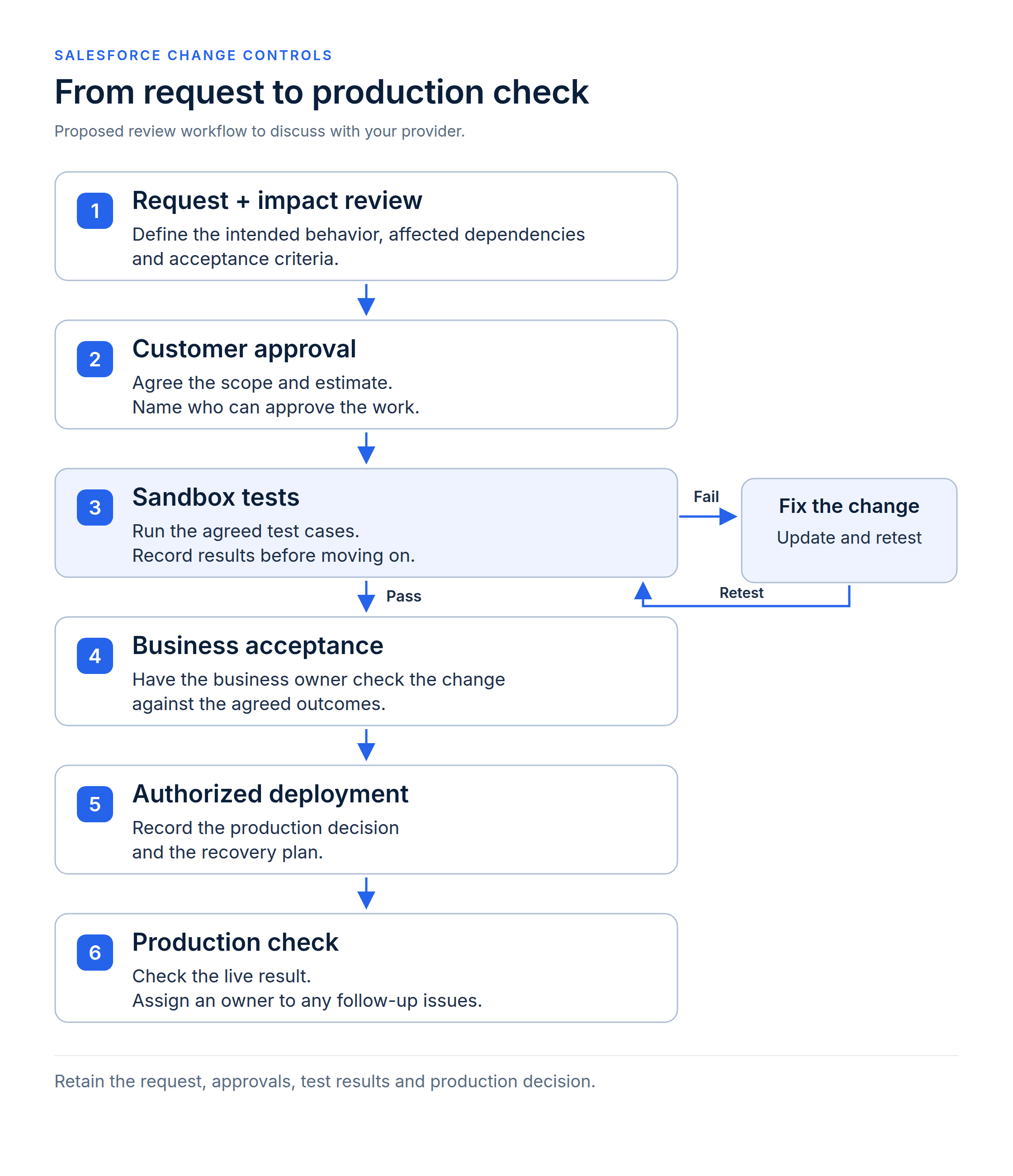
Proposed review workflow for a Salesforce change. Agree the owners and required evidence with your provider; failed sandbox tests return to fixing the change and retesting.
Legacy automation needs its own assessment. Salesforce's Workflow Rules & Process Builder End of Support notice states that customer support and bug fixes ended on December 31, 2025. Existing automation can continue running. Salesforce recommends migration to Flow Builder. Ask whether inventory, migration planning and testing are included in the proposal.
Match Salesforce Success Plans to the agency agreement
Salesforce's Success Plans comparison lists Standard, Premier and Signature plans. It states that all provide case and incident support, with operating hours and target response times varying by plan. Customers can also have different plans for different products. On September 7, 2026, the same page listed Premier at 30% of net license fees and described it as bundled with Unlimited Edition. Confirm the products, editions and entitlements on your order before adding a separate support charge to the budget.
Check your entitlements before buying additional support. Record the relevant product, Success Plan, support contacts and case-submission process. Then ask the agency to identify the administration and delivery work it is contracting to perform.
Avoid assuming that either agreement covers every responsibility. Have the proposal state who investigates an issue, who opens a Salesforce case, who supplies diagnostic information and who follows up. Confirm whether that coordination consumes paid capacity.
This division gives your staff a named owner when a problem involves both custom configuration and vendor support. It also lets you compare proposed work against support you already purchase.
Agree onboarding and exit deliverables
Start onboarding with an access inventory, open issues and a prioritized backlog. Confirm which accounts belong to your organization and the permissions each external user needs. Review these Salesforce security considerations when agreeing access and approval responsibilities.
Use the first approved change to check the working process. Review the estimate, test evidence, documentation and final acceptance together. Record any changes needed before assigning more work.
Specify the exit package before signing. Include configuration documentation, source files covered by your ownership terms, outstanding requests, deployment history and third-party dependencies. Confirm what the provider can transfer, the handover effort included in the fee, and any assistance that costs extra.
The UK Cabinet Office's Sourcing Playbook, section 13 recommends coordinating the outgoing supplier's exit with the incoming supplier's start. Its exit-plan checklist covers activities, responsibilities, timelines, dependencies and asset transfers. This public-sector guidance offers a useful planning reference; your agreement determines the obligations for your engagement.
Plan access removal and secure reassignment or rotation of credentials. Avoid treating a document containing passwords and keys as a complete handover. The incoming owner should verify access and identify missing information while the outgoing provider is still available under the agreed transition terms.
Buyer glossary: connect the terms to evidence
Use these definitions to check whether a proposal makes its commitments testable.
| Term | Meaning in the service proposal | Evidence to request |
|---|---|---|
| Acceptance criteria | Acceptance criteria are the agreed conditions a change must meet before your team accepts it. | An expected result, test evidence and a named reviewer. |
| Capacity | Capacity is the agreed availability of people or time for the contracted work. | The allocation, scheduling limits and approval route for additional work. |
| Exit package | An exit package is the agreed set of documents, files and open-work records transferred when service responsibility changes. | A transfer inventory with owners, dates and an incoming-owner review. |
Key takeaways
- A Salesforce managed services agreement should name the work, capacity, customer approvals and service hours.
- Comparable fees require the same scope, billable activities and contractual commitment.
- Response time, resolution time and coverage hours describe different support commitments.
- Each approved change needs acceptance criteria, test evidence and a named production approver.
- Onboarding and exit plans should identify access, documentation, open work and the people accepting the handover.
Salesforce managed services buyer FAQs
| Buyer question | Answer |
|---|---|
| Can we keep our internal administrator? | Yes. Assign the internal admin and external provider distinct responsibilities for user requests, technical approvals and the shared backlog. Match the division to your staff's capacity and the skills required. |
| What determines the monthly fee? | Evaluate quoted capacity, skills, service hours and included activities. Confirm how additional work is priced. Compare the same requests and support expectations, with subscription and third-party charges identified separately. |
| Are implementation and licenses included? | The proposal must identify project deliverables, software subscriptions and recurring support charges individually. The service name does not establish their inclusion, exclusion or billing route. |
| What should we receive when the agreement ends? | Agree transferable documentation, source files, access responsibilities and open work before signing. Include an incoming-owner review and outgoing-access removal. Ownership, licensing and transition terms determine the final package. |
Twelverays' Salesforce services cover CRM assessment, workflows, integrations, reporting and continuing refinement. Bring your prioritized backlog, current staffing and support expectations to discuss your Salesforce support scope. Those inputs give the conversation a concrete starting point for deciding what your team should retain and what to assign externally.


