

A Salesforce Pardot implementation configures Account Engagement and the marketing processes your team agrees to run through it. A useful account engagement implementation starts with a defined audience and sales handoff. Put the Pardot Salesforce integration scope in writing so the proposal explains which records move, which fields are mapped and who approves the result.
Account Engagement is the Salesforce marketing automation product buyers also know as Pardot. This guide concerns that product and its connection to Salesforce customer relationship management (CRM) records. Name the products and business units in the agreement; a reference to the wider Marketing Cloud portfolio does not establish what your rollout includes.
The buying decision is practical: can the partner deliver a tested prospect journey that your team can operate? Software access, connector setup, marketing assets, data preparation and ongoing campaign management each need an owner.
Define your Account Engagement implementation
Begin with a short description of the first journey you want to launch. For example, a prospect submits an approved form, receives appropriate follow-up and reaches the correct sales owner when agreed qualification criteria are met. Treat this as an illustrative scope, then specify your actual process.
List the business units, connected Salesforce environment, user roles and existing data involved. Identify whether the work starts from a new account or an existing configuration that must be assessed. An inherited setup may contain fields, automations and assets that affect the proposed journey.
Ask the provider to confirm the applicable setup prerequisites and product entitlements before committing to a design. Separate a feature available in your account from one that needs another subscription, configuration or integration. Avoid attaching a generic product feature list to the contract as if every item were included.
Twelverays' Salesforce service describes assessment and roadmap work across workflows, integrations and reporting. Bring your marketing-to-sales requirements to that conversation and confirm the proposed Account Engagement responsibilities explicitly.
A statement of work (SOW) should connect each deliverable to an observable acceptance condition. For a connector, that means approved records and field values moving as intended. For an email template, it means the agreed content, rendering and links pass review.
Document the Pardot Salesforce integration scope
A connector establishes technical communication. Your business still needs rules for record eligibility, identity, field values and ownership.
Salesforce's connector prework describes matching considerations, including CRM identifier matching for business units that allow multiple prospects with the same email address. Confirm the mode used by your account before designing deduplication or migration rules. Do not assume email address alone determines every relationship. Salesforce connector prework
Create a field and ownership map before configuration:
| Scope question | Decision to document | Acceptance evidence |
|---|---|---|
| Which records participate? | Eligible prospect population and exclusions | Included and excluded test cases |
| How are records identified? | Matching behavior for the actual connector setup | Existing and new record examples |
| Which values synchronize? | Field mappings and applicable sync behavior | Expected values on both sides |
| Who receives the handoff? | Approved assignment and follow-up responsibility | Correct receiving owner and visible task or record |
| How are exceptions handled? | Duplicate, missing-value and sync-error process | Named recovery owner and documented resolution |
Keep prospect qualification separate from the technical record relationship. A marketing-qualified lead (MQL) is a prospect marketing considers ready for sales under your agreed criteria. A sales-qualified lead (SQL) meets the sales team's qualification criteria. Those definitions need business approval before they become automation rules.
Specify how existing customers, repeat inquiries and prospects already associated with Salesforce records should behave. Do not assume a qualified prospect automatically creates an opportunity or that a sync setting implements your complete sales process.
For wider product context, the Salesforce Marketing Cloud overview can help frame the discussion. The signed scope should identify Account Engagement's particular role in your environment.
Build a Pardot implementation checklist for launch inputs
Implementation depends on work outside the configuration screens. List those dependencies with a named supplier, approver and required date.
Your asset inventory should include the forms, landing pages, email templates, lists and initial nurture logic you expect to use. State the number or specific names of the assets, required languages, revision allowance and approval method. "Set up marketing automation" leaves too much room for disagreement.
Agree who supplies copy, design files and approved sender information. Identify who can make domain configuration changes and who verifies the prerequisites for the sending and tracking setup. The implementation team should describe its required inputs in enough detail that your internal owners can prepare them.
Data preparation needs a similar boundary. Determine who reviews existing prospects, Salesforce records, duplicate candidates and obsolete field values. Agree the imported population and mappings before moving a large dataset.
Salesforce's connector setup guidance says existing Salesforce leads and contacts that are absent from Account Engagement do not automatically appear there simply because the connector is enabled; establishing that initial sync can require an import. Treat historical population setup as an explicit task with a reconciliation check. Salesforce connector enablement
Include the fields and controls needed to apply your approved communication preferences and suppression rules. Name the person who approves those requirements. Technical implementation should follow the agreed policy; testing a field or unsubscribe journey does not establish a legal compliance conclusion.
A practical checklist ends with readiness evidence: approved assets, approved record population, mapped fields, required access, test cases and a launch decision owner.
Evaluate an Account Engagement implementation partner through tests
Ask a prospective partner to describe the tests it would run for your first journey. The answer should cover both expected behavior and exceptions.
Salesforce's configuration guidance covers custom field mapping and connector testing with existing and new records. Use those documented behaviors as a starting point, then add the business rules specific to your rollout. Salesforce connector configuration and testing
For each test, record the starting condition, action, expected result, observed result and approver. A screenshot is useful evidence only when the reviewer knows which behavior it demonstrates.
| Test case | What the business should verify |
|---|---|
| New eligible prospect | Required values arrive and the agreed record path is followed |
| Existing Salesforce record | Matching and field behavior agree with the approved configuration |
| Excluded or suppressed prospect | The record does not enter an inappropriate campaign or handoff |
| Conflicting field values | The documented sync behavior produces the expected result |
| Failed or delayed sync | An owner can identify the exception and follow the recovery process |
| Marketing-to-sales handoff | The receiving user can see the information needed to act |
Use controlled test records and an approved test audience. Keep live campaign activation behind an explicit go-live decision. Salesforce documents that the Salesforce-Account Engagement connector is created paused and must be configured and unpaused; selective syncing arrangements should be considered before that step. Salesforce connector activation guidance
Have marketing and sales users participate in user acceptance testing (UAT). The administrator can confirm configuration behavior, while business users confirm that the result supports the intended task. Both perspectives belong in acceptance.
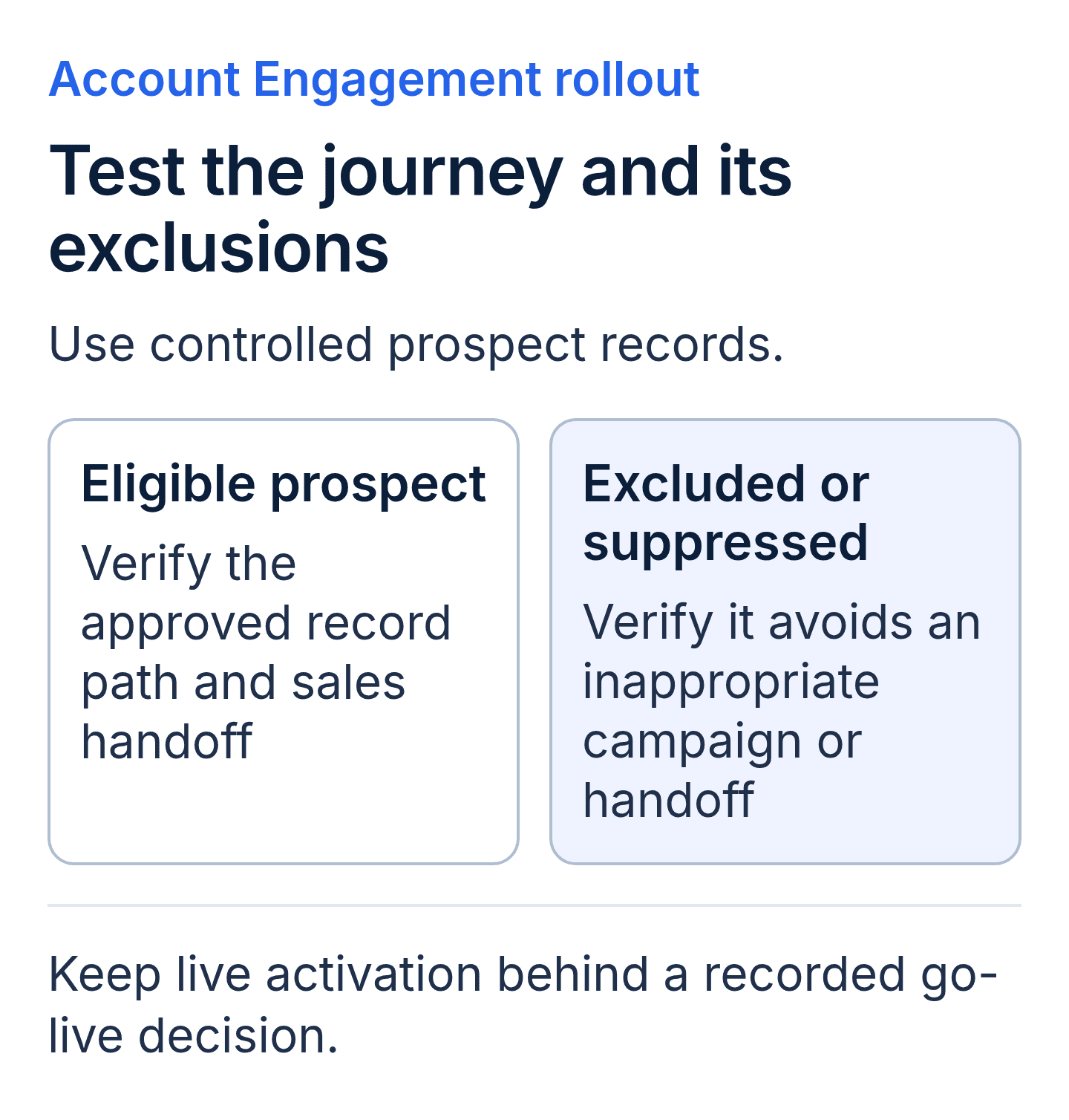
Proposed acceptance cases for the first journey. Record the starting condition, expected result, observed result and business approver.
Plan the cutover and the first operational checks
The launch plan should identify who authorizes activation, when it occurs and who watches the initial results. List dependencies that must be satisfied beforehand, such as approved assets, completed testing and the intended data population.
Ask how the team will pause affected campaigns or sync activity if the launch exposes a problem. The recovery method depends on what has already happened. Stopping future messages, for instance, does not recall an email already sent.
Define a small set of post-launch checks. Review the expected record population, failed or delayed transfers, assignment results and the visibility of agreed reporting. Use an agreed observation period and owner rather than assuming that a successful setup screen proves the journey is working.
Record discrepancies with enough detail to reproduce them. Distinguish an observed configuration defect from a newly requested business behavior. The contract should explain how each is triaged and approved.
This is also the point to verify that internal users can perform routine tasks without the implementation partner. Have them locate a prospect, explain its status, identify an exception and find the relevant operating instructions.
Compare Salesforce Pardot implementation handover terms
The handover package should make the delivered setup understandable to the people who inherit it.
Request the configuration record, field map, asset inventory, completed test log and open-issues list. Include access ownership, the documented activation decision and the process for support requests. Your team should receive usable copies rather than depend on a supplier's private project workspace.
Training should name the tasks covered and the intended users. Running a campaign, editing an approved template and diagnosing a sync issue require different knowledge. Confirm which tasks belong to your administrators, marketers, sales users and external support team.
Separate the commercial components when comparing proposals:
- Software subscriptions and any required additional products.
- Initial configuration and connector work.
- Asset production and revision.
- Data preparation or migration.
- Training, post-launch support and ongoing campaign operations.
Ask for the assumptions behind each estimate. An uncertain data-cleanup effort should carry an explicit assessment dependency. A support allowance should state its period, included work and response arrangements.
Define a delivery defect using the accepted requirements and the agreement's correction terms. Do not assume that every post-launch issue is included or that every later request is automatically chargeable.
For work beyond the initial rollout, the automated lead nurturing guide provides context for designing and maintaining follow-up programs. Decide separately whether that ongoing work belongs in the engagement.
Salesforce Pardot implementation buyer FAQs
Is Account Engagement the product formerly known as Pardot?
Yes. Buyers and older material still use Pardot, while current Salesforce setup documentation uses Account Engagement. Confirm the product, account configuration and business units in the proposal so everyone is discussing the same environment.
Does connecting Salesforce complete the implementation?
No. The connector is one component. Your rollout may also require approved field behavior, data preparation, marketing assets, qualification rules, testing and an operational handover. Name those deliverables individually.
Who decides when a prospect is ready for sales?
Your marketing and sales stakeholders should agree that rule. The implementation partner can configure and test it within the approved design. Assign a business owner who can resolve disagreements about qualification and follow-up.
Should all existing records be imported at launch?
Only the approved population should be included. Review identity matching, exclusions, field mappings and communication preferences first. Use a representative test and reconcile the result before approving a wider import.
What makes a proposal ready to sign?
It identifies deliverables, dependencies, responsible people, acceptance evidence and change terms. It also explains what happens after launch. Resolve unknown product entitlements and record-scope questions before treating the estimate as a committed delivery plan.
Terms to clarify with your partner
Connector: The configured connection through which supported information synchronizes between systems.
Field mapping: The relationship between fields on each side of that connection, together with the applicable value-handling rules.
Suppression: Rules that exclude a record from specified communications or activity.
Cutover: The controlled transition from preparation and testing to the approved live process.
Key takeaways
- Identify the Account Engagement environment and first prospect journey.
- Approve record eligibility, matching, field behavior and sales ownership.
- Assign responsibility for assets, data preparation and launch prerequisites.
- Test expected and exception paths before activation.
- Accept documentation, training and explicit support terms at handover.
Bring the handoff requirements to the scoping call
Gather your prospect stages, existing assets and Salesforce requirements before you contact Twelverays. Use that material to agree the Account Engagement implementation scope, test evidence and responsibilities your proposal should contain.


