Key Takeaways
- The best Salesforce certification is the one that matches the job you already have or the job you are chasing next, not the credential with the flashiest name.
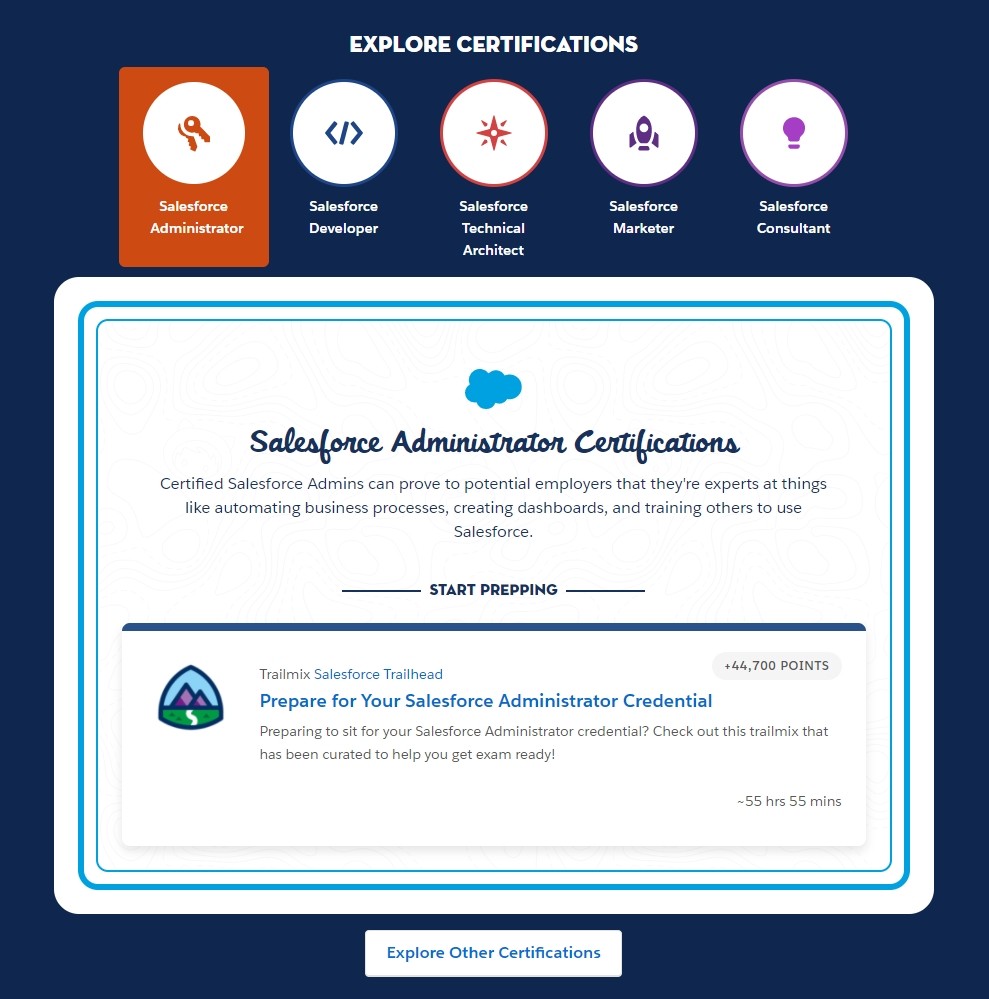
- The Salesforce admin certification is now called Platform Administrator, and it is the prerequisite nearly every other Salesforce track builds on.
- A Salesforce Trailhead certification is earned entirely through Trailhead Academy today, since Salesforce retired the old Webassessor registration platform on July 21, 2025.
- The best Salesforce certification to get is increasingly an Agentforce or Data Cloud credential in 2026, since AI skills carry the clearest salary premium in the current market.
- Which Salesforce certification pays the most is not a matter of opinion: Architect-tier and Certified Technical Architect credentials post the highest ceilings in every salary survey.
- The Salesforce associate certification is now named Platform Foundations, and it is the lowest-stakes way to test your interest before you commit to a full Administrator track.
What Is the Best Salesforce Certification? Certification Overview
A Salesforce certification is proof that you can operate one of the biggest CRM (Customer Relationship Management) platforms on the market. It is a fast way to signal expertise to employers and clients.
Each credential maps to a specific job role. You learn platform best practices, configuration, business process design, requirements gathering, and custom development, depending on the track you pick.
Salesforce offers more than 40 active certifications across Foundations, Administrator, Developer, Consultant, Architect, and Marketing tracks. This guide walks the most useful ones and helps you choose the path that fits your career.
Pick a track, earn the credential, and build credibility in the ecosystem.
RELATED: What is Salesforce Used For?
Advantages of the Salesforce Admin Certification and Every Other Track
Certifications are flexible. You can prepare in a few weeks or a few months and control your own career path. Earn one credential or stack several over time.
More certifications can raise the salary or hourly rate you command. Salesforce roles span technical work (architects, developers, and application experts), marketing, and sales. Each role demands a different depth of platform knowledge.
The pay reflects that demand. As of 2026, Salesforce Developers average close to $101,000 per year in the United States, per PayScale, with a typical range from about $71,000 to $139,000. Salesforce Administrators sit in a similar band: 2026 cross-survey data puts the national median near $92,000, with the middle range running $75,500 to $119,000 and top earners clearing $140,000. Even the administrator certification Salesforce professionals start with pays a real premium over no certification at all, though its ceiling sits far below the Architect tier.
Salesforce began as sales automation software. It now spans cloud products for sales, service, analytics, marketing, commerce, app development, and artificial intelligence, anchored by its Customer 360 platform.
The AI layer is the headline story in 2026. Agentforce, the platform for building and deploying autonomous AI agents, has reshaped how teams run customer operations on Salesforce. Skills in this area are in high demand.
You will find Salesforce in use across automotive, healthcare, nonprofit, retail, media, communications, and financial services. The platform serves businesses of every size, from small teams to global enterprises.
Salesforce also ships products beyond core CRM. Heroku is a platform as a service (PaaS) inside the Salesforce family. The Lightning Platform (formerly Force.com) lets you build and integrate custom apps with Salesforce. Marketing Cloud Account Engagement (formerly Pardot) handles business-to-business marketing automation. MuleSoft, Tableau, and Slack round out the portfolio.
RELATED: Salesforce Marketing Cloud: Features & Pricing
What Top Salesforce Certifications Cost and How to Register
Most Salesforce certification exams cost $200 USD, plus any applicable local tax. The entry-level Platform Foundations exam is $75. Retakes are 50% of the original price, so a standard exam runs $100 to retake. Architect-level exams cost $400, and the Certified Technical Architect (CTA) exam costs $6,000.
Here is how the fees break down by tier:
| Certification tier | Exam fee | Retake fee | Example credentials |
|---|---|---|---|
| Foundations | $75 | $37.50 | Platform Foundations |
| Core (Admin, Developer, Consultant, Marketer) | $200 | $100 | Platform Administrator, Platform Developer, Sales Cloud Consultant |
| Agentforce Specialist | $200 | $100 | Agentforce Specialist |
| Architect | $400 | $200 | Application Architect, System Architect |
| Certified Technical Architect | $6,000 | $3,000 | CTA review board |
Trailhead Academy is where every Salesforce, Tableau, MuleSoft, and Slack certification gets registered today, after Salesforce retired the old Webassessor platform on July 21, 2025. Book your exam through the Trailhead Academy exam catalog. You can sit most exams online with a proctor or at a testing center.
Every certification requires free annual maintenance. Complete the assigned Trailhead modules by each release deadline or the credential expires. Budget time for this, not just for the initial exam.
Salesforce training resources
There are three high-level ways to prepare for a Salesforce certification.
These are:
- Salesforce in-app guidance.
- Self-paced learning.
- Instructor-led learning.
Salesforce in-app guidance
- Salesforce's built-in app guidance. In-app guidance surfaces help prompts and tips on screen, so users learn components as they work.
Self-paced learning (online training)
- Trailhead is Salesforce's free learning platform. Work through modules, projects, and trailmixes at your own pace, and use the Trailhead GO mobile app for learning on the move.

RELATED: Becoming a Salesforce Consultant
Instructor-led learning
- Salesforce Trailhead Academy delivers in-person and virtual instructor-led classes worldwide. Pick a class and follow a structured path to build your Salesforce skill set.
RELATED: 10 CRM Implementation Steps for Company Success
- Third-party training. Plenty of independent instructors and platforms offer Salesforce courses. Vet them before you pay. Check that the instructor is certified, confirm the material covers the current exam, and read reviews. Free study guides and video walkthroughs are easy to find online, so use search to round out your prep.
The Salesforce Certification Tracks
Salesforce does not use associate, specialist, and professional tiers across the board. Instead, credentials map to job roles and tracks common among Salesforce professionals. In July 2025, Salesforce renamed 35 certifications to align titles with current products and roles, so the names below are the current official titles. Here is the current lineup, grouped by track.
Foundations and administrator
The administrator certification Salesforce candidates most often start with is Platform Administrator, the credential formerly named Salesforce Administrator.
- Platform Foundations (entry-level, 0 to 6 months of platform familiarity; formerly the Salesforce associate certification).
- Platform Administrator (for people who manage and configure Salesforce day to day; formerly Administrator).
- Platform Administrator II (advanced configuration, automation, and data management; formerly Advanced Administrator).
- Platform App Builder (design and build custom apps with the platform's declarative, low-code tools).
Architect
The Architect track covers the full spectrum of enterprise design. The titles below reflect the current names after the 2025 rename. The credential list is:
- Application Architect (deep command of native Salesforce features, plus role hierarchy, data modeling, and sharing design).
- System Architect (testing, governance, and integration with external systems).
- Technical Architect (broad expertise across development platforms, assessing customer architecture to design secure, high-performance solutions).
- Platform Data Architect (scalable, high-performing enterprise data design; formerly Data Architecture and Management Designer).
- Platform Integration Architect (end-to-end integration design on the platform; formerly Integration Architecture Designer).
- Platform Identity and Access Management Architect (scalable solutions that meet single sign-on (SSO) requirements).
- Platform Sharing and Visibility Architect (sound, scalable sharing and visibility design).
- Platform Development Lifecycle and Deployment Architect (release management and deployment solutions).
- Heroku Architect: architecting scalable solutions and managing apps and build workflows on Heroku.
- B2C Commerce Architect: global, multi-brand, multi-channel commerce sites using standard design patterns.
RELATED: Salesforce NPSP: Features & Pricing
Consultant
- Sales Cloud Consultant (design and implement maintainable, scalable Sales Cloud solutions).
- Service Cloud Consultant (the same for Service Cloud).
- Experience Cloud Consultant (formerly Community Cloud Consultant): implement and advise on Experience Cloud sites.
- Education Cloud Consultant: implement Education Cloud in customer-facing roles.
- Nonprofit Cloud Consultant: implement Nonprofit Cloud solutions.
- Field Service Consultant: configure and consult on Field Service operations.
- CRM Analytics and Einstein Discovery Consultant (formerly Einstein Analytics and Discovery, then Tableau CRM): data ingestion, security, and dashboard design.
Developer
- Platform Developer (build custom declarative and programmatic apps on the Lightning Platform with Apex; formerly Platform Developer I).
- Platform Developer II (advanced Apex, integration, and data modeling for experienced developers).
- JavaScript Developer (JavaScript fundamentals plus the Lightning Component framework and Lightning Web Components; formerly JavaScript Developer I).
- B2C Commerce Developer (build eCommerce solutions on Commerce Cloud).
- CPQ Administrator (formerly CPQ Specialist; implement the Salesforce CPQ solution for configure, price, quote workflows). This credential is retiring February 1, 2027, and the last day to register is July 24, 2026. Revenue Cloud Consultant is the natural next certification once you have CPQ fundamentals in place.
RELATED: Salesforce Costs & Pricing Plans
Marketing
Salesforce renamed Pardot to Marketing Cloud Account Engagement (MCAE) in 2022, and the credentials follow the new naming:
- Marketing Cloud Administrator: configure and maintain Marketing Cloud and handle common business requirements.
- Marketing Cloud Email Specialist: email marketing best practices, message design, subscriber and data management, and deliverability.
- Marketing Cloud Developer: hands-on Marketing Cloud development and configuration.
- Marketing Cloud Consultant: set up and implement Marketing Cloud for tactical and strategic campaigns.
- Marketing Cloud Account Engagement Specialist (formerly Pardot Specialist): build and run marketing workflows in MCAE.
- Marketing Cloud Account Engagement Consultant (formerly Pardot Consultant): implement MCAE solutions that meet customer requirements.
The AI Track: Agentforce
The newest and most in-demand track centers on Salesforce AI. The Agentforce Specialist certification (formerly the AI Specialist credential, renamed March 2025) validates your ability to build, configure, and deploy AI agents on the platform. The exam costs $200, runs 60 questions in 105 minutes, and requires a 73% score to pass.
If you already hold the Platform Administrator credential and want to stay ahead of where the ecosystem is heading, this is the track to watch. AI skills carry a clear premium in the 2026 job market.
Which Salesforce Certification Pays the Most?
Which Salesforce certification pays the most comes down to tier, not title. Architect-level credentials sit at the top of every salary survey, with the Certified Technical Architect as the ceiling: a $6,000 exam fee that reflects a multi-stage review board, not a multiple-choice test.
Niche cloud specializations form a strong second tier. Data Cloud is Salesforce's data unification layer, and CPQ, Marketing Cloud, and Data Cloud certifications all carry outsized demand relative to how few professionals hold them. That supply gap shows up directly in project rates.
Developer certifications also tend to start higher than standard Admin credentials. A Platform Developer typically enters the market at a stronger compensation point than a freshly certified Platform Administrator, reflecting the added technical complexity of the role.
None of this makes the Salesforce admin certification a weak choice. It is still the fastest route into a paying Salesforce role, and every Architect and Consultant path above it requires it as a foundation.
Which certification should you start with?
For most people, the Platform Administrator certification is the best first step. It is the fastest route to a Salesforce job, it teaches the platform fundamentals, and it grounds you in business processes before you specialize.
From there, your path depends on your goal. Aim for Platform Developer if you want to write code. Pursue a Consultant credential if you want to lead implementations. Target the Architect track for senior technical roles, or Agentforce Specialist to ride the AI wave. Map each credential to the job you want, then commit.
One scheduling note: Salesforce retires and renames credentials on a regular cadence. Salesforce renamed 35 certifications in July 2025, and it is renaming 16 more, effective July 24, 2026, the same day 24 certifications close to new registration ahead of their February 1, 2027 retirement. Check the current exam catalog before you register so you sit the right version.
For more, use the resources below.
If your team needs a certified partner to implement or scale Salesforce rather than build the skill in-house, see how Twelverays approaches Salesforce implementation.