

Most companies do not have an alerting problem. They have a 3am problem. The tooling detects things correctly, and then the detection sits in a console until somebody opens a laptop the next morning. Bitdefender MDR exists to close that specific gap, and this guide covers what the service actually includes, how its two tiers differ, and when buying it is the wrong move.
The service details below come from Bitdefender's own product and support documentation, checked August 2026.
Terms this guide uses
- EDR (endpoint detection and response) records what happens on an endpoint and gives an analyst the tools to investigate and respond. It supplies capability, not people.
- XDR (extended detection and response) correlates those endpoint signals with identity, network, cloud, and productivity telemetry so an incident is visible across the environment.
- MDR (managed detection and response) is a service: somebody else's security operations center watches, investigates, and acts on your behalf.
- SOC (security operations center) is the staffed team doing that watching, around the clock.
- Pre-Approved Actions (PAA) are the responses you authorize the SOC to take without calling you first. They are what turns 24x7 monitoring into 24x7 containment.
What is managed detection and response, and when you need it
Managed detection and response means somebody else's security operations center watches your environment, investigates what fires, and takes action inside agreed limits. It is not a product you install. It is a team attached to a platform you already run.
The distinction that matters for buying: EDR gives your people the ability to investigate. MDR supplies the people. If you have analysts, EDR is what they need. If your endpoint security is owned by an IT generalist who also handles the helpdesk and the printers, more console capability does not help, because nobody is looking at the console at 2am.
Bitdefender frames it the same way. Its documentation says modern EDR and XDR solutions require skilled analysts to continually monitor the environment, with an ever-increasing number of alerts and ownership of time-critical response workflows, and that MDR takes responsibility for those challenges.
The honest test is a single question: name the person who would act on an alert at 3am on a Sunday. If the answer is a name, you may not need MDR. If it is a job title, a rota that does not exist, or a pause, you do.
What Bitdefender MDR actually includes
Per Bitdefender's own service documentation, the base tier covers:
- 24x7 coverage from global SOCs. When an incident occurs, Bitdefender states its SOC will take action and a security account manager will call your emergency contact within 30 minutes, staying in communication throughout. That callback commitment is the most concrete thing on the page, and it is the number worth holding other providers against.
- Pre-Approved Actions. Analysts act inside limits you agree in advance, rather than waiting for you to answer a phone. This is the mechanism that makes 24x7 meaningful; without it, a SOC can only notify.
- Professional service onboarding, with their team guiding the setup rather than handing you a portal.
- Threat hunting, drawing on telemetry from what Bitdefender describes as hundreds of millions of covered endpoints.
- Incident root cause and impact analysis, with after-action reports and enhanced monitoring for 72 hours afterwards to catch related activity.
- Expert recommendations to improve posture, not just incident closure.
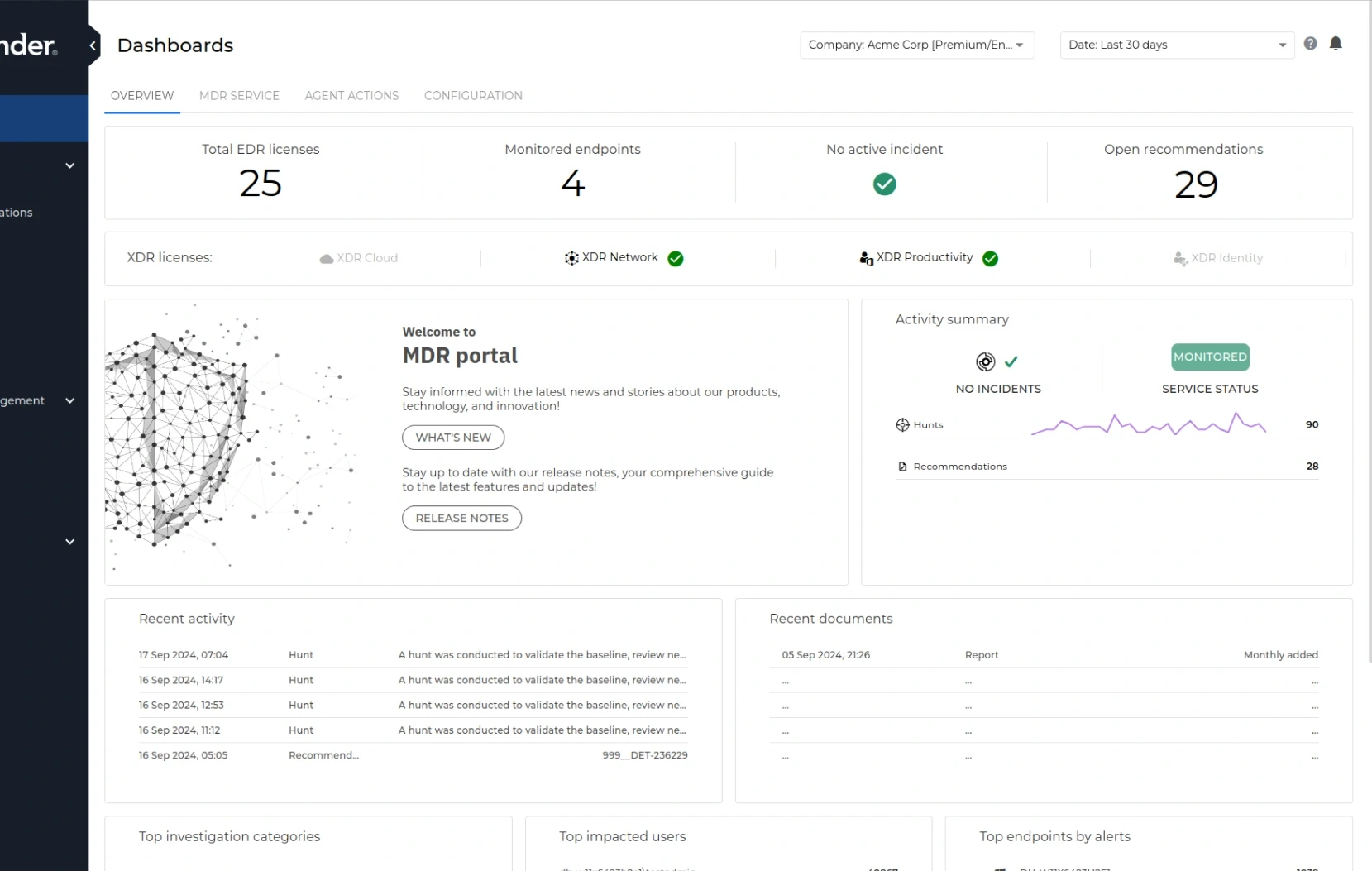
- The MDR portal, with dashboards and monthly reporting.
Bitdefender's SOC team is described as over 285 analysts, researchers, and threat hunters. Bitdefender also states it led participants for highest scored actionability with the least noise in the 2024 MITRE Engenuity ATT&CK Evaluations for Managed Services. Treat that as the vendor's claim about a named public evaluation, which is the right way to weigh any vendor citing its own results.
Bitdefender MDR vs Bitdefender MDR PLUS
There are two tiers, and the split is about intelligence and attention rather than about whether somebody watches your endpoints. Both tiers get the 24x7 SOC.
Bitdefender MDR is the base service, everything listed above.
Bitdefender MDR PLUS adds all of that plus:
- A dedicated 24x7 Security Account Manager as your single point of contact
- Dark web monitoring for leaked or stolen organizational data
- Global intelligence analysis
- Brand and IP protection
- High priority target monitoring, for the specific people in your organization most likely to be attacked
The pattern is clear once you see it. The base tier answers "is something happening in our environment". PLUS answers "are we being targeted, and is anything of ours already out there". That second question matters if you hold valuable IP, have named executives who are plausible spear-phishing targets, or operate a brand worth impersonating. For a 60-person manufacturer, it usually does not.
Both tiers carry a cybersecurity breach warranty, and the gap between them is the other reason to weigh PLUS. Bitdefender's MDR product page states the base service covers up to $100,000 in response expenses in the event of a ransomware event, at no additional cost. Its managed services page puts MDR PLUS at up to $1,000,000 in response expenses in the event of a cybersecurity incident, again at no additional cost. The trigger differs as much as the number does, so ask for the warranty terms in writing during scoping rather than taking them from any summary, including this one.
What happened to Bitdefender MDR Foundations
If you have been researching this for a while you will find references to Bitdefender MDR Foundations, and it is not one of the two tiers above. Bitdefender announced Foundations in July 2022 as a lower-cost service for organizations with limited resources, for managed service providers, and for their customers. Its current service documentation lists exactly two tiers: MDR and MDR PLUS. What is left of Foundations sits on the MSP side and in older material. Bitdefender's MDR page for managed service providers still carries an MDR Foundations video, the 2022 announcement and a 2023 MSP datasheet are still published, and Foundations SKUs are still listed in reseller catalogs.
The practical takeaway is to price against the current two-tier structure, and if a proposal quotes you Foundations, ask which document it comes from before comparing it to anything else.
Bitdefender MDR pricing: why there is no list price
Bitdefender publishes list pricing for its three self-serve GravityZone tiers. It does not publish MDR pricing, and that is not evasion. MDR is scoped rather than looked up, because the cost depends on endpoint count, environment complexity, which sensors feed it, and the tier.
What that means practically:
- You will get a quote, from Bitdefender directly or through a partner. Both routes exist, and MDR is quote-only either way.
- Compare against the real alternative, not against zero. The comparison is not MDR versus nothing. It is MDR versus the fully loaded cost of a person who can triage at 3am, which for genuine 24x7 coverage means more than one person.
- Check what the quote already covers. Bitdefender's own MDR FAQ says the service includes the underlying security platform, GravityZone Business Security Enterprise, so for the endpoints in scope the platform and the service arrive as one line item rather than two. Our pricing guide covers the platform side and our tier comparison covers which level you need for endpoints outside that scope.
The Bitdefender MDR portal and what you actually see
Buyers reasonably worry that a managed service means losing visibility. The MDR portal is where that concern gets settled, and it is worth asking to see it during evaluation rather than after signing.
It provides dashboards plus monthly actionable reporting covering security incidents, cybersecurity trends, and guidance for remediation. Two questions worth asking of that reporting, and of any MDR provider's:
Does the monthly report change what you do? A report that lists incident counts is a receipt. A report that names your three weakest configurations is a work plan.
Can you see what was done, not just what was found? With Pre-Approved Actions the SOC acts on your behalf, so the audit trail of those actions is the thing your auditors will eventually ask for.
Is Bitdefender a Russian company?
No. Bitdefender is Romanian, with corporate headquarters in Bucharest and a North American headquarters in San Antonio, Texas. Romania is a member of both the European Union and NATO. For MDR specifically, Bitdefender names three SOCs, in Texas, Romania, and Singapore, running follow-the-sun shifts.
This question comes up often enough to be worth answering plainly, and it is usually confusion with Kaspersky, which is Russian and which the US Commerce Department restricted in 2024. If your procurement or compliance function has a jurisdiction question, that is a reasonable diligence step, and the answer here is straightforward. Our migration guide covers the mechanics for teams moving off Kaspersky specifically.
When MDR is the wrong buy
Several situations where we would tell you not to buy it yet.
You have not fixed prevention. MDR responds to what gets through. If your estate is on a tier without policy control, or half the machines are unmanaged, buy coverage of the basics first. A SOC watching a badly configured estate generates work, not safety.
You already have a security team with after-hours coverage. Then you want EDR or XDR depth, not a managed service, and paying for both is the consolidation mistake we spend most of our time unwinding.
Nobody internally will own the relationship. MDR is not fire-and-forget. Pre-Approved Actions have to be agreed, escalation contacts have to be current, and somebody has to read the monthly report. Without an owner, you are paying for a service that phones a number nobody answers.
Your real problem is inventory. If you cannot say how many endpoints you have, start there. Our renewal guide covers why seat counts drift and how to fix them.
Questions buyers ask us
How is MDR different from just buying EDR? EDR is capability, MDR is capability plus the people who use it. Bitdefender's own framing is that EDR and XDR require skilled analysts continually monitoring and owning time-critical response, and MDR takes on that responsibility. If you have those analysts, buy EDR. If you do not, EDR alone tends to become an expensive alert feed.
Do we still need GravityZone licenses underneath? Not for the endpoints under MDR. Bitdefender's own FAQ says the service includes the underlying security platform, GravityZone Business Security Enterprise, alongside the monitoring and response. Endpoints outside the MDR scope still need their own licenses, so agree the covered list during scoping.
What can the SOC actually do without asking us first? Whatever your Pre-Approved Actions say, which is why that conversation during onboarding matters more than any feature list. Set them too tight and the service can only call you. Set them thoughtfully and containment happens inside those limits while you sleep.
How quickly do we hear about an incident? Bitdefender commits to a security account manager calling your emergency contact within 30 minutes of an incident. Make sure the contact on file is a person who answers their phone at night, because that single detail decides whether the commitment means anything.
Can we start with the base tier and move up? Yes, and for most companies starting at the base tier is right. The PLUS additions are largely about being targeted, and about the larger breach warranty, so buy them when that describes you rather than pre-emptively.
Do you cover the US as well as Canada? Both. We are a Bitdefender Reseller Gold Partner working with businesses across the United States and Canada, and licensing, deployment, and renewals run the same way in either country. That Gold status is what makes the pricing work: it opens deeper partner discounts across the GravityZone catalog, and that room goes into your quote.
How does this compare to the managed tiers from other vendors? Falcon Complete and SentinelOne's Wayfinder MDR solve the same problem, and all of them are quoted rather than listed. Our comparisons with CrowdStrike and Microsoft Defender for Business cover the platform economics underneath.
The short version
- MDR supplies the people, EDR supplies the capability. Decide which one you are short of.
- Two tiers: Bitdefender MDR, and MDR PLUS which adds a dedicated account manager, dark web monitoring, global intelligence analysis, brand and IP protection, and high priority target monitoring.
- The concrete commitment is a security account manager calling your emergency contact within 30 minutes of an incident, with enhanced monitoring for 72 hours after.
- Pre-Approved Actions are what make 24x7 more than a notification service. Scope them carefully.
- The breach warranty differs by tier: up to $100,000 in response expenses for a ransomware event on the base service, up to $1,000,000 for a cybersecurity incident on PLUS.
- MDR is quote-only. Compare it against the loaded cost of real after-hours staffing, not against zero.
- Do not buy MDR before prevention and inventory are in order.
- Bitdefender is Romanian, not Russian. The confusion is usually with Kaspersky.
Send us your endpoint count, what you run today, and an honest answer about who covers nights and weekends. We will scope the right MDR tier, confirm which endpoints the service license already covers, and price anything outside it at partner-tier rates, then tell you if the base tier is enough. We are a Bitdefender licensing partner serving Canadian businesses nationwide, with US coverage available, and Gold is a discount tier rather than a badge: it opens deeper partner discounts across the GravityZone catalog, and that room goes into your quote. Our guide to buying through a reseller explains what that does and does not change. Our Bitdefender Gold Partner practice in Canada covers how we run deployments, and the same operating-model thinking runs through our workflow automation practice.


