

The Mid-Market Scaling Trap: Why Manual Processes Are Stalling Your Growth
At a certain growth stage, every RevOps team hits the same wall. The processes that worked at $10M ARR quietly become the bottleneck that prevents reaching $50M. Business process automation services exist to close that gap, replacing ad hoc fixes with disciplined process automation management the whole revenue team can rely on.
The instinctive response is to hire. Another ops analyst. Another SDR coordinator. Another reporting specialist. But adding headcount to patch a broken process doesn't fix the process. It makes the broken process more expensive. This is the headcount trap, and it's one of the most common growth killers in mid-market revenue operations.
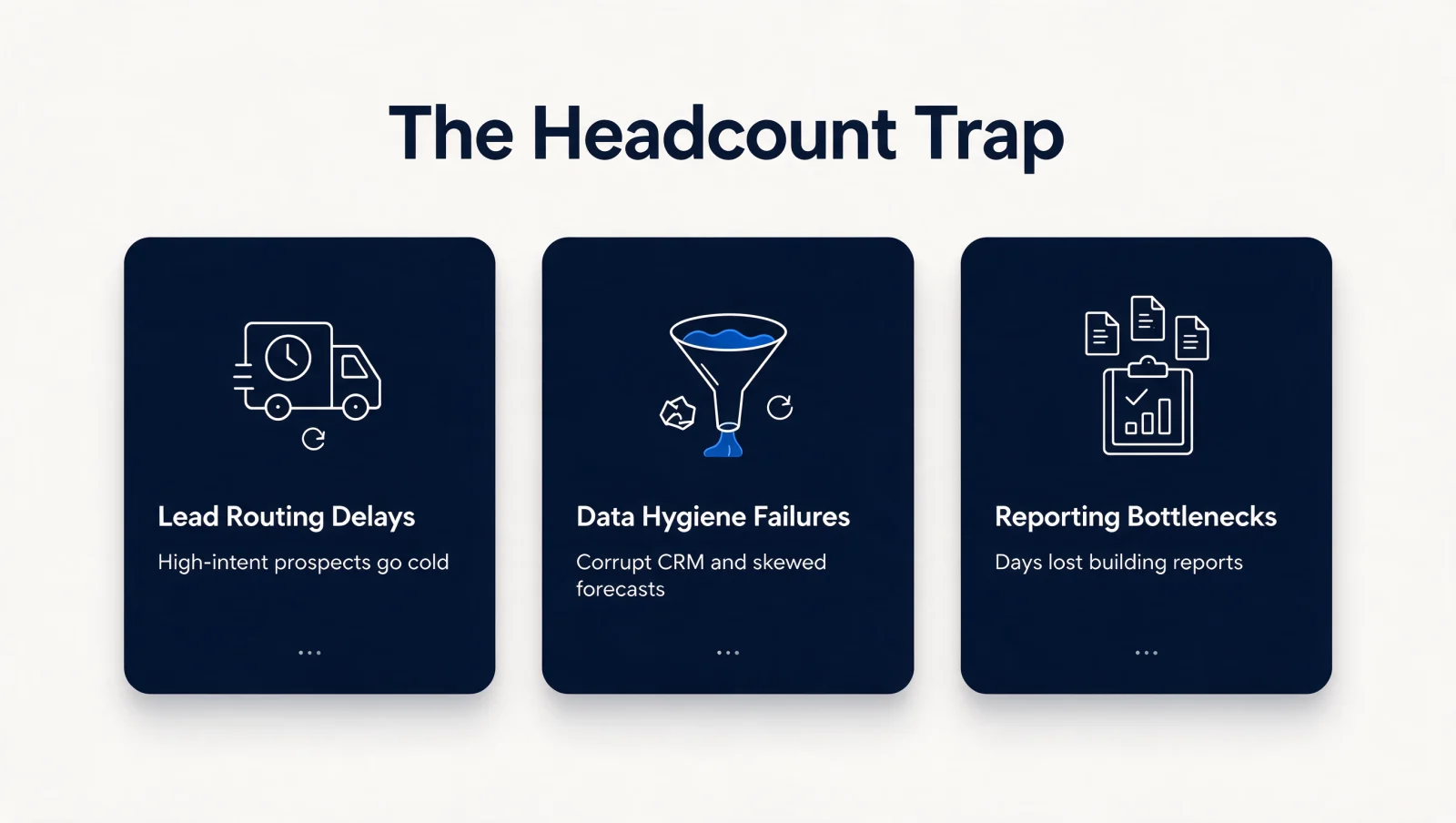
The friction shows up in predictable places:
- Lead routing delays that let high-intent prospects go cold while reps argue over territory assignments
- Data hygiene failures that corrupt your CRM, skew pipeline forecasts, and erode trust in every downstream report
- Reporting bottlenecks where revenue leaders spend days assembling dashboards instead of acting on insights
These aren't people problems. They're process problems, and that distinction matters enormously when you're deciding where to invest next.
As IBM frames it, business process automation is the use of technology to execute recurring tasks where manual effort can be replaced. What's changed is the sophistication of that technology. Basic RPA scripts, the kind that mimic mouse clicks and form fills, solve narrow, fragile problems. Strategic business process automation services treat your entire revenue workflow as an interconnected system worth engineering properly.
That shift in thinking, from tactical scripts to intelligent workflow design, is exactly where modern BPA delivers its real leverage. It's worth understanding precisely what that looks like in practice.
What Modern Business Process Automation Services Actually Deliver
Modern business process automation solutions go far beyond the simple rule-based scripts that most teams picture when they hear "automation." They orchestrate complex, multi-step workflows across entire business systems.
The distinction matters. A script executes one task. A business process automation workflow connects dozens of tasks into a governed, self-correcting system that runs without human handholding.
Integration: Connecting the SaaS Stack
Mature business process automation integrates applications like CRM, ERP, and customer communication tools so data flows between them cleanly. No copy-paste, no reconciliation spreadsheets, no data lag. A deal closing in Salesforce can automatically trigger contract generation, finance system updates, and onboarding sequences in a single orchestrated motion. That kind of end-to-end coordination is what separates genuine BPA from a collection of isolated scripts duct-taped together.
The connective tissue holding all of this together is the integration layer, the plumbing that links your SaaS stack. RevOps teams running HubSpot, Salesforce, Gong, and a billing tool simultaneously need automation that speaks to all of them fluently. That's the real infrastructure problem modern BPA services are built to solve, and it's exactly where the strategic benefits start to compound.
AI Agents: From Fixed Scripts to Adaptive Decisions
AI agents push this further. Where traditional automation follows a fixed decision tree, modern AI-powered workflows interpret unstructured inputs, handle exceptions, and adapt routing logic dynamically. In our scoping work, this is the design decision that changes the ceiling on what automation can own.
McKinsey research on where machines could replace humans found that 60% of occupations have at least 30% of their constituent activities that could be automated with current technology, and that share keeps climbing as AI agents take on judgment-based work RPA never could.
The Benefits of Business Automation: Moving from Efficiency to Revenue Velocity
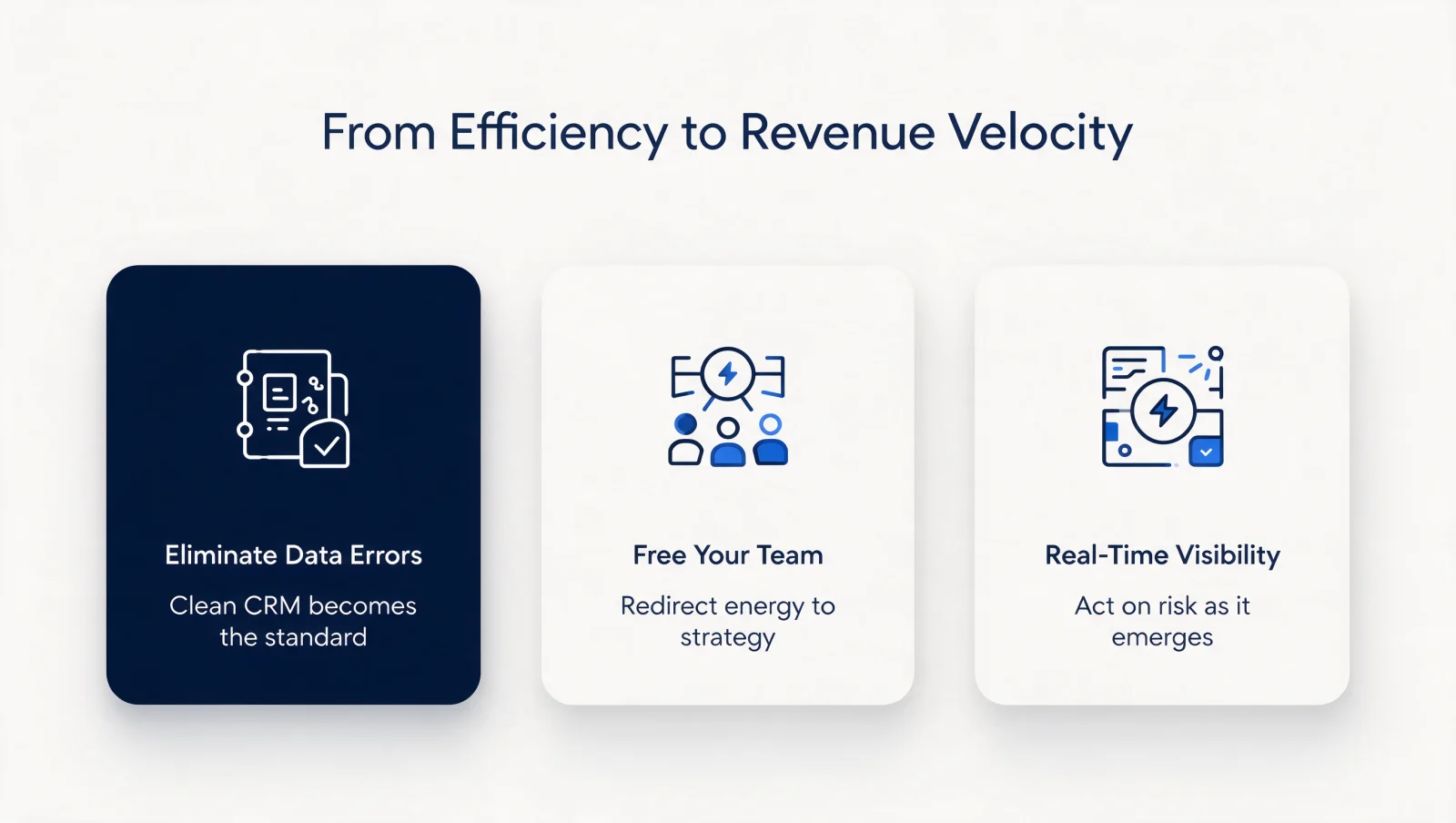
The real benefits of business automation extend well beyond cutting headcount or speeding up routine tasks. At the mid-market level, they compound directly into revenue velocity.
Eliminating data errors in high-stakes CRM environments is where many teams see the fastest return. When contact records, deal stages, and renewal dates are populated manually, even a small error rate creates compounding problems: missed follow-ups, inaccurate forecasting, and pipeline reports that executives can't trust. Automating those data flows makes clean CRM data a realistic standard, not an aspiration, and it reliably takes cost out of the operation. That priority shows up at the finance level too: in a Gartner survey of CFOs and CEOs, a third named back-office automation their top technology investment for driving down costs.
Automation doesn't just reduce errors. It removes the conditions that create them.
Freeing your team from drudge work has a second-order effect that's easy to underestimate: employee experience. When revenue operations analysts spend their days on data entry and manual handoffs, your highest-value thinking capacity is wasted. Thoughtfully designed automation workflows redirect that energy toward analysis, strategy, and customer relationships, the work that actually moves the needle.
Real-time visibility transforms executive decision-making. Automated workflows feed live, structured data into dashboards without waiting for someone to compile a weekly report. Leaders can identify pipeline risk, capacity gaps, or churn signals as they emerge, not two weeks later. This shift from reactive to proactive is what separates teams that scale cleanly from those that scramble.
These benefits only materialize when the underlying tooling is sound. Which raises an important question: what happens when automation is built on a fragile foundation?
Why RPA Alone Isn't Enough: The Need for CRM-Centric Workflows
Standalone RPA is only as reliable as the screen it reads, and in a fast-moving RevOps stack, that's a serious problem.
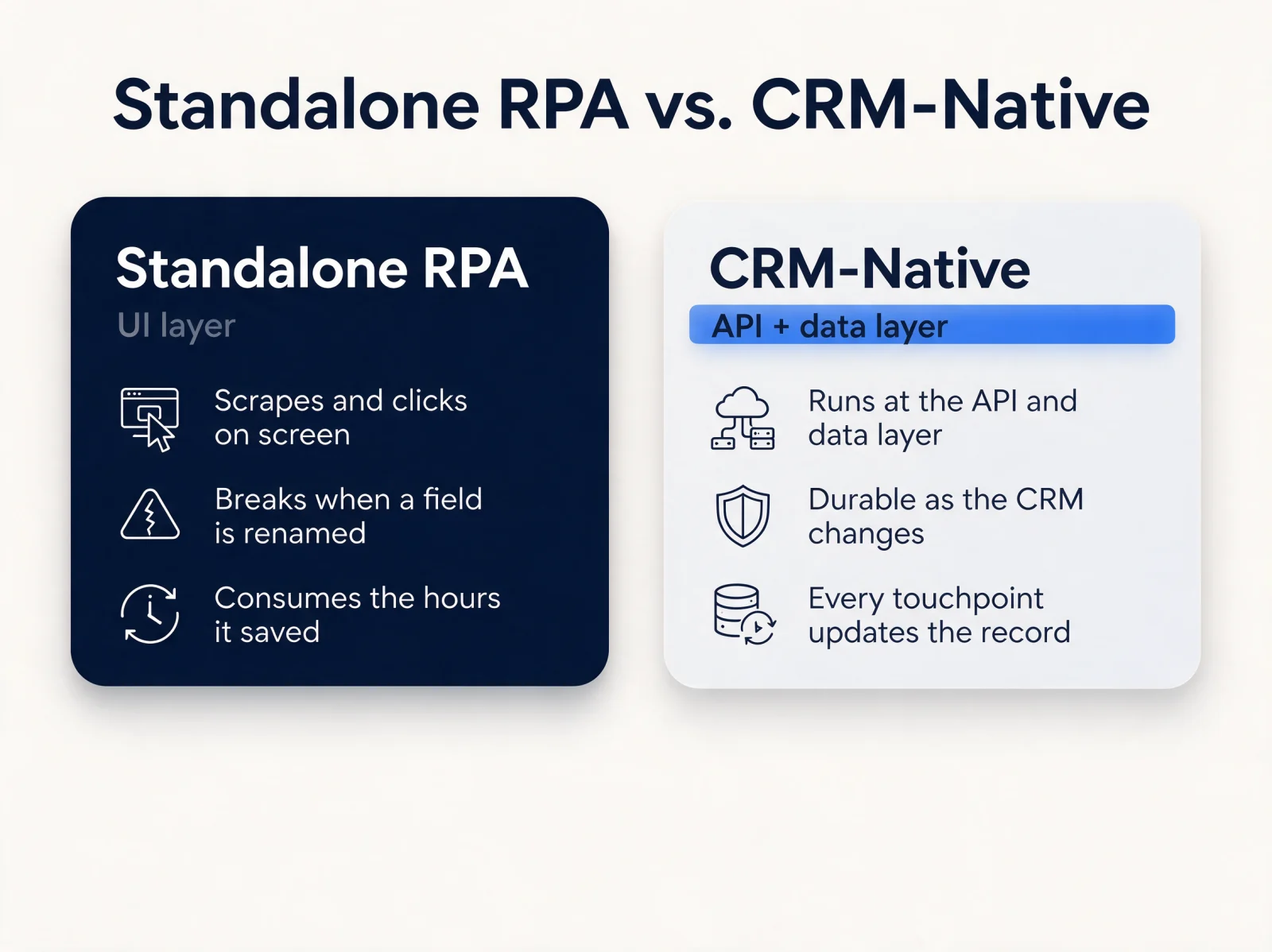
Fragile bots are the quiet liability most teams don't anticipate. Traditional RPA tools work by mimicking UI interactions: clicking buttons, scraping fields, moving data between screens. The moment a CRM update shifts a button's position or renames a field, the bot fails, silently or loudly. In practice, these failures consume the engineering hours that were supposed to be saved, and they erode trust in automation programs across the organization.
The fix isn't patching bots faster. It's building automation on a foundation that doesn't shift: your CRM. Whether you're running Salesforce or HubSpot, CRM-native workflows operate at the API and data layer, not the UI layer, which makes them structurally more durable. The most successful automation initiatives are the ones deeply integrated with existing business process management platforms, not layered on top of them as afterthoughts.
| Dimension | Traditional RPA | CRM-Native Business Process Automation |
|---|---|---|
| Operates at | UI layer (clicks, screen reads) | API and data layer |
| Failure trigger | Any button move or field rename | Schema or data-contract changes only |
| Decision logic | Fixed script, no judgment | Interprets context, adapts routing |
| Maintenance load | Constant patching as the UI shifts | Governed by the CRM record, lower drift |
| Best fit | High-volume, rules-based tasks | Judgment-heavy, cross-system workflows |
This is where business process management consulting services add a strategic layer that software alone can't provide. A consultant maps your revenue workflows, lead routing, quote generation, renewal triggers, and ensures automation connects those processes to the CRM record, not to a fragile UI click.
Siloed automation creates islands of efficiency that never add up to enterprise-wide velocity. The danger isn't automating too little. It's automating in the wrong places. Connecting inbound documents, form fills, and support tickets directly to the revenue engine means every touchpoint updates the CRM record in real time. Native workflow tooling makes that integration more accessible, but the underlying process architecture still has to be intentional. Getting that architecture right is precisely what the implementation roadmap covers next.
Implementation Roadmap: How to Evaluate Business Process Automation Solutions
Choosing the right path into digital business process automation demands more than a vendor shortlist. It requires an honest look at your own operational readiness before a single workflow gets built.
Successful automation requires a clear understanding of the underlying business process before technology is applied. That principle shapes every step below.
-
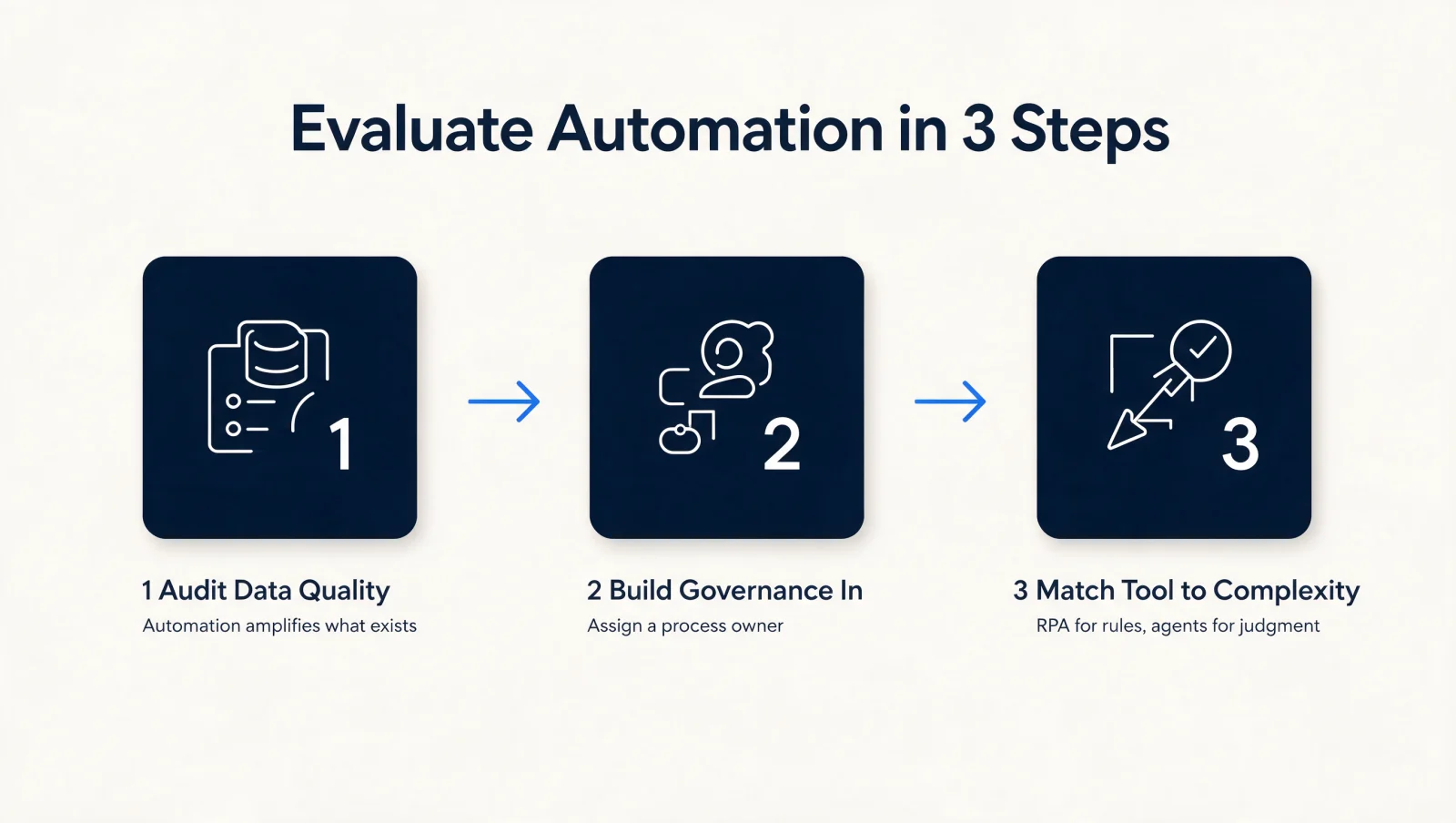
Audit your data quality first. Automation amplifies whatever exists in your systems. If your CRM holds duplicate records, inconsistent field values, or incomplete contact data, any workflow built on top will inherit those flaws. Before evaluating tools, assess whether your core CRM platform is structured cleanly enough to serve as a reliable data source.
-
Build governance in from day one. "Set it and forget it" is a myth. Automated workflows drift as products, pricing, and processes change. Assign clear ownership, a RevOps lead or process steward, who reviews trigger logic and output quality on a regular cadence.
-
Match the tool to the complexity. Off-the-shelf RPA software handles high-volume, rules-based tasks well. Custom AI agents are better suited for judgment-heavy workflows where context varies. Knowing that distinction up front prevents costly rework six months in.
The right consulting partner won't sell you a tool. They'll help you earn the right to use one. That shift in mindset separates durable automation programs from expensive experiments, and it sets the stage for something more ambitious: AI operations that don't just follow rules, but learn from them.
Beyond the Bot: Process Automation Management for AI-Driven Revenue Teams
Process automation management is the discipline of governing what automation is allowed to do: which decisions run unsupervised, which escalate, and who owns the exceptions. AI agents aren't just faster bots. They reason, adapt, and make decisions that rule-based automation simply cannot replicate.
Rule-based automation executes a fixed script: if field A equals X, trigger action B. It's reliable within narrow boundaries but collapses the moment a lead's data is incomplete, an email bounces unexpectedly, or a prospect takes an unscripted path through your funnel. That brittleness is why sophisticated workflow and business process management now demands something more dynamic, systems that interpret context rather than just follow instructions.
AI-based automation changes the calculus entirely. Rather than mapping every possible condition in advance, AI agents evaluate inputs in real time, infer intent, and choose the most appropriate next action. In a RevOps context, that means an agent can qualify a lead, personalize outreach, update your CRM, and flag an anomaly, all without a human touching the queue. Tools like Power Automate are already bridging the gap between legacy workflow logic and this more adaptive layer.
Sales teams are already leaning in: Salesforce's 2026 State of Sales report found that 94% of sales leaders using AI agents say the agents are essential for meeting business demands, a clear signal that agentic process automation management is moving from pilot to standard practice.
The commercial upside extends into demand generation, too. As AI-driven search reshapes how buyers discover vendors, automated content operations, optimized for both traditional SEO and AI answer engines, become a genuine growth lever. Companies that connect their CRM signals to content workflows can personalize outreach at scale and surface at exactly the moment a buyer is searching for a solution. Mature BPA services now fold AI strategy and readiness into the core offering, so organizations can operationalize these agents without accumulating technical debt.
The sum of these capabilities, adaptive agents, connected CRM data, and intelligent content operations, is what separates a growth system from a collection of tools.
The Bottom Line: Key Takeaways for RevOps Leaders
Automation is a strategy first and a software purchase second. Mid-market RevOps leaders who treat it otherwise consistently underperform those who don't.
The shift from basic RPA to intelligent process automation isn't optional. It's the defining operational decision of the next growth cycle. When RPA automates business process services at the task level, it creates efficiency. When AI agents layer judgment and adaptability on top of that foundation, it creates competitive advantage. The difference between the two is where mid-market B2B companies either accelerate or stall.
- Automation is a strategy. Tools without process design produce technical debt, not results. Mid-market companies see the highest return when automation targets lead-to-cash cycles end-to-end, not isolated tasks.
- CRM integration is non-negotiable. Disconnected automation generates siloed data and broken handoffs. A platform like Dynamics 365 built for mid-market scale provides the connective tissue that makes cross-functional workflows viable.
- Professional services reduce downstream risk. Poorly scoped automation projects routinely generate rework costs that dwarf the original implementation fees. Consulting expertise isn't overhead. It's risk mitigation.
- AI agents are the logical next step. Rule-based RPA was the foundation. AI-driven orchestration is the structure built on top of it.
What all four points share is a common dependency: execution quality. The tools available today are genuinely powerful, but the results they produce are only as good as the processes they're built around and the expertise guiding implementation.
Turning Technology into Operating Results
The shift from manual friction to automated growth isn't a technology decision. It's an operating strategy that determines whether your revenue engine scales or stalls.
Mid-market RevOps teams that have moved beyond basic RPA share a common thread. They stopped treating automation as a point solution and started treating it as a connective layer across their entire pipeline. Practical automation doesn't just save time. It scales measurable growth by connecting systems, people, and data into a single operating rhythm. The difference between a workflow that reduces clicks and one that accelerates revenue is how intelligently those connections are designed from the start.
That design complexity is precisely why U.S. and Canada-based CRM expertise matters at this stage. Complex CRM environments, spanning Dynamics 365, HubSpot, and layered integrations, require practitioners who understand North American compliance requirements, enterprise data structures, and the operational nuance that offshore generalists routinely miss. Implementation quality consistently outranks tool selection as the primary driver of automation return. The technology is rarely the constraint. Execution is.
If the frameworks and takeaways throughout this article resonate, the logical next step is straightforward. Audit your current workflow for automation potential before committing to any platform or engagement. Map where manual handoffs slow pipeline velocity, where data entry creates error risk, and where your team spends time on work a well-designed automation could handle in seconds. When you're ready to turn that audit into a plan, start with a scoped workflow automation engagement that ties each automation to a CRM record and a measurable outcome. That's where strategy meets reality, and where the right partner turns both into operating results.


