

A Dynamics 365 Customer Service implementation is a project to configure and launch agreed case handling, routing, knowledge and service reporting. A Dynamics 365 Customer Service implementation plan turns those decisions into deliverables. When comparing a Dynamics Customer Service implementation partner, ask who will define each rule, configure it and prove that it works for your agents.
The purchase includes more than software configuration. Someone must decide which requests belong in a queue, what an escalation means and how open cases will move from the old system. Those decisions need business owners, even when a partner facilitates the work.
Define the Dynamics 365 Customer Service implementation scope
Dynamics 365 Customer Service is Microsoft's application for handling customer support work, including cases, knowledge and service reporting. A case is the record of a customer issue and the work needed to resolve it. Microsoft lists case tracking, knowledge sharing, unified routing and service-level agreements among the product's capabilities, while noting that available capabilities depend on the licensing module purchased. Microsoft's Customer Service overview explains that distinction.
Ask the proposal to name the application, agent experience and licenses assumed. "Dynamics 365" alone leaves too much open. If a requirement involves a customer portal, telephony or another business application, have the partner identify the required product and its connection to the case process.
Avoid using a generic feature list as a licensing commitment. A demonstration can show a capability that your proposed subscription does not include. Request a written entitlement check for the selected plan and any additional channel or consumption charges before approving the commercial scope.
For wider product context, see the guide to Dynamics 365 Customer Engagement. Keep this engagement's acceptance criteria focused on the service team's workflows.
Write the Dynamics 365 case management implementation rules
A scope table gives operations and the delivery team a common place to record decisions. Each row should connect a service rule to a named owner and a test. The following is an illustrative starting point, not a description of default product behavior.
| Case stage | Decision for the service team | Evidence to request |
|---|---|---|
| Intake | Which channels create cases, and which fields are required? | A submitted request creates the expected record with the correct source and customer link. |
| Classification | Which categories are required, and who can correct them? | An agent can classify the sample case and make an authorized correction. |
| Assignment | Which queue receives each case type? | Test records reach the expected queue, including an exception with missing information. |
| Escalation | What triggers escalation, and who receives it? | The agreed condition produces the expected assignment or notification. |
| Communication | Which messages are sent, reviewed and recorded? | A test message reaches the intended recipient and appears in the agreed history. |
| Resolution | What information is required before closure? | A case closes with the required resolution details and appears correctly in reporting. |
Write business thresholds as decisions to approve. For example, an acknowledgment deadline should come from your service policy. It should not become a contractual target because a template happened to include a number.
Define exceptions as carefully as the usual path. A request might lack a customer identifier, concern two products or arrive after hours. Decide whether an agent reviews it, a separate queue receives it or the system requests more information. The proposal should distinguish configuration, custom work and manual handling.
An SLA, or service-level agreement, defines an agreed service target. For any SLA configured in the system, specify the relevant calendar, start event, pause conditions and escalation behavior. Ask the partner to confirm what the selected product configuration supports, then test that behavior.
Set the customer service implementation scope for routing and knowledge
Unified routing distributes work according to configured rules. It needs its own scope because installation does not prove that routing is enabled or ready. Microsoft states that unified routing is not enabled by default when only Customer Service is installed, and documents permission and licensing prerequisites. Microsoft's unified routing setup guidance is the relevant reference.
Have the partner describe the proposed assignment method, required user setup and fallback when no suitable agent is available. A buyer evaluating skills, capacity or availability rules should request evidence for those exact requirements. Do not infer them from the word "routing."
For channels, separate preserving an existing tool from replacing it. Keeping a phone provider may require an integration, while adopting a different voice solution changes the licensing, operating process and training. List what must work on launch day and what can wait for a later phase. Include the owner of each external system in discovery.
Knowledge management also has a content workload. Decide which articles move, which need editing and who can approve publication. The proposal should identify the people responsible for article preparation as well as system configuration. A searchable library of outdated instructions is still an unresolved business problem.
If an AI feature is proposed, describe the specific task it will assist, the information it can use and the review required before an action or response reaches a customer. Require confirmation of its availability and licensing in your environment. Keep unvalidated automation out of the launch commitment.
Separate migration from ongoing integrations
Historical migration is the transfer of existing records into the new system. An ongoing integration exchanges information after launch. They need different estimates and different acceptance evidence.
For migration, identify source systems, date ranges, record types, attachments and relationships to preserve. Agree who cleans the source data and who approves a mapping when fields do not correspond. Request a rehearsal report with imported counts, rejected records and checks of representative case histories. A total record count alone does not show whether attachments or customer links survived.
For integrations, document the direction of data exchange, update frequency, system of record and owner of failed transactions. An application programming interface, or API, is a defined way for software systems to exchange requests and data. A reference to an API does not establish that a particular connection has been built, licensed or tested.
Ask for the proposed connector or integration method and its support arrangements. Include a failure scenario in acceptance: when the receiving system is unavailable, who sees the error and how is the transaction recovered? This question applies whether the connection uses a vendor connector or custom development.
Keep external billing or finance dependencies explicit without expanding the engagement into implementation of those systems. The Dynamics 365 implementation cost guide provides broader budgeting context; your quote should identify the particular migration and integration work included here.
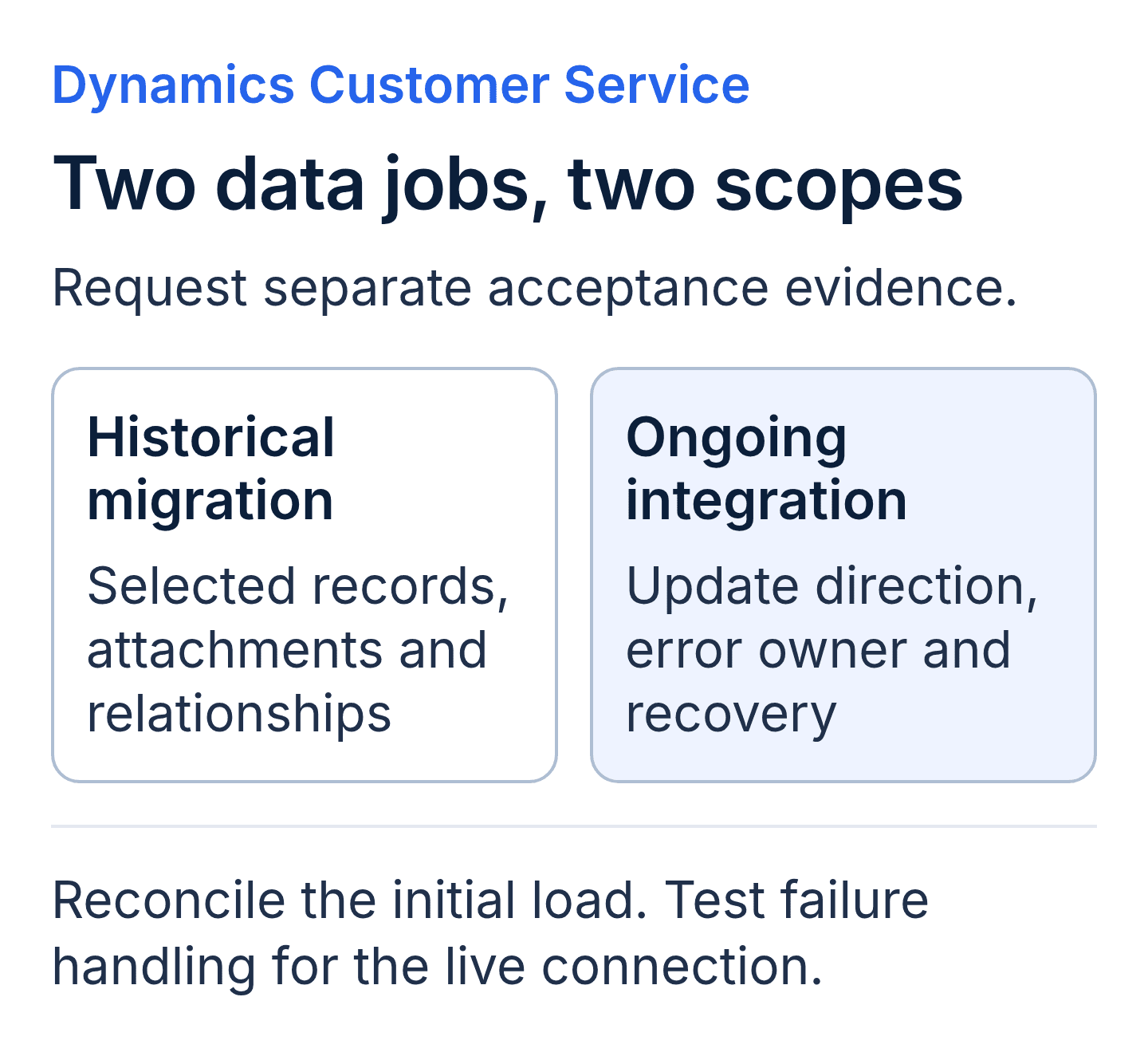
Price the historical transfer and the continuing connection separately. Each needs its own responsibilities and acceptance evidence.
Review the Dynamics 365 Customer Service implementation plan for testing
During selection, ask candidates to explain how they would test your representative scenarios and which assumptions need discovery. After configuration, require execution evidence in the agreed test environment. These are different checkpoints: a proposal walkthrough helps assess the approach, while completed tests support acceptance of the delivered system.
User acceptance testing, or UAT, is business-user testing against agreed requirements. Microsoft's Dynamics 365 testing guidance connects test scope to business processes and calls for documented results and stakeholder sign-off. Assign service representatives and a business approver to UAT. Give them time in the plan and access to realistic, appropriately prepared test data.
Use this acceptance checklist when reviewing the proposed test plan:
- A new request creates the expected case and customer relationship.
- An ambiguous or potentially duplicate request follows the agreed review process.
- A restricted case is accessible to an authorized user and unavailable to a user who should not see it.
- An escalation reaches the intended team with the required history.
- A reassigned case follows the agreed service-timer behavior.
- A resolved case appears in the correct report, with its status and resolution details intact.
For each test, record the requirement, expected result, person executing it, evidence location and approver. Screenshots can support a result, but may need a report, recorded walkthrough or transaction log to establish the full sequence. Record failures and retests as well as passes.
Agree how unresolved defects affect launch. A cosmetic issue and an access failure should not be treated as interchangeable. Define the classification, decision authority and required remediation before the test period begins.
Put cutover and support responsibilities in the quote
Cutover is the transition from the old process to the new one. Ask how the team will handle cases that are still open, messages arriving during the transition and changes made after the final migration extract. The plan should name the person authorized to proceed, pause or invoke the agreed fallback.
A handover package should explain the delivered configuration in terms your administrators can maintain. Specify whether the price includes routing documentation, role descriptions, integration recovery instructions, training recordings and administrator access. Agree where those materials will live.
Post-launch support can be included in the implementation or purchased separately. Either arrangement needs a defined period, coverage, intake process and responsibility for defects versus new requests. Do not assume that "support included" means unlimited changes or that a separate retainer is required.
When comparing a Dynamics 365 implementation partner, ask each candidate to price the same case types, channels and deliverables. Put buyer responsibilities beside partner responsibilities, including data preparation, subject-matter expert time and approvals. Unpriced dependencies belong in the decision record before contract approval.
Key takeaways
- Name the Customer Service application and confirm licensing assumptions for the proposed channels and features.
- Connect case rules to test evidence, including exceptions, access restrictions and reporting.
- Estimate migration separately from ongoing integrations and knowledge content preparation.
- Assign business approvers for UAT and define how unresolved defects affect launch.
- Document cutover, handover and support responsibilities in the commercial scope.
Customer Service implementation buyer FAQs
Can we keep our existing support channels?
Possibly, but the answer depends on the tools, integration options and licenses involved. Give candidates the current channel inventory and ask them to confirm the supported approach, ongoing costs and acceptance tests for each connection.
Does buying the software include implementation?
Do not infer delivery services from a subscription. Ask the commercial proposal to show software entitlements and implementation deliverables separately, even if one provider coordinates both purchases.
Who should own knowledge and routing after launch?
Name an accountable business owner and a person or provider responsible for maintenance. Your team may maintain the configuration, retain a partner or divide responsibilities. Document approval rights and access so the arrangement is workable.
What should we bring to a scoping call?
Bring case examples, current channel names, escalation policies, reporting requirements and known integration dependencies. An estimate of historical cases and attachments also helps the partner identify migration questions.
Terms to use consistently in the proposal
| Term | Meaning in this purchase |
|---|---|
| Case | A record of a customer issue and its handling history. |
| Queue | A collection of work awaiting handling or assignment. |
| SLA | A service-level agreement describing an agreed service target. |
| UAT | User acceptance testing performed against business requirements. |
| Cutover | The planned transition to the new operating system and process. |
Twelverays describes CRM assessment, workflows, integrations and reporting within its Dynamics 365 consulting services. To discuss a Customer Service scope, book a discovery call and bring the case rules and dependencies your team needs to resolve.


