OpenAI Consulting Services: What They Are and When to Hire
OpenAI consulting is help designing, building, and deploying real business systems on OpenAI's models, safely and in production, not just experimenting with ChatGPT. Whether you reach the models directly or through Azure OpenAI consulting services, a good consultant closes the gap between a promising demo and a governed system your team actually runs.
Most companies have already tried ChatGPT. The hard part is not the first prompt. It is turning that spark into something that connects to your data, respects your rules, and holds up when real users depend on it. That is what OpenAI consulting is for. Call it GPT consulting or AI integration consulting; the job is the same. As an OpenAI and Anthropic partner, Twelverays builds these systems on your existing stack, with the governance that keeps them trustworthy.
Key Takeaways
OpenAI consulting turns ChatGPT experiments into governed systems that run in production, not just demos.
Azure OpenAI consulting services deploy the same models inside your Microsoft tenant when compliance demands it.
The real work is integration, governance, and evaluation, not prompting.
You need it when you have a use case but no safe path from pilot to production.
As an OpenAI and Anthropic partner, Twelverays builds on the model that fits the task, avoiding lock-in.
Deploy narrow first: one governed use case, validated against trusted results, then expand on proof.
OpenAI's own consulting arm reportedly starts around $10 million per engagement; independent partners cover the mid-market.
What Is OpenAI Consulting?
OpenAI consulting is advisory and implementation work focused on OpenAI's models, GPT and the surrounding APIs, applied to a specific business problem. It covers strategy, architecture, build, and the guardrails that make the result safe to run.
OpenAI consulting spans a range. At the light end it is a strategy engagement: where does OpenAI fit, what is the use case, what is the ROI. At the heavy end it is a full build: connecting the model to your systems, designing what it can and cannot do, and deploying it into production. The valuable engagements do both, because a strategy nobody can implement is just a slide deck, and the same holds across generative AI consulting generally. This is the same discipline behind AI operations design: decide what the AI controls, who approves, and how it learns.
What Is OpenAI and What Does It Do?
OpenAI is the AI research and product company behind ChatGPT, the GPT model family, and the developer API businesses build on. It sells intelligence three ways: ChatGPT products for consumers and teams, a developer platform, and enterprise deployments.
Founded in 2015, OpenAI has moved from research lab to default AI vendor for business. The company reported more than 1 million business customers in November 2025, with over 800 million people using ChatGPT every week. The distinction that matters for buyers is between using ChatGPT as a product and building on OpenAI's models through the API. The first needs training and policy. The second needs engineering, and that is where OpenAI consulting earns its fee: connecting the models to your data, your rules, and your systems.
What Does an OpenAI Consultant Actually Do?
An OpenAI consultant maps your process, picks the right model and pattern, connects it to your data, designs the guardrails, and ships it to production. The work is 20% prompting and 80% integration, governance, and evaluation.
The prompt is the easy part. The real work is everything around it. Which data does the model need, and how does it reach that data safely. What is it allowed to do on its own, and what needs a human to approve. How do you measure whether its answers are right, and catch it when they are not. How does it fail gracefully instead of confidently inventing an answer. A consultant who only talks about prompts is selling you the 20%. The 80% is where projects succeed or quietly fail, and it is the same rigor that separates durable workflow automation from a brittle script.
What Do OpenAI Consulting Services Include?
OpenAI consulting services cover strategy, integration, build, and operations: picking the use case, connecting models to your data, shipping the system, and running it. Most engagements bundle four kinds of work.
Strategy and roadmap. Which processes justify AI, in what order, and what the ROI case is.
OpenAI integration consulting. Wiring GPT models into your CRM, support desk, or data warehouse through a governed retrieval layer, so answers come from your data.
Custom assistant and agent builds. Production applications with defined permissions, approval steps, and fallbacks.
Evaluation and governance. Test suites that score output against known-good results, plus monitoring that keeps the system inside its lane.
Ask a prospective partner which of these they deliver themselves. A firm that only sells the strategy layer leaves you holding the hard 80%.
When Does Your Business Need OpenAI Consulting?
You need OpenAI consulting when you have a clear use case but no safe path to production, or when early experiments produced impressive demos that never became reliable systems. The signal is a gap between what you have seen AI do and what you can actually deploy.
The pattern repeats. A team builds a compelling proof of concept, leadership gets excited, and then it stalls, because nobody knows how to connect it to real data, govern it, or trust its output at scale. That stall is the norm, not the exception: McKinsey's State of AI research finds 88% of organizations now use AI in at least one business function, yet most still struggle to turn pilots into bottom-line impact. That gap is the moment consulting pays for itself. You also need it when the stakes are high enough that a wrong answer is expensive, so the guardrails and evaluation matter more than the demo. If your AI ambitions keep dying between the pilot and production, that is the exact gap to close.
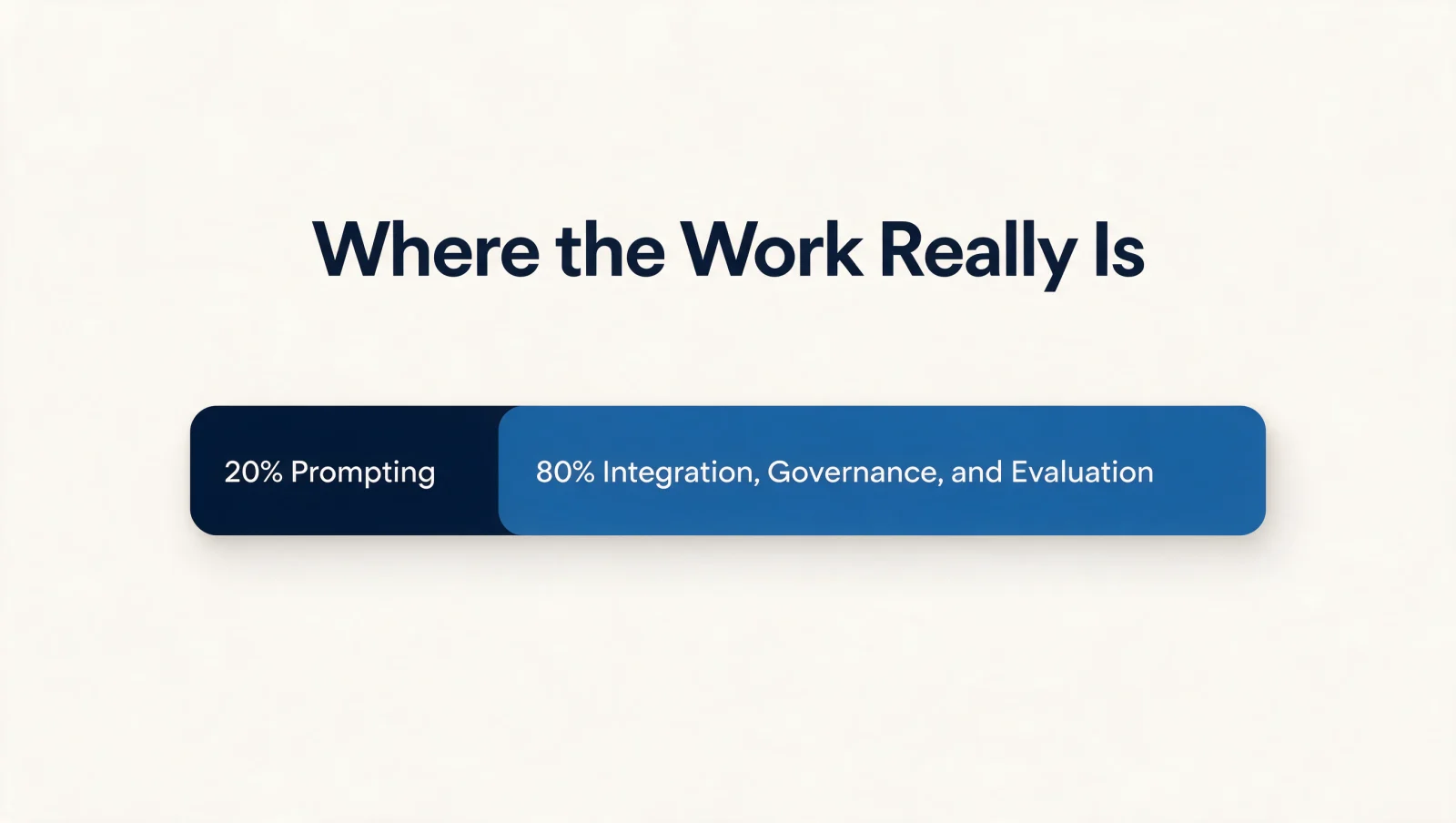
Prompting is the easy 20%. Integration, governance, and evaluation are the real 80%.
Do You Need an OpenAI Deployment Company or Azure OpenAI Consulting Services?
They are two routes to the same models. An OpenAI deployment company builds directly on OpenAI's APIs; Azure OpenAI consulting services deploy the same models inside your Microsoft tenant for compliance and identity reasons. Choose by where your governance lives, not by the model.
Route | Best for | Trade-off |
|---|---|---|
Direct OpenAI APIs | Speed, newest models first | You manage the boundary |
Azure OpenAI | Microsoft tenant, compliance, identity | Model releases arrive later |
The terms confuse buyers because the model is identical either way. Enterprises already committed to Microsoft often want Azure OpenAI, now sold through Microsoft Foundry, which runs OpenAI's models inside the Azure boundary: your tenant, your security perimeter, your data residency. Companies without that constraint integrate OpenAI's APIs directly, which is simpler and tracks new model releases faster. OpenAI itself now operates a consulting arm, but the OpenAI consulting arm is aimed at the very largest enterprise engagements. For mid-market companies, an AI transformation consulting firm who works both routes, and who is honest about which one your compliance picture actually requires, is the practical way in.
Is the OpenAI Consulting Arm Right for You?
Only at the largest scale. OpenAI's consulting arm embeds forward deployed engineers inside enterprise accounts, and Forbes reports engagements start around $10 million. Everyone else works with an independent OpenAI consulting firm.
The OpenAI consulting arm confirms the argument of this whole article: models alone do not transform a business, deployment does. OpenAI staffs its largest customers with engineers who build custom applications inside client workflows. If your project budget clears eight figures, that route exists. For everyone else, an independent partner does the same category of work at mid-market scale: integration, governance, and evaluation on the systems you already run. It also adds the one thing OpenAI cannot: model-agnostic advice on when a different provider fits the task better.
OpenAI or Anthropic: Which Models Should You Build On?
Both are excellent, and the right choice depends on the task, not the brand. Twelverays is a partner of both OpenAI and Anthropic, so we pick the model that fits your use case instead of forcing everything onto one.
Vendor lock-in is a real risk in AI. A shop that only knows one model will make every problem look like that model's strength. As an OpenAI and Anthropic partner, we build on whichever fits: one model may handle your reasoning-heavy analysis better, another your high-volume, cost-sensitive tasks. The architecture we design keeps you able to switch as the models evolve, which they do every few months. Betting your whole system on a single provider's current lead is how you get stranded when the lead changes hands.
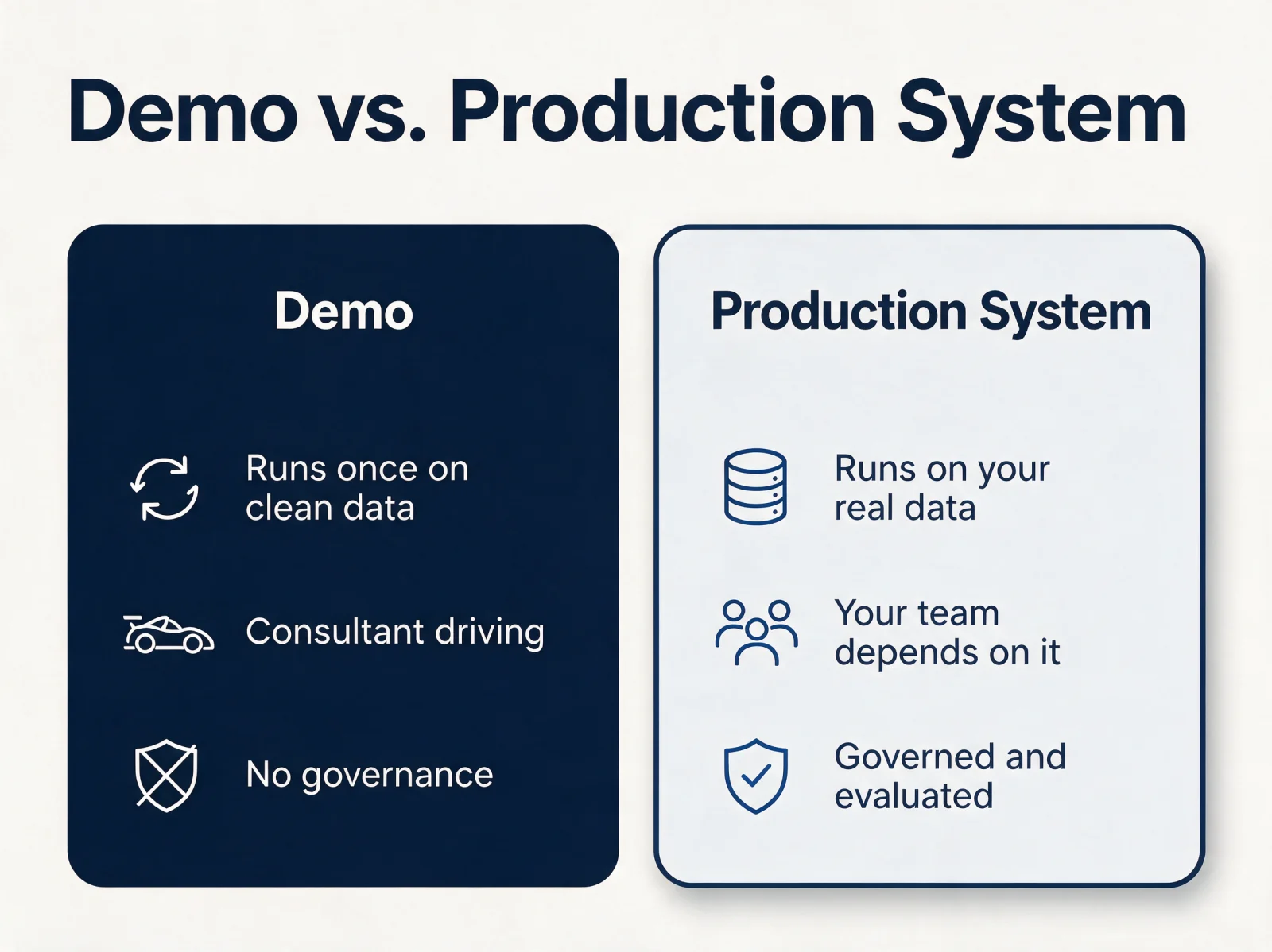
A demo runs once on clean data. A production system runs reliably on yours.
What Separates Good OpenAI Consulting From a Demo?
Governance, evaluation, and integration. A demo shows what the model can do in ideal conditions. Good consulting builds what it does reliably on your data, with a way to measure and trust the output.
The gap between a demo and a system is trust. A demo runs once, on a clean example, with the consultant driving. A production system runs thousands of times, on messy real data, with your team depending on it. Getting there needs a governed connection to your data so the model works from the truth, an evaluation loop so you know when it is wrong, and guardrails so it stays inside its lane. The same reliability question decides whether a natural language to SQL tool is useful or dangerous: the model is easy, the governance is the work.
How Do You Deploy OpenAI in Production Safely?
Start with one narrow, well-understood use case. Connect it to governed data, define what it can do on its own versus what needs approval, evaluate its output against known-good results, then expand. Safety comes from scope and guardrails, not from slowing down.
The safe path is deliberately narrow at first. In our own engagements at Twelverays, the deployments that reached production fastest were the ones that resisted a broad launch.
Start with one contained use case
Pick one process where the value is clear and the blast radius is small. Give the model access only to the data it needs, through a governed layer, not the whole database. Decide explicitly what it can act on and where a human signs off.
Validate, then widen
Test its answers against results you already trust until they match, then widen. Trying to deploy OpenAI across the whole company at once is how these projects become unsafe and stall. A partner who has shipped this before will insist on the narrow start, because the fast path to scale runs through one trusted win first.
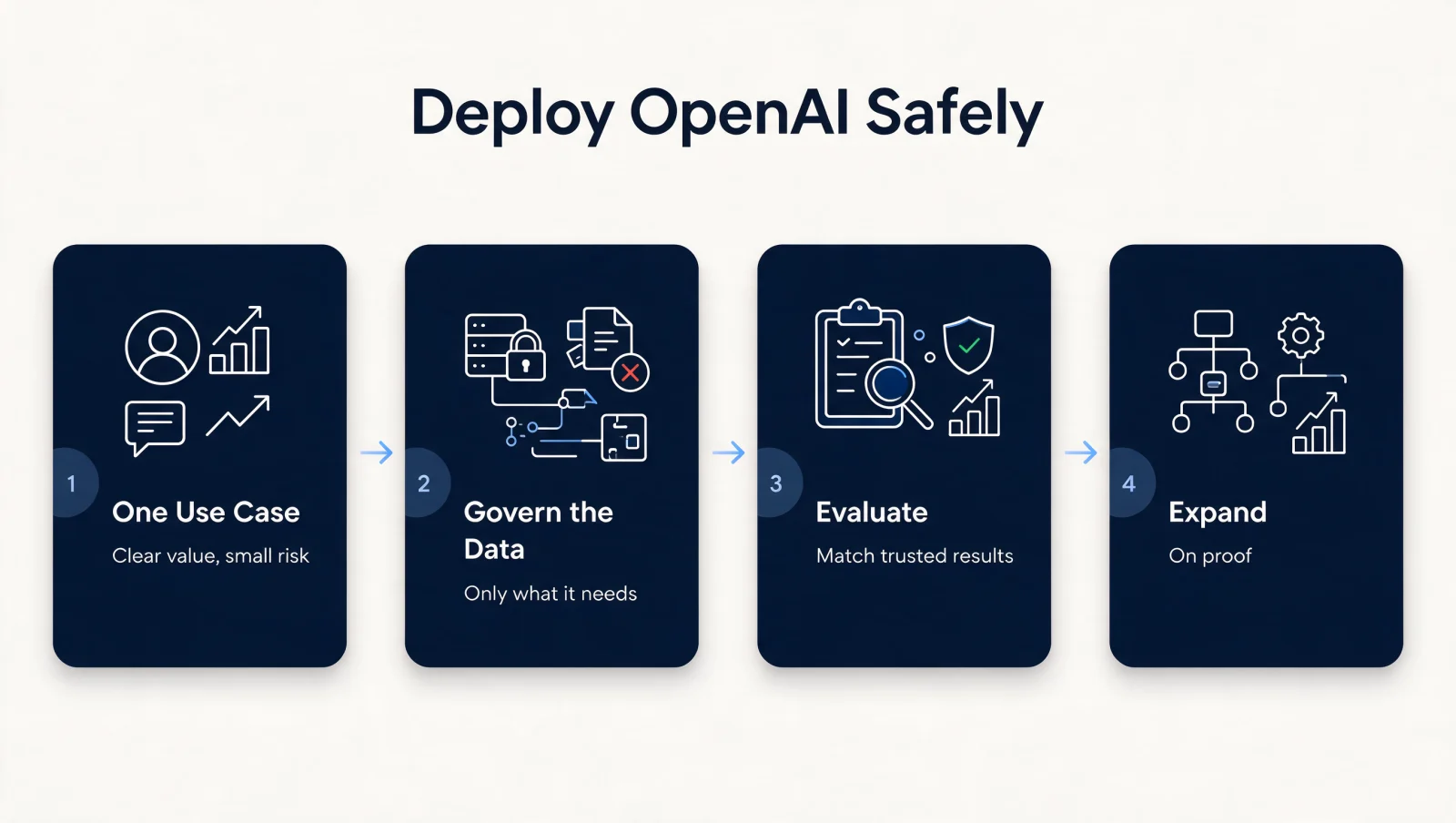
Start narrow, govern the data, evaluate, then expand.
GPT Consulting: Hire a Consultant or Build In-House?
Bring in OpenAI consulting when speed matters and your team has not shipped AI to production before. Build in-house when you have the AI engineering talent and the time to make the early mistakes yourself. Most companies benefit from a consultant for the first deployment, then bring it in-house.
The honest answer depends on your team. If you already employ people who have connected models to real data, governed the output, and deployed at scale, building in-house keeps the knowledge close. Most companies do not have that yet, and the first project is where the expensive lessons live: the failed integration, the ungoverned output, the pilot that never shipped. A consultant who has crossed that gap before compresses months into weeks and leaves your team able to run and extend the system. The best engagements are built to hand off, not to create dependence.
Getting OpenAI Into Production on Your Stack
The distance between a ChatGPT demo and a system your business relies on is the whole job. It is governance, integration, and the discipline to start narrow and prove the numbers before scaling. Done well, AI becomes something your team trusts and uses daily. Done as a rushed demo, it becomes another stalled pilot.
Twelverays is an OpenAI and Anthropic partner, and we design, build, and deploy AI on the systems you already run through our artificial intelligence practice. If your AI experiments keep stalling before production, book a discovery call and we will scope the fastest safe path to a working system.