

Why Self-Service Analytics Keeps Failing Your Team
Most "self-service" analytics never becomes self-service. The tool ships, but business users still file a ticket and wait days for a chart, because the self-service layer still assumes you can model data and write queries.
Every BI vendor sells the same promise: hand business users a dashboard tool and they will answer their own questions. In practice the analyst queue never shrinks. A marketing lead who needs last quarter's pipeline by region still pings the data team, because Power BI and Tableau reward people who already know how to build. That is the gap between self-service in theory and self-service in reality, and it is exactly where mid-market reporting stalls.
What Actually Blocks Self-Service Analytics?
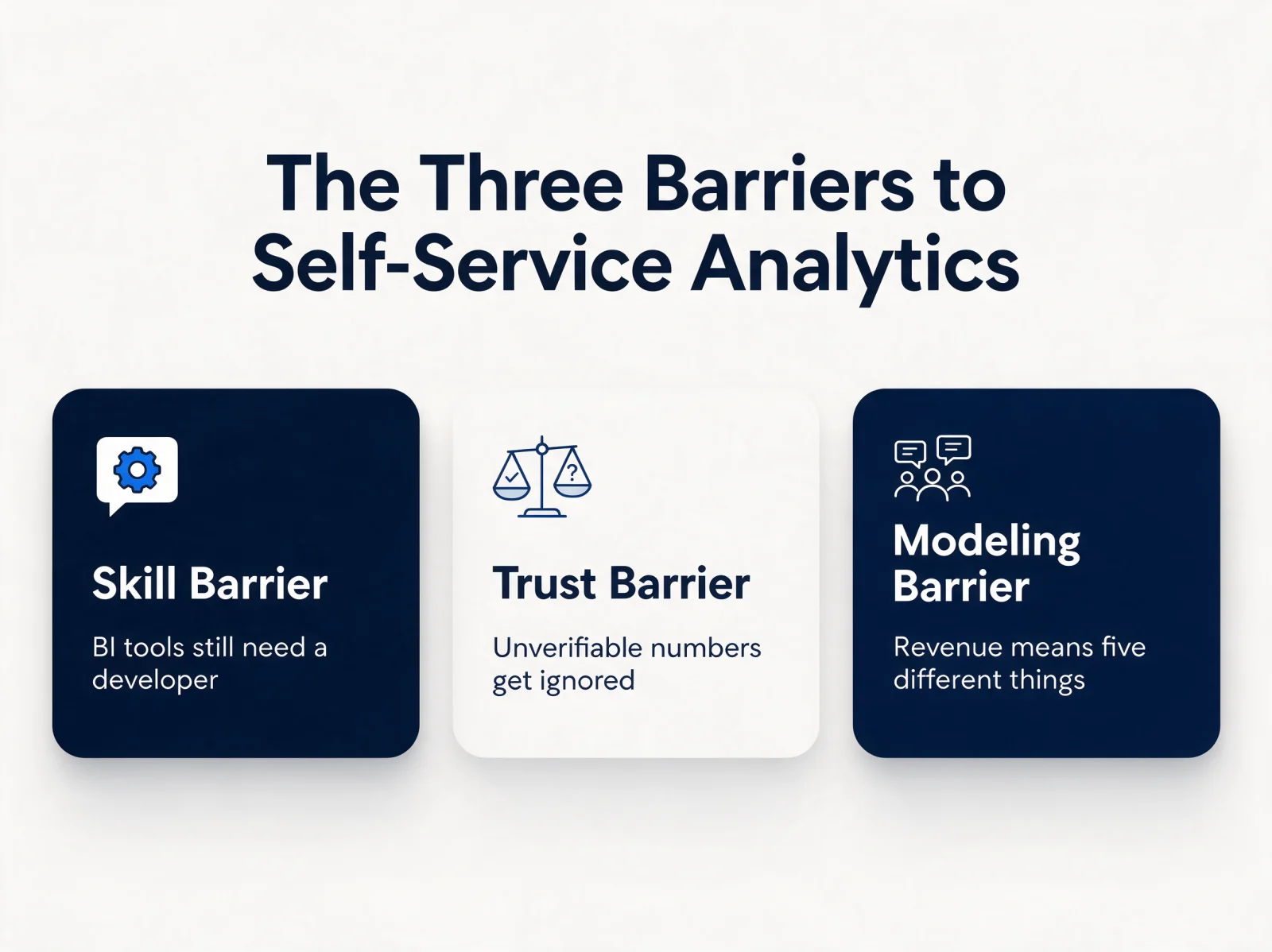
Three barriers block it, and dashboard tools solve none of them on their own: skills, trust, and data modeling.
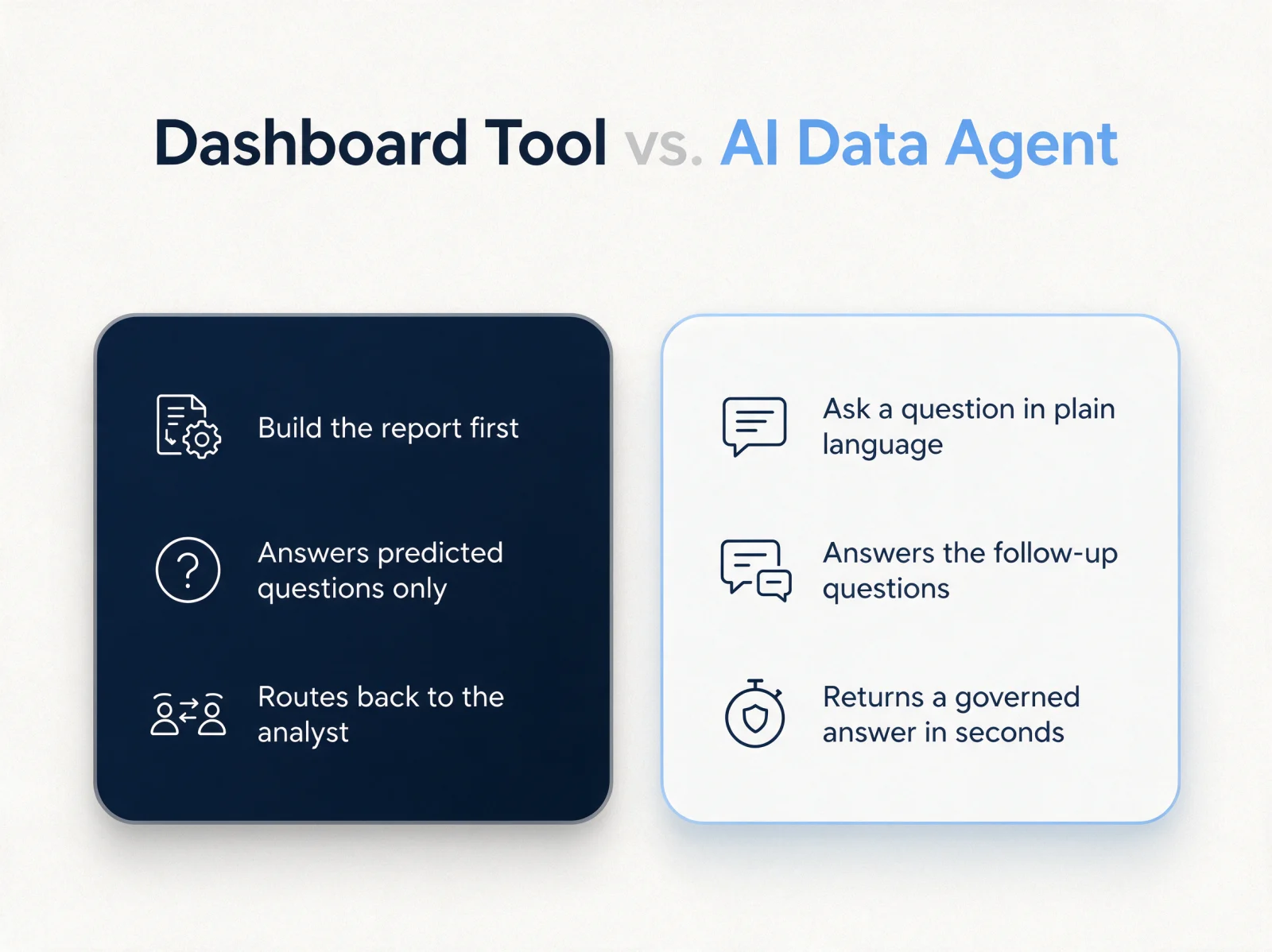
- The skill barrier. Building a report in Power BI or Tableau is a technical task. Measures, joins, and data models are not business-user skills, so the "self-service" tool quietly routes work back to the analyst.
- The trust barrier. A number nobody can verify is a number nobody acts on. When users cannot trace where a figure came from, they revert to the spreadsheet they do trust.
- The modeling barrier. "Revenue" means one thing to finance and another to sales. Without a governed definition, every self-serve answer becomes a debate instead of a decision.
Adding another dashboard on top of these barriers does not remove them. It just moves the bottleneck.
How Does an AI Data Agent Change This?
An AI data agent removes the build step entirely. Instead of constructing a report, you ask a question in plain language and get an answer grounded in your governed data.
The shift is from building to asking. The agent connects to your systems, interprets the question, runs the query against a governed model, and returns the answer with the logic behind it. A regional pipeline breakdown becomes a sentence, not a two-day ticket. This is the same pattern behind AI agents in the CRM: the value is not the chat window, it is the connection to live, trusted data.
For a lean team, that changes the math. The analyst stops fielding routine chart requests and moves to the analysis that actually needs a human. The business user gets an answer in the moment the question matters.
Why Is the Chat Interface the Easy Part?
The conversational front end is the simple 20 percent. The work that makes an AI data agent trustworthy is the semantic layer, the query accuracy, and the governance behind it.
Any team can wire a chat box to a language model in a weekend. The hard part is making the answers correct. Point a model at a raw, messy schema and it will write confident, wrong queries. In reporting, one wrong number destroys trust permanently, which is worse than no tool at all.
That is why a real deployment starts with the unglamorous work: defining metrics once, mapping the data model, setting access controls, and building the checks that keep answers accurate as the data changes. Get that foundation right and the chat interface finally delivers on the self-service promise. Skip it and you have shipped a faster way to be wrong. This is the core of disciplined AI operations design.
What Does Real Self-Service Analytics Look Like in Practice?
It looks like a business user getting a correct answer in the moment, with no ticket and no analyst in the loop.
A RevOps lead asks for enterprise pipeline by region and reads the answer in seconds. A finance manager checks last month's recognized revenue without waiting for the Monday report. A customer success lead pulls accounts with declining usage before the renewal call, the same proactive signal that makes AI customer support agents valuable. In each case the question is specific, the answer is governed, and nobody opened a BI tool.
That is the bar. If getting an answer still means building a view or filing a request, the system has not reached self-service. It has just relabeled the queue.
Which Metrics Should You Govern First?
Start with the handful of numbers your leadership already argues about. Those are the metrics where a single governed definition creates the most trust.
Every company has a short list of figures that mean different things in different rooms: revenue, active customers, pipeline, churn. Governing those first does two things. It removes the debates that waste meetings, and it gives the AI data agent a reliable foundation to answer from. Trying to model everything at once is how these projects stall. Modeling the ten metrics that drive decisions is how they earn adoption.
The rest of the schema can stay descriptive and expand over time. The governed core is what has to be right on day one.
How Do You Deploy an AI Data Agent Without Losing Trust?
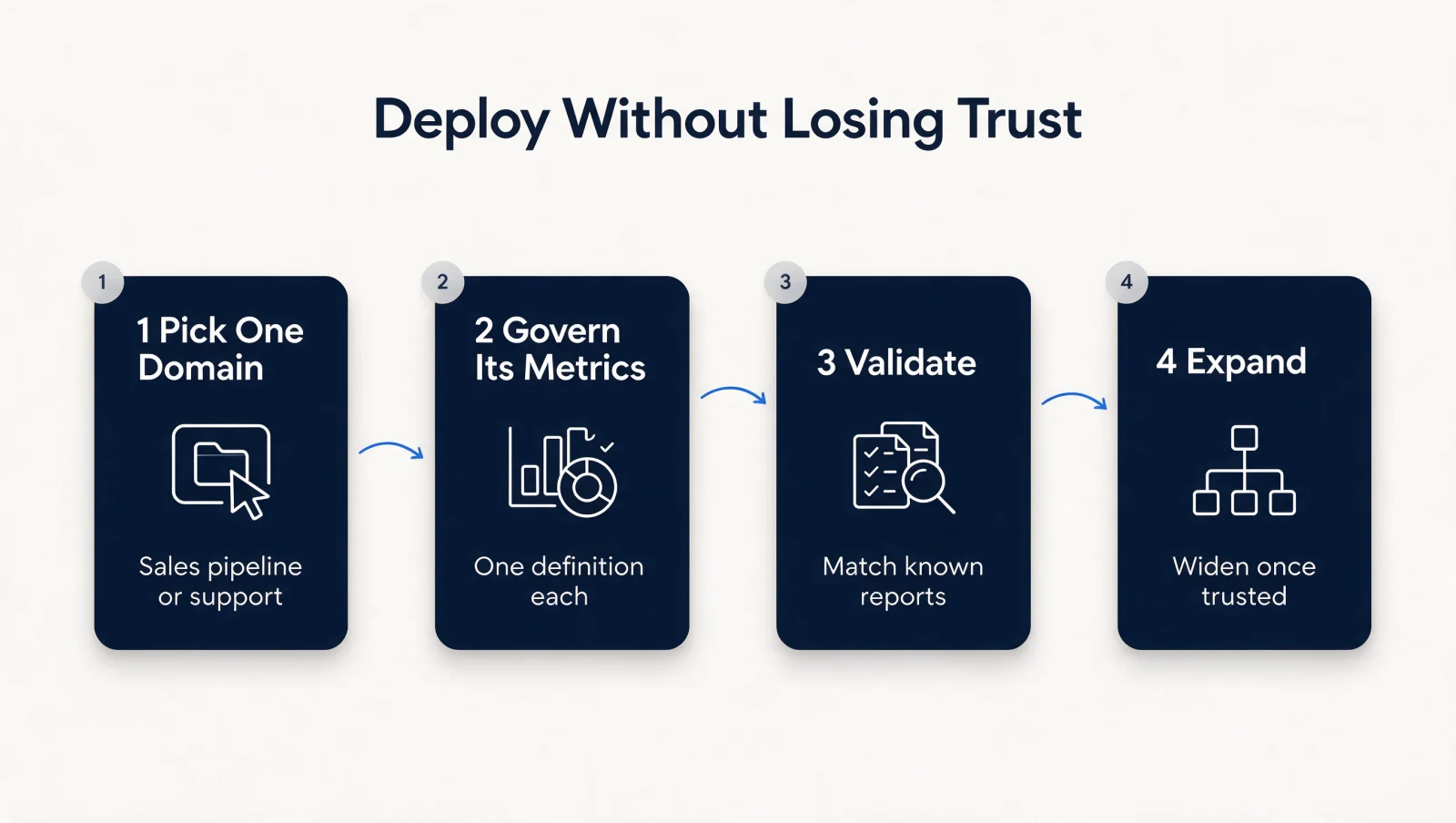
Start narrow, prove the numbers against reports people already trust, then expand. Trust is earned one verified answer at a time.
The failure mode is launching broad and letting a wrong answer surface early. A disciplined rollout does the opposite. Pick one well-understood domain, such as sales pipeline or support volume. Define its metrics in a governed model. Validate the agent's answers against the existing reports for that domain until they match every time. Only then widen the scope.
This staged approach is a hallmark of sound AI operations design, and it mirrors how the best AI agents for CRM roll out: one narrow, high-value use case, proven, then scaled. A data agent earns its way into daily decisions. It is never trusted by default.
What Is the ROI of Self-Service Analytics?
The return comes from two places: analyst time reclaimed from routine requests, and faster decisions across the business.
The direct saving is obvious. When routine chart requests disappear, your analysts stop being a reporting help desk and return to work that needs real judgment. The larger, less visible return is speed. A leader who gets an answer in the moment makes the call in the moment, instead of waiting two days for a report that lands after the decision window closed. Multiply that across every manager who currently waits on data, and the effect on decision velocity dwarfs the headcount math. The way to justify the investment is simple: reclaimed analyst hours plus the value of decisions made on time, measured against the cost of the build.
Key Takeaways
- Self-service BI stalls on skills, trust, and data modeling, not on missing features.
- An AI data agent replaces report-building with a question: ask in plain language, get a governed answer.
- The chat interface is trivial. The semantic layer, query accuracy, and governance are what make it trustworthy.
- A single wrong number ends adoption, so the governed data model is the prerequisite, not an afterthought.
Turning Self-Service Into Something Your Team Actually Uses
The technology to let anyone ask a question and trust the answer exists today. What separates a working deployment from an expensive experiment is the implementation: connecting your sources, defining your metrics, and building the accuracy and governance layer on top of the stack you already run.
See how a B2B SaaS company cut preventable churn 27% with an AI operating layer.
Twelverays designs and implements AI data agents on your existing systems, so business users get answers they trust without learning a BI tool. If your reporting still runs through a queue, book a scoped discovery call and we will map where an AI data agent fits your stack.


