

What Does an AI Agent Cost? The Short Answer
Ask ten vendors how much does an AI agent cost to run and you will get ten different numbers, because the AI agent development cost quoted upfront rarely covers what happens after launch. A functional, integrated AI agent for a mid-market B2B team usually lands in the mid five figures to build. Simple proofs-of-concept start lower, and advanced multi-agent systems run into six figures. The build price is only half the story: integration, data cleanup, and ongoing operation drive the real total.
An AI agent is software that plans and carries out multi-step tasks with some autonomy, not a chatbot that answers a single prompt. Most teams misjudge the number badly because they price the model and the logic, then get surprised by everything around it. Punch your requirements into any AI agent pricing calculator you find online and you will get a wide range, not a number your finance team can commit to. The ranges below reflect how we scope AI agent work at Twelverays, not a fixed rate card. Your actual number depends on integration depth, data readiness, and how much autonomy the agent needs.
AI Agent Development Cost: The Three Pricing Tiers
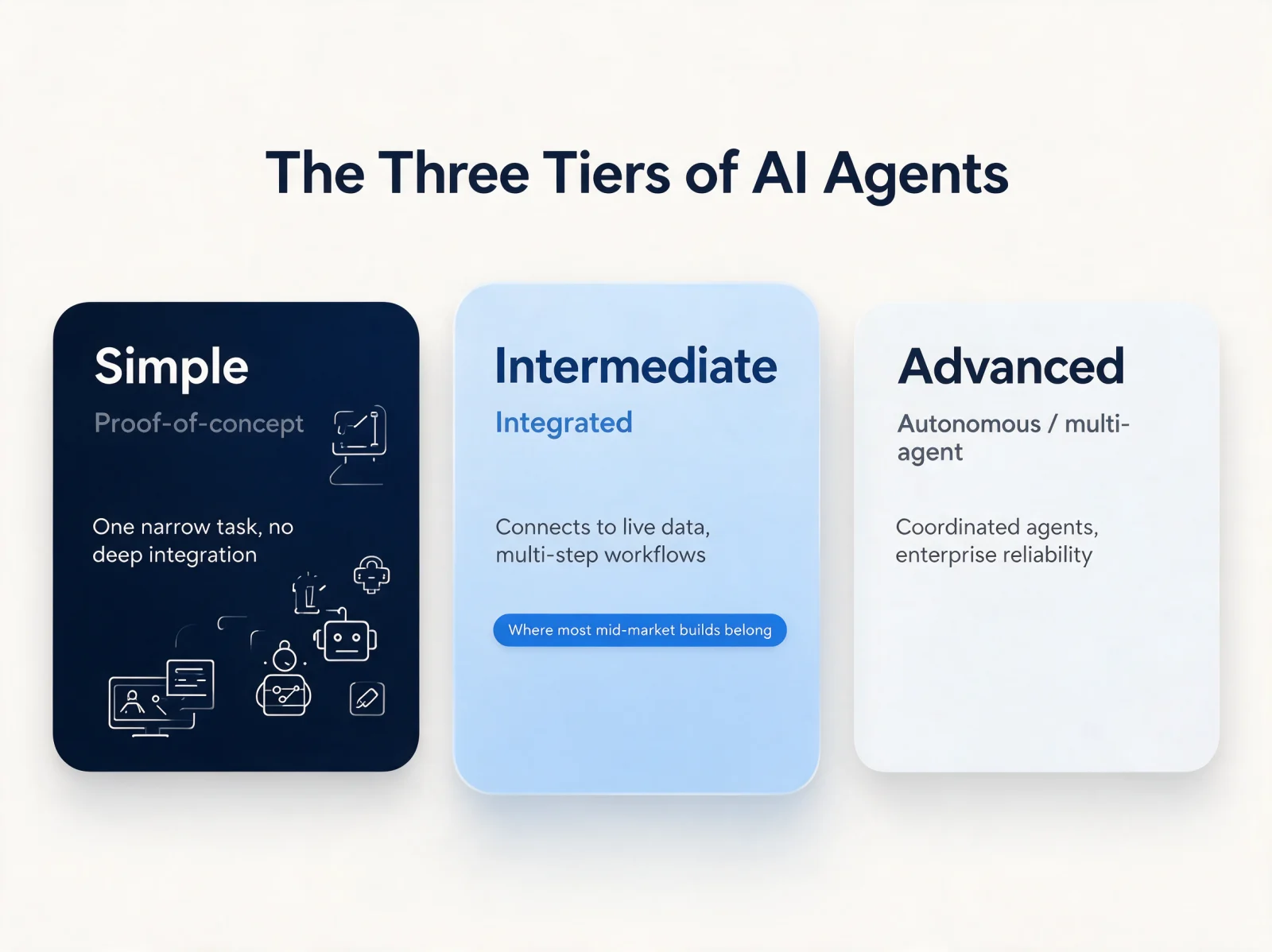
AI agents fall into three practical tiers, and knowing which one you actually need is the single biggest cost decision you'll make.
| Tier | What You Get | Best Fit |
|---|---|---|
| Simple (proof-of-concept) | A thin layer over an existing model, handling one narrow task such as FAQs or ticket routing, with no deep integration | A demo, rarely enough for production |
| Intermediate (integrated) | Connects to live business data, runs multi-step workflows, and operates inside your existing tools | Where most mid-market B2B deployments genuinely belong |
| Advanced (autonomous / multi-agent) | Multiple coordinated agents, deeper custom logic, and enterprise-grade reliability engineering | Organizations with mature data infrastructure and complex, high-stakes automation |
The common mistake is scoping toward the extremes. A bargain proof-of-concept rarely survives contact with real operational data, and an advanced build is overkill without the organizational readiness to support it. Assessing that readiness first is the step most firms skip. Gartner projects up to 40% of enterprise applications will carry task-specific AI agents by the end of 2026, up from under 5% in 2025, so budgeting for a tier now beats scrambling into one later. The market for AI agent platforms and builders shifts fast enough that last quarter's shortlist is already stale.
Why Integration Costs More Than the Model
The intelligence inside your AI agent is rarely the expensive part. Connecting it to your actual business data is.
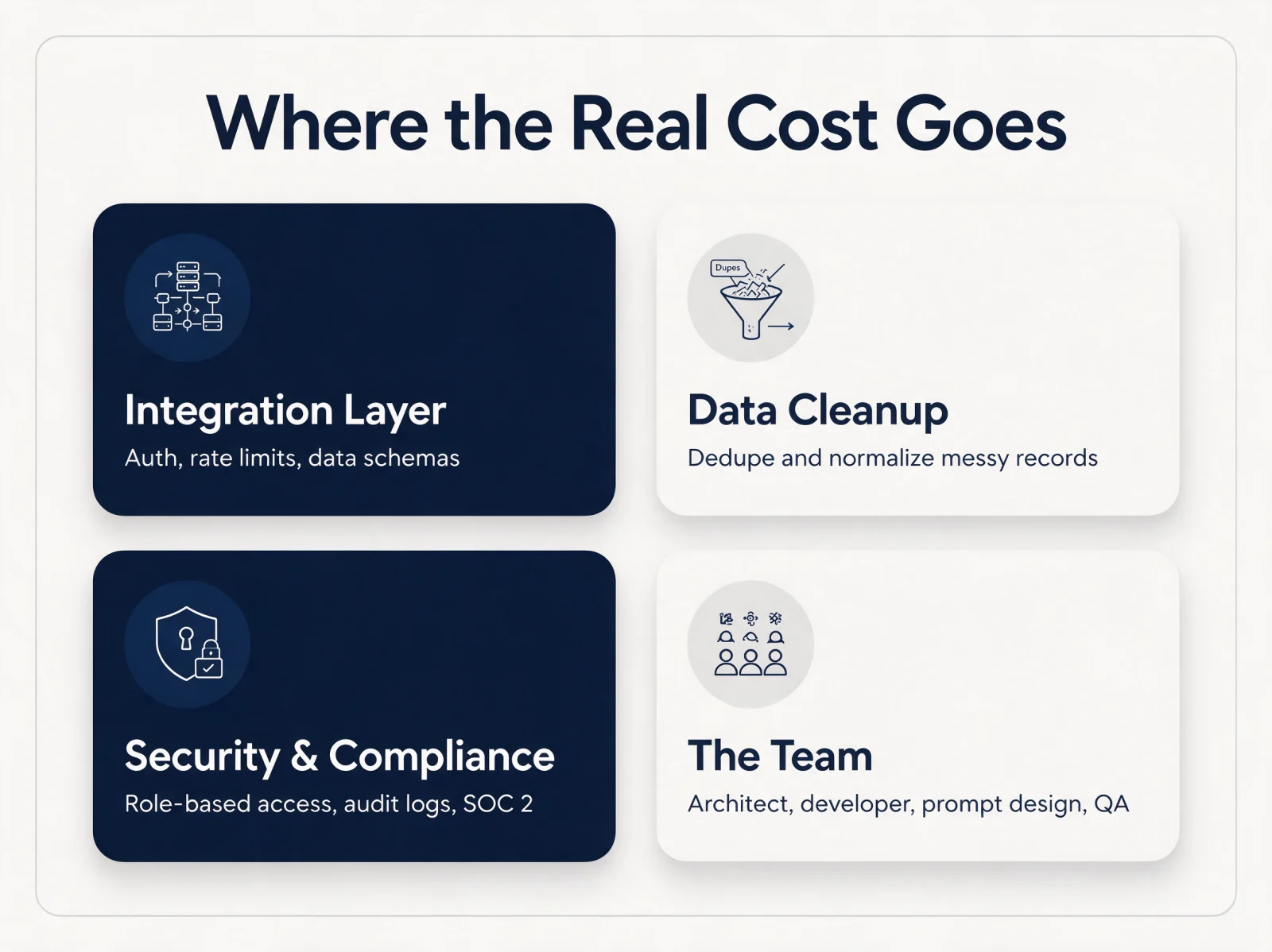
Teams budget for the model and the logic, then discover the real spend lives in the integration layer. Connecting an agent to systems like Salesforce, HubSpot, or Microsoft Dynamics 365 means dealing with different authentication patterns, rate limits, and data schemas for each. A reliable two-way connection, one that reads pipeline data and writes outcomes back, is a meaningful line item on its own, and it compounds when your stack carries multiple CRMs from acquisitions or legacy deployments. For AI agents for CRM workflows, integration depth is the single biggest swing factor in the quote.
Messy data is the silent budget-killer. Agents fail when they hit inconsistent field formats, duplicate records, or missing values, and most databases have all three. Data cleaning and normalization is work agencies routinely under-quote, because clients assume their data is cleaner than it is.
Security and compliance add another layer buyers rarely expect: role-based access, audit logging, and sometimes GDPR or SOC 2 considerations depending on your verticals. Proper governance for an agent is what separates a defensible production system from a liability.
The Real Cost to Build an AI Agent: Who You're Paying For
A production-ready agent is a team effort, and the people, not the model, are the largest single cost driver.
The Core Build Team
A functional agent is not a solo-developer project. A typical build needs an AI architect to design the reasoning structure and guardrails, a developer to handle integrations and orchestration, someone owning prompt design and iteration, and QA to test the edge cases and failure modes that standard unit tests miss. See how we structure this team in AI agent design consulting.
Why Cheap Builds Cost More Later
Agency teams cost more upfront but usually cost less overall. Teams that hire the cheapest option to cut corners often absorb heavy refactoring costs when brittle agent logic fails under real production load. Cheap builds break in ways that are expensive to diagnose. Understanding how the operating model fits together before hiring matters more than the rate card.
AI Agent Cost Per Month: The Monthly Bill After Launch
Once your agent is built, the invoices change form rather than stop. Recurring costs are the most underestimated line item in any AI agent budget.
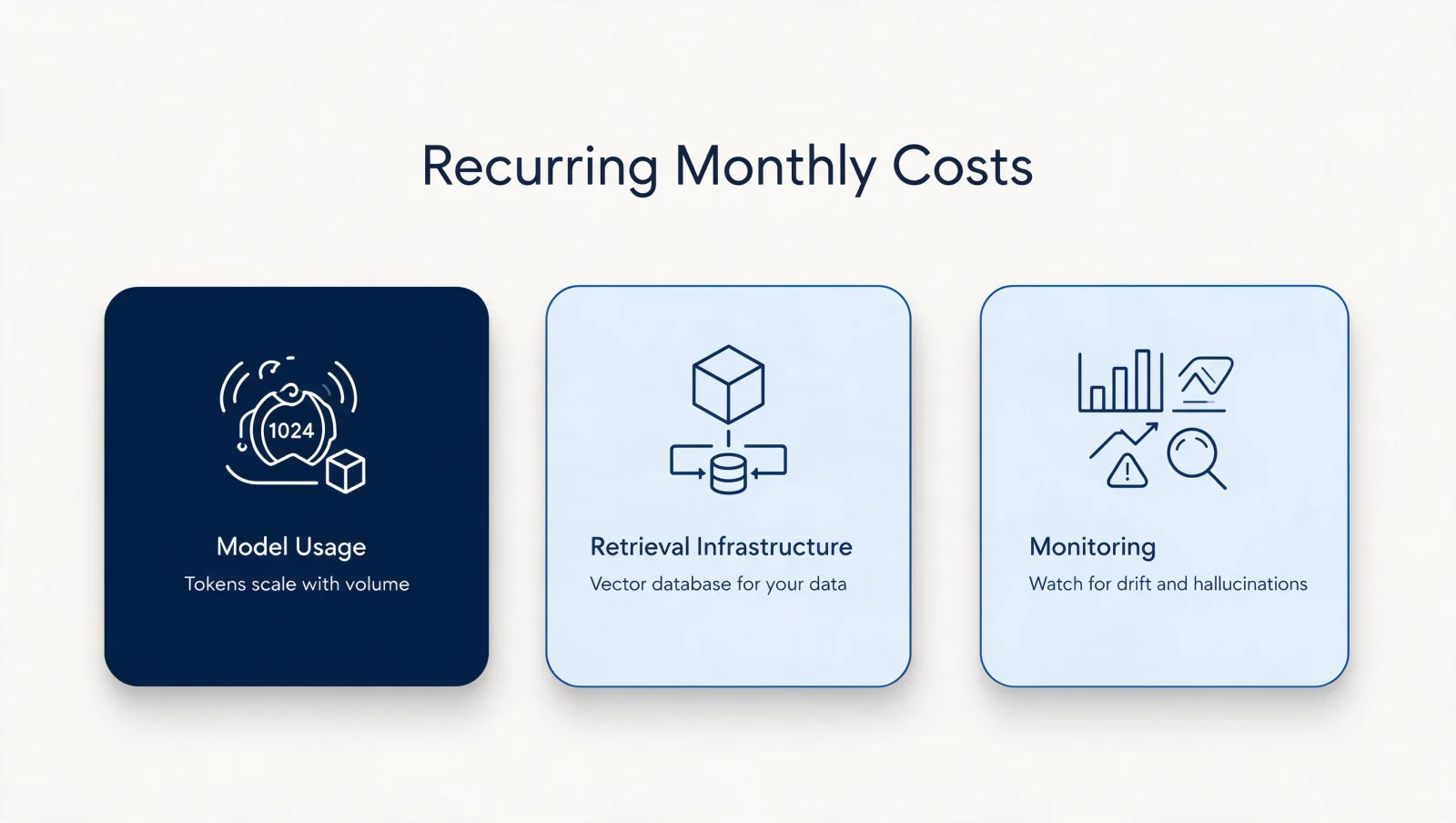
Three costs compound monthly:
- Model usage. Every query, context load, and response consumes tokens, and cost scales directly with volume. An active agent handling thousands of requests a day accrues real monthly spend, more if it uses premium model tiers.
- Retrieval infrastructure. Agents that pull answers from your own documents or CRM (retrieval-augmented generation) need a vector database to store and query embeddings. Costs are fairly predictable but grow with your data footprint.
- Monitoring. Watching for hallucinations, drift, and failures is a genuine operational requirement, not optional overhead.
Input token prices keep falling. McKinsey has tracked the cost per million input tokens dropping from about $36.00 in March 2023 to about $3.50 in August 2024, close to a tenfold decline in under two years. That trend looks reassuring until volume, premium model tiers, and retrieval infrastructure claw the savings back, which is why the agent cost per month rarely shrinks the way buyers expect.
The Maintenance Trap
AI agents are not set-it-and-forget-it software, and the gap between what teams budget for upkeep and what they actually spend is where ROI quietly erodes.
Plan for ongoing maintenance as a standing annual cost, not a one-time fee. The disruptive part is the underlying model. When a foundation model changes generation, the prompts and behaviors your agent was built on can shift. What worked reliably at launch may drift, truncate, or produce off-brand responses after an update. Prompt design is an ongoing discipline with real labor cost.
Traditional IT systems keep annual run costs to roughly 10 to 20 percent of the initial build, per McKinsey's research on gen AI deployment economics. AI agents break that pattern: at scale, recurring costs can meet or exceed the original build, so a maintenance budget modeled on old software rules undercounts the real number.
Human-in-the-loop oversight is the underbudgeted line item that prevents brand damage. Without structured review checkpoints, an agent at scale can surface wrong information or execute flawed workflows before anyone notices. Building oversight into the architecture from day one is risk management, not overhead. Teams that treat it as optional usually discover it becomes mandatory after an incident.
AI Automation Agency Pricing: How Agencies Price AI Agent Work
The billing model shapes your total spend as much as the build itself, so understand it before signing a statement of work.
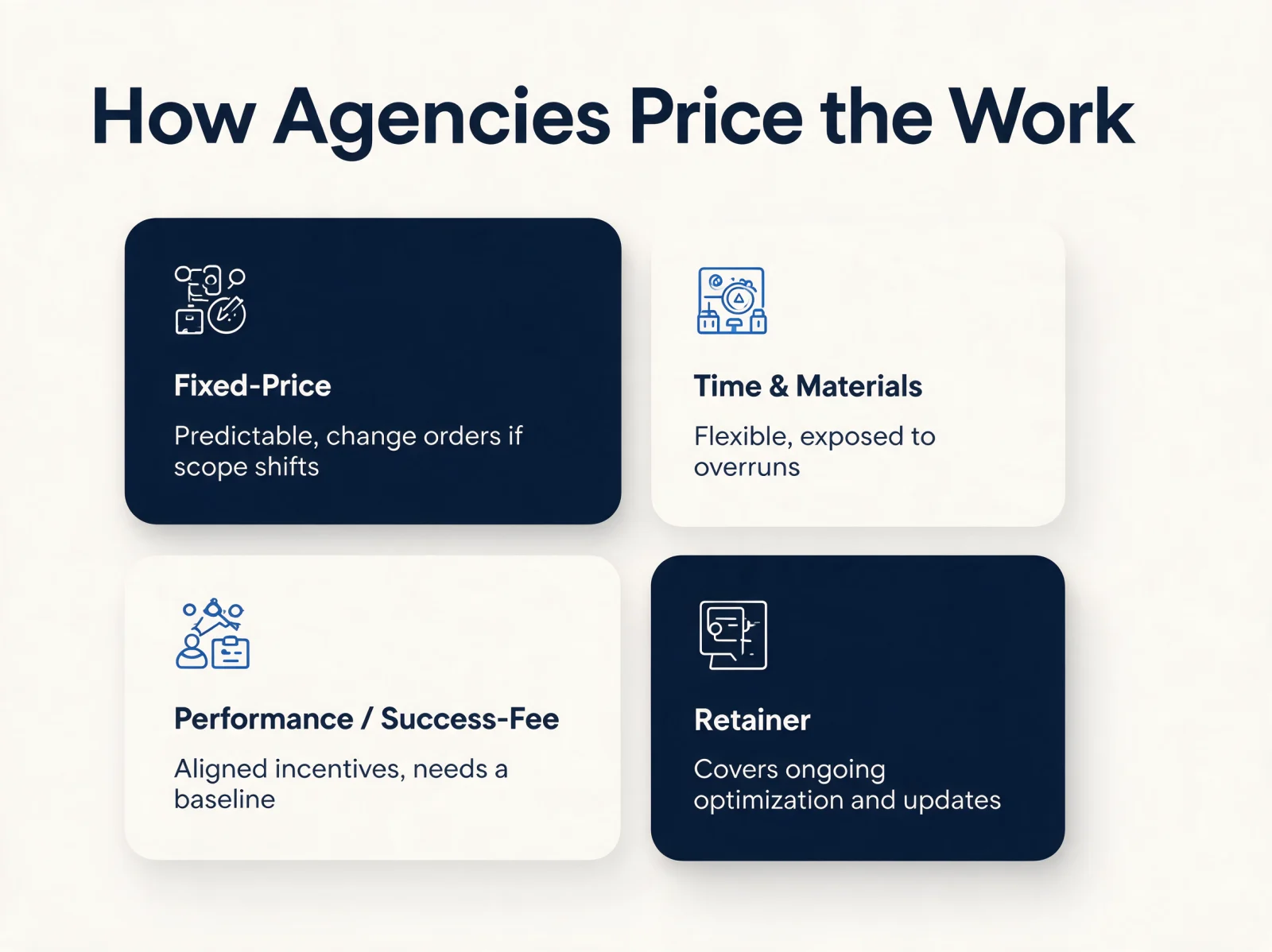
- Fixed-price gives predictability for clearly scoped automations, but generates change orders when requirements shift mid-build, which they often do in complex B2B environments.
- Time and materials flips that risk to you: flexible as the build evolves, but exposed to overruns if discovery surfaces hidden complexity.
- Performance or success-fee models tie cost to the volume of work automated. Salesforce's own Agentforce runs on this logic: $2 per resolved conversation, or credit-based consumption past the included allotment. This ai automation agency pricing model aligns incentives well but demands rigorous baseline measurement, or you'll argue over what counts.
- Retainers cover ongoing optimization, model updates, and governance, the work that keeps a deployed agent accurate. For agents running across sales and RevOps workflows, factor a retainer in from day one. Skipping it is a leading reason agents degrade within months of launch.
When Does an AI Agent Pay for Itself?
An AI agent investment makes financial sense only when you can model, specifically, where cost savings or revenue impact cross the build price.
The first mistake is measuring only hours saved. Freed hours have no dollar value unless they're redeployed into revenue work. A rigorous frame combines two variables: direct cost elimination (headcount reduction or reallocation) and indirect revenue lift (faster pipeline velocity, fewer dropped leads, tighter quote-to-close cycles).
Error reduction is undervalued. In sales and RevOps, a single misrouted enterprise lead or duplicated record costs real money in wasted effort and delayed revenue. Agents that enforce data hygiene at the point of entry compound their return quietly, quarter over quarter.
Scalability is where the math becomes clear. A human team handling 500 monthly touchpoints has to add headcount to reach 5,000. An agent handles that volume at marginal infrastructure cost. The way to justify the spend to a CFO is a simple model: annual labor savings plus revenue lift from error reduction, divided by total agent cost (build plus maintenance). Aim to cross a 2x return, and define the baseline before the build starts.
Key Takeaways: Budgeting for an AI Agent
The real cost of an AI agent is not just the build. It's everything that keeps it working after launch.
- Budget for a functional, integrated B2B agent in the mid five figures. Where you land depends on integration complexity, data volume, and how many decisions the agent handles.
- Reserve an annual maintenance budget. Models evolve, token pricing shifts, and business logic drifts, so plan for ongoing upkeep from day one.
- Prioritize CRM integration above all else. An agent disconnected from your customer data is an expensive novelty. Integration with Salesforce, HubSpot, or Dynamics is what turns cost into pipeline impact.
- Build human-in-the-loop governance in from the start. Automated decisions without oversight create financial and brand exposure no ROI model accounts for.
Turning Cost into Result
The firms that get the most from AI agent development treat it as a business transformation first and a software project second.
A pure dev-shop relationship optimizes for shipping code. A consulting-led approach optimizes for business outcomes, and that difference explains why two companies can spend identical budgets and land in completely different places. The consulting layer forces the hard questions early: which workflows actually bottleneck revenue, and where automation creates compounding value versus marginal efficiency. Skipping that diagnostic is the most reliable way to overbuild and underproduce.
Readiness and governance are cost controls, not bureaucracy. Before a line of code is written, you need a clear picture of your data maturity, integration landscape, and compliance exposure. Teams that skip it routinely discover mid-project that their CRM data is too fragmented to support the agent logic they've already paid to design. That rework is avoidable.
See how a wealth advisory firm cut client-review prep 68% with governed, CRM-connected AI agents.
Twelverays scopes AI agent development as an integrated system, aligning automation with CRM workflows and growth targets so every agent serves a measurable commercial purpose. If you're ready to move from budgeting to a clear plan, start with a scoped AI readiness assessment and agent build.


