

HubSpot implementation cost depends on the work included, the condition of your data and who will perform each task. The useful HubSpot onboarding vs implementation comparison is a deliverable-by-deliverable review of the offers in front of you. Before judging HubSpot implementation pricing, separate software charges, onboarding services, delivery work and the time your own team must contribute.
Implementation is the work to configure agreed business processes, prepare and move data, connect tools, test the result and help users operate it. Onboarding is a service for getting started with the purchased software. Its agreement determines whether the supplier advises your team, performs specific tasks or combines both approaches.
Compare HubSpot onboarding vs implementation by responsibility
HubSpot describes its onboarding services as a plan based on the customer's goals, organization, purchased products and current technology. Its service descriptions include technical and strategic guidance. The scope still needs to be read alongside the service purchased and the order.
Avoid reducing the comparison to “HubSpot teaches, partners build.” HubSpot's Product & Services Catalog describes onboarding specialists assisting with setup or implementation and also lists separate migration and consulting services. A partner's offer can likewise involve advice, delivery or both.
For each task, ask who performs it, what your team supplies and what demonstrates completion. Use the following worksheet for both vendor and partner offers. Fill in the supplier's actual commitment rather than assuming the answer from its business model.
| Work item | Question for each supplier | Evidence to define |
|---|---|---|
| Process design | Who approves pipeline stages, lifecycle rules and handoffs? | An approved process map and decision record. |
| Configuration | Who creates and tests the agreed properties, pipelines and automation? | Configuration documented against the approved requirements. |
| Migration | Who maps, cleans, imports and checks the source data? | Rehearsal results, exceptions and representative record checks. |
| Integrations | Who connects each system and owns failures after launch? | Tested data flow and a recovery procedure. |
| Reporting | Who defines the measures and builds the agreed reports? | Reports reconciled to their documented source records. |
| Training and handover | Who prepares users and administrators? | Delivered training, working access and maintenance instructions. |
The HubSpot implementation setup guide explains the broader setup sequence. Use it as background while keeping this comparison focused on what each quoted fee buys.
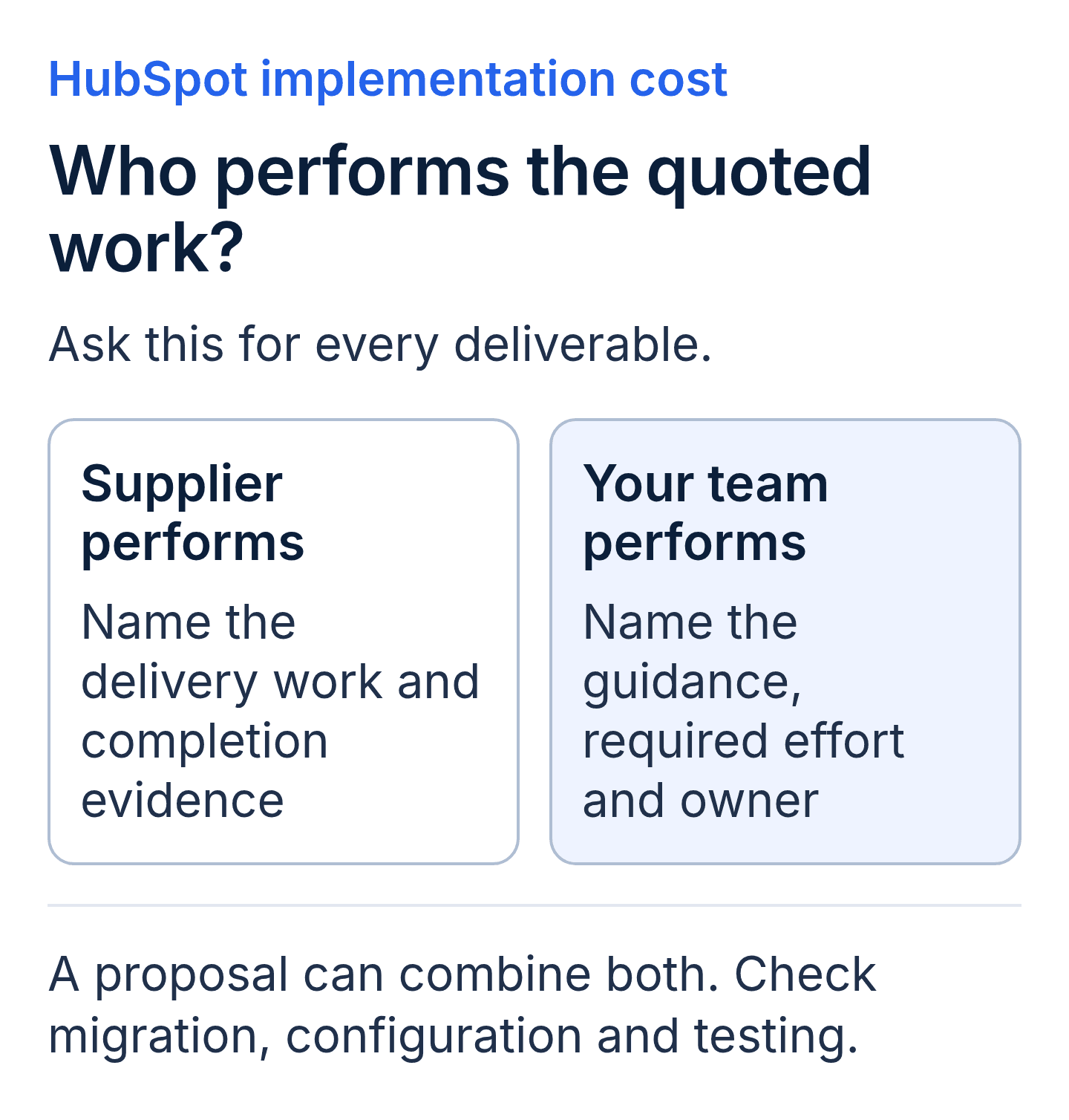
Compare actual commitments in each onboarding or implementation offer. The supplier’s label alone does not establish who performs the work.
Build a HubSpot implementation cost worksheet
For a stated planning period, a HubSpot implementation budget should include delivery fees, applicable onboarding charges, software, external tools and support. Compare those categories across proposals, and record your staff time separately. This puts bundled and itemized offers on the same basis.
Separate one-time fees from recurring charges. According to HubSpot's Product & Services Catalog, user access depends on seat type, while eligible AI and automation features can consume HubSpot Credits. Credits reset monthly, and unused credits do not roll over. Ask which subscriptions, seats and credit usage the quote assumes, and who approves additional capacity.
For each cost line, capture the supplier, currency, billing schedule, contract period and quantity assumption. If you operate in the United States or Canada, keep currency explicit. Comparing a US-dollar services quote with a Canadian-dollar estimate without conversion produces a misleading total.
Customer effort is the work your staff must contribute to delivery. It can include process decisions, content preparation, data cleanup, workshops and testing. Estimate those hours using your own staffing assumptions. Keep them visible alongside the vendor fees, with a named owner for each required input.
| Cost category | What to check before comparing totals |
|---|---|
| HubSpot subscriptions | Products, tiers, seat types, quantities and term. |
| Vendor onboarding or other services | Exact service purchased, delivery period and responsibilities. |
| Partner implementation | Included deliverables, assumptions and customer inputs. |
| External tools | Connector, middleware or other subscription charges. |
| Ongoing support | Coverage, capacity, request process and renewal terms. |
| Optional work | Separately priced requirements that are not part of the base commitment. |
Ask whether taxes, travel if relevant, and third-party fees are included in the quoted totals. Request a current commercial quote for the selected software configuration. A published subscription price does not establish a partner's delivery fee.
Read a HubSpot implementation quote through a worked example
Consider this hypothetical comparison in US dollars. These numbers illustrate quote normalization; they are not market averages or Twelverays prices. Both offers concern the same launch requirements, and software, taxes and recurring support are excluded from both totals.
| One-time service item | Hypothetical offer A | Hypothetical offer B |
|---|---|---|
| Base configuration and training | $8,000 | $12,000 |
| Required data migration | $3,000 separately | Included |
| Required integration | $2,000 separately | Included |
| Total for the stated scope | $13,000 | $12,000 |
Offer A's initial figure is lower, but its total for the stated work is $1,000 higher. That does not automatically make B preferable. You still need to compare the migration limits, integration behavior, acceptance plan and customer effort behind the numbers.
If A's migration price assumes a clean file and B includes source cleanup, the comparison needs another clarification. If both exclude cleanup, assign that work and estimate its cost before selecting either offer. An unanswered scope question should stay visible rather than disappearing into a single total.
Use the same method with your proposals. Add required exclusions back into the comparison, separate optional work and retain the assumptions supporting every estimate. A smaller purchase can be appropriate when your team has the capacity to deliver the remaining work.
Identify the assumptions behind HubSpot implementation pricing
Data condition is a concrete place to start. Record count matters, but it does not describe the work needed to resolve duplicate people, inconsistent company names or missing relationships. Ask for the proposed matching rules, cleanup owner and handling of rejected records.
According to HubSpot's import-file requirements, updating records requires a unique identifier, such as a Record ID, contact email or company domain. Blank import cells do not clear existing property values. Ask the supplier how it will identify existing records and remove unwanted values. Those are separate delivery decisions from preparing a file that imports successfully.
Workflow effort depends on the rules and exceptions you need. Give candidates representative handoffs, including reassignment, missing information and a request that should stop. Ask which requirements use standard configuration, which require additional subscriptions and which involve custom work. Confirm the relevant entitlements before approving the design.
Integrations need a similar review. Name the systems, records, direction of exchange and update frequency. Ask who manages authentication, errors and later changes to either application. The CRM integration guide provides background on these dependencies.
Content and approvals can affect delivery too. Identify the owner of email copy, forms, sales templates and reporting definitions. State how many review rounds are included and what happens when a requested revision changes the approved requirement. This is a scope decision, not a reason to assume every delay creates an extra fee.
Check what changes the HubSpot partner onboarding cost
Fixed fee means an agreed price for defined work, subject to the contract's change terms. A time-based estimate projects charges from expected effort and rates. For either model, ask what could change the payable amount and who must approve it. A recurring service should identify the capacity or deliverables purchased.
Ask the supplier to explain how it treats additional pipelines, new integrations, extra migration attempts and changes requested after approval. Where an allowance is included, define what consumes it and how the balance is reported. Request written approval before additional work becomes a billable commitment under the agreed process.
Check the service window before committing your team. HubSpot's onboarding service descriptions, reviewed September 7, 2026, list delivery periods of 60 days from purchase for Sales Hub Professional Onboarding and 90 days for Sales Hub Enterprise Onboarding. These are periods for the named services, not a launch deadline for your entire implementation. Confirm staff availability, required inputs and the process for rescheduling or unfinished work in the applicable order.
The HubSpot partner guide offers context for evaluating providers. Your own proposal review should concentrate on the named team, responsibilities and commercial terms, without treating a partner label as proof of a particular delivery package.
Tie payment milestones to observable delivery
A statement of work (SOW) records the deliverables, responsibilities, assumptions and boundaries of an engagement. User acceptance testing (UAT) checks the delivered system against agreed business requirements. A completed onboarding service and an accepted implementation can represent different milestones. Define the evidence needed for each before tying either one to payment.
For an illustrative sales handoff, acceptance might require a test enquiry to create the expected record, reach the approved owner and appear in the agreed report. Include an exception, such as missing territory information, and document what should happen. Confirm that the selected product configuration supports the requirement.
For migration, ask for totals and representative record checks. Verify mapped fields, relationships and exceptions. For reporting, give the approver a known set of records and ask the delivery team to explain the filters and calculations behind the result.
Document the evidence location, reviewer and treatment of unresolved defects. Payment terms are negotiated, but the deliverables associated with a milestone should be understandable before the invoice arrives. Avoid using a future revenue target as the sole test of technical completion; sales results depend on business activity beyond configuration.
At handover, verify customer-controlled access and the agreed documentation. Identify who will maintain automation, troubleshoot integrations and update reports. Support can be included or separate. Define its coverage and the process for distinguishing defects from new requests.
Key takeaways
- Compare each supplier's promised work and your team's responsibilities, including configuration, migration and testing.
- Use one planning period and currency for software, services, external tools and support.
- Add required exclusions to each quoted total; keep optional work separate.
- Check service windows and customer availability before buying onboarding.
- Record acceptance evidence, change approval and post-launch ownership in the agreement.
HubSpot implementation cost buyer FAQs
Is HubSpot onboarding the same as implementation?
The terms can overlap. Read the exact service description and agreement. Ask who will perform configuration, migration, integration, testing and training, then identify any work your team must still complete.
Can we pay for software and still need delivery help?
Yes. Software access does not establish who will configure your processes or prepare data. Your internal team, HubSpot services, a partner or a combination can perform the work, depending on the services purchased and your available capacity.
Does working with a partner automatically remove an onboarding charge?
Do not assume a waiver. Ask HubSpot and the proposed partner to confirm the purchasing arrangement and any applicable service requirements in the current order. Keep the answer in the commercial record before approving either quote.
What is the fastest way to compare two offers?
Map them to the same deliverables, customer responsibilities, assumptions and acceptance evidence. Separate recurring costs from one-time fees. Resolve material differences before deciding which total represents the scope you need.
Terms to define in the cost comparison
| Term | Meaning |
|---|---|
| Scope assumption | A condition used to estimate the work, such as receiving a cleaned source file. |
| Exclusion | Work omitted from the quoted commitment that needs another owner or budget if required. |
| Change request | A proposed adjustment to approved scope, with its cost and schedule effect reviewed before approval. |
| Acceptance criteria | Observable conditions used to decide whether a deliverable meets the agreed requirement. |
| Recurring support | Ongoing assistance with defined coverage, capacity, responsibilities and commercial terms. |
Twelverays' HubSpot consulting services describe assessment, marketing automation, sales pipelines, reporting and training. Bring your subscription details and onboarding proposals to a discovery call to identify the implementation work and responsibilities your budget needs to cover.


