

Hiring a LinkedIn Ads agency starts with agreeing what the team will deliver and how you will assess it. A useful LinkedIn agency proposal connects audience selection, creative production and sales follow-up to your buying process. Define LinkedIn lead quality before launch so a low cost per form submission does not become the only measure of success.
A LinkedIn Ads agency provides the campaign services specified in its agreement. That can include planning, creative, media management and reporting, with different responsibilities assigned to the agency and customer. Read the deliverables before assuming that a management fee includes design, website work or customer relationship management (CRM) integration.
Interview a B2B LinkedIn advertising agency about buyer fit
Bring a short account and buyer brief to each interview. Describe the organizations you want to reach, the roles involved in a purchase, your sales territories and any audiences you intend to exclude. Explain the offer and the action it asks someone to take. A technical guide, product demonstration and sales consultation represent different commitments from the reader.
According to LinkedIn's audience targeting overview, advertisers can use member-generated professional data, including job title, company, industry and seniority. The platform also describes company, contact and retargeting options. These capabilities give the agency ways to construct an audience; they do not establish demand for your particular offer.
Ask the candidate to show how your buyer criteria translate into the available settings. Request the proposed inclusions, exclusions and an explanation of any assumptions. Treat audience estimates as planning evidence, then check who the campaign actually reaches when reporting becomes available.
If you supply named accounts, agree who checks the list and investigates unmatched or unsuitable entries. If the agency proposes a broader audience, ask which hypothesis justifies it and what evidence would support keeping or changing that approach. Avoid treating a precise job-title list as a complete buying committee.
For a broader account strategy, use the existing account-based marketing guidance. Keep this procurement discussion focused on the audience work included in the proposed engagement.
Compare LinkedIn advertising services by deliverable
Ask each supplier to mark the following work as included, separately priced or supplied by your team. A recommendation and a finished asset are different deliverables, so identify the person responsible for implementation as well as the person giving advice.
| Workstream | What the proposal should specify | Completion evidence |
|---|---|---|
| Audience and offer | Buyer criteria, proposed offer and testing rationale | Approved audience brief and campaign objective |
| Copy and design | Formats, quantities, source assets and revision terms | Approved files and usable final ad assets |
| Destination | Form or landing-page work, implementation owner and tracking | Working destination and agreed test results |
| Campaign management | Launch checks, monitoring, changes and spending authority | Recorded settings, approvals and change history |
| Lead handoff | Retrieval method, field mapping, routing and exception owner | A representative lead reaches the intended destination |
| Reporting | Measures, data sources, review cadence and decisions | A report that can be traced to its source records |
Define what prompts new creative. The proposal might include an agreed production cadence, a review after enough delivery data exists, or additional work by approval. Ask how the agency distinguishes an audience issue from an offer, creative or destination issue. A falling response rate alone does not identify the cause.
Confirm who supplies customer stories, screenshots, subject expertise and brand files. Record rights to use those materials, approval responsibility and the treatment of late revisions. If destination changes sit with your website team, give that team a named contact and a clear request process.
The article on whether LinkedIn ads fit your business addresses the channel decision. The proposal should now explain what will be built, by whom, and within which fee.
Test the sales handoff in your LinkedIn agency proposal
Lead routing is the process that assigns an enquiry to the person or queue responsible for the next action. Include that process in your scope discussion even if another supplier implements the technical connection.
LinkedIn's Lead Gen Forms documentation describes forms populated with professional profile information. It also states that leads can be downloaded from Campaign Manager or passed to a CRM or marketing automation tool through an integration. The availability of those routes does not tell you which one your agency has priced or who maintains it.
Ask for a handoff map covering the form, destination, required fields, matching rules and record owner. Identify who checks permissions, confirms permitted data use and responds when delivery fails. For a manual download, name the person and schedule. For an integration, name the implementation and monitoring owners.
A useful acceptance test follows an authorized test submission into the destination system. Verify the campaign reference, mapped fields, assigned owner and next action. Include an exception, such as an existing contact or an unavailable owner, rather than checking only a straightforward new enquiry.
Agree a follow-up expectation that your sales team can meet. There is no need to invent a universal deadline. State which business hours apply, who covers absences and how an unworked enquiry is escalated. The agency's delivery responsibility and your sales team's response responsibility should both be visible.
Finally, give sales a practical way to return rejection reasons. Wrong organization, unsuitable role, no relevant need and duplicate enquiry imply different decisions. A shared definition of marketing-qualified and sales-qualified leads helps the campaign team interpret that feedback.
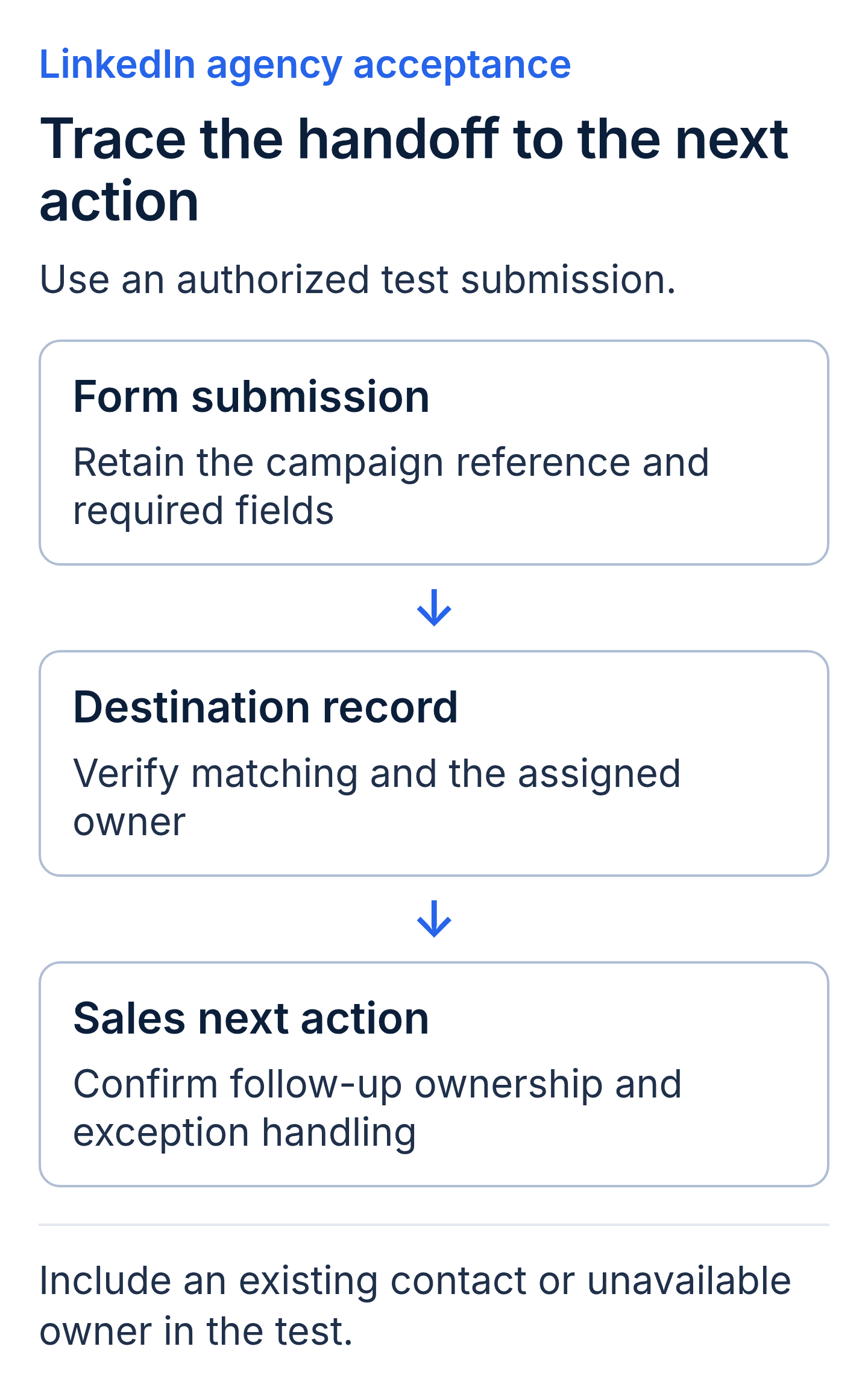
Test technical delivery and sales responsibility together. The agreed retrieval method still needs an owner, and a delivered record does not prove that follow-up occurred.
Judge LinkedIn lead quality with traceable evidence
Lead quality means how well an enquiry meets the fit and qualification criteria agreed by your business. Define those criteria before reviewing results. Separate raw submissions, accepted leads, opportunities and records that remain unassessed. Keep the reporting period and the date each stage was reached visible.
According to LinkedIn's conversion tracking guide, advertisers can share conversion data through a website tag, manual uploads and connected data methods. Ask which method the proposal includes, which action it records and who checks the implementation. A tracking installation is not complete merely because a code snippet has been added.
Request the rules behind each reported conversion: the qualifying action, attribution settings, source system and treatment of duplicate events. Attribution is the method used to assign credit for an outcome to marketing interactions. LinkedIn reporting and your CRM can answer different questions, so ask the agency to explain differences before combining their totals.
Use a hypothetical review during selection. Suppose form submissions increase, but sales rejects more enquiries for poor company fit. Ask the agency to inspect audience delivery, the offer, form responses and sales disposition before proposing a change. If rejected leads were actually suitable but never contacted, an audience adjustment would address the wrong problem.
A sample report should show a decision record alongside results: what changed, why it changed and what evidence will be reviewed next. Ask how the team reports missing feedback and limited data. An empty opportunity column may mean no opportunities, incomplete qualification or a reporting problem; the agency should identify which explanation the records support.
Set boundaries for LinkedIn ad management
Separate media spend from agency fees, production charges, software and optional implementation work. Record the currency and billing basis, particularly when comparing United States and Canadian proposals. Confirm any minimum commitment, renewal terms and process for approving additional work from the actual offer.
Define the spending limit and change authority in writing. Name the customer approver for budget increases, new audiences, new claims and material destination changes. Give the agency enough approved discretion to perform the contracted work while making exceptions visible.
Retain appropriate customer access to the account and reporting. Confirm the access required by each agency role, who controls billing and how access changes when someone leaves the engagement. Do not assume that account access also grants ownership of every creative file or third-party asset.
For exit, list the campaign records, reports, approved assets and documentation to be delivered or retained. State any licensing restrictions and the handover timing. Ask who will disable obsolete integrations or remove agency access after the replacement arrangements are tested.
Ask who will perform the work after the sale, who reviews their decisions and how staff changes are communicated. Evaluate the delivery roles alongside the pitch team.
Glossary for LinkedIn Ads agency buyers
| Term | Working definition for the engagement |
|---|---|
| Ideal customer profile (ICP) | The organizational characteristics that describe a suitable customer |
| Buying committee | The people whose requirements or approval influence a business purchase |
| Offer | What the advertisement invites the audience to request or use |
| Accepted lead | An enquiry that meets the agreed criteria for the next sales action |
| Cost per accepted lead | The stated campaign cost divided by accepted leads for the defined period |
| Attribution window | The period used when considering a marketing interaction for conversion credit |
| Acceptance evidence | Records showing that a contracted deliverable meets its agreed conditions |
| Change authority | The decisions a supplier may make within the customer's approved limits |
Use these definitions to resolve differences between proposals. For cost per accepted lead, specify whether the numerator includes only media spend or also service fees. Neither version is useful for comparison if the suppliers count different costs or qualify leads differently.
LinkedIn Ads agency buyer FAQs
Does the management fee include creative?
Check the proposal. Ask for the number and type of finished assets, copywriting responsibilities, revision terms and production charges. A supplier may include creative or price it separately. Avoid inferring either arrangement from the phrase "full service."
Who follows up on leads?
Assign that responsibility explicitly. Your sales team, the agency or another provider may perform agreed follow-up work. The contract should identify the owner, required access, qualification rules and feedback process, with technical lead delivery tested separately.
What makes a useful pilot?
A pilot tests a specific question with an approved audience, offer, budget and decision process. Agree the evidence needed to continue, change or stop. Choose timing around expected delivery and your buying cycle; a fixed number of weeks cannot establish that every campaign has enough evidence.
Should the first report include pipeline?
Include available pipeline evidence, with its limits. Early reporting should also establish whether delivery, tracking, lead receipt and follow-up work as intended. Do not turn an early absence of opportunities into a final verdict without checking the sales cycle and record completeness.
What stays ours when the engagement ends?
Confirm account control, data access and asset rights in the agreement. Specify the files, reports and operational notes needed for continued management. Some third-party materials can have separate licences, so distinguish usable final assets from transferable source files.
Key takeaways
- Give candidates the same buyer criteria and offer before comparing audience recommendations.
- Separate creative production, destination work and management responsibilities in each quote.
- Test lead delivery and agree who follows up, qualifies and returns rejection reasons.
- Compare traceable lead-quality evidence, spending authority and handover terms alongside fees.
Twelverays' paid social services describe audience analysis, campaign planning and ongoing creative testing. Bring your audience brief, offer and sales qualification rules to a paid-social scope discussion to identify the work and ownership your engagement needs.


