

Natural Language to SQL: Query Your Data Without Writing Code
Natural language to SQL turns a plain-English question into a database query automatically. You ask "which accounts churned last month," and the system writes and runs the SQL for you, so business users get data without knowing SQL and analysts stop writing the same queries over and over.
SQL is the language of data, and most of the people who need data cannot write it. That gap is why reporting bottlenecks form: every question has to pass through someone technical. Natural language to SQL closes the gap by putting a translation layer between the question and the database. It is the engine under most conversational BI and AI data agents, and it is now good enough to rely on, if it is built correctly.
How Does Natural Language to SQL Work?
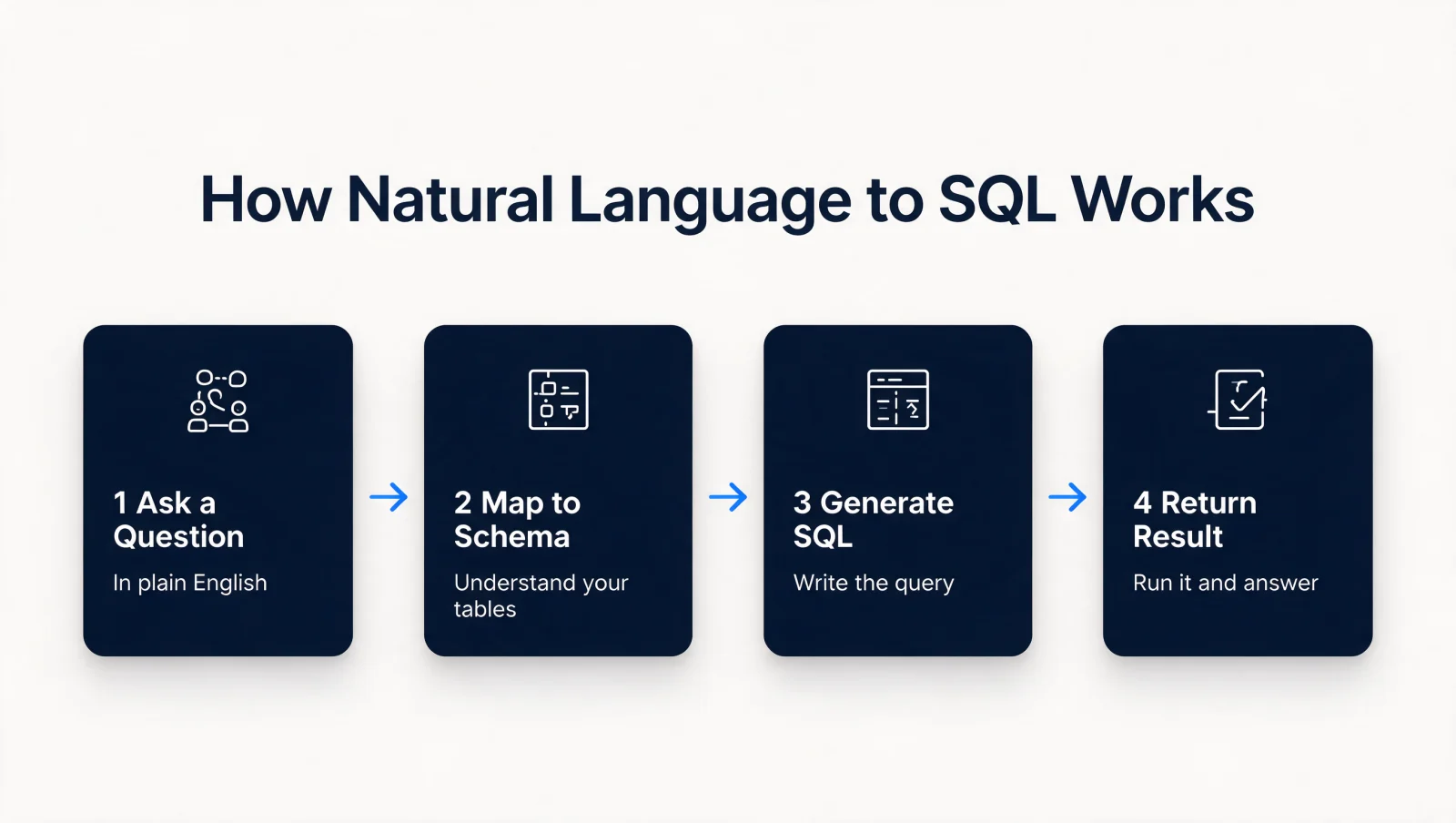
A language model reads your question, maps it to your database structure, generates the SQL, runs it, and returns the result. The quality depends entirely on how well it understands your specific schema.
The flow is straightforward. The model interprets intent, references a description of your tables and columns, writes the query, and executes it against your database. Modern models handle joins, filters, and aggregations that used to require a trained analyst.
The catch is context. A model that does not understand your schema will guess. It might join the wrong tables or misread which column holds the value you asked for. Accuracy comes from grounding the model in a clear, governed description of your data, not from the model alone.
Why Do Natural Language to SQL Tools Fail in Production?
They fail on ambiguity. Real business questions and real database schemas are messy, and a model with no governed definitions produces confident, wrong queries.
The demo always works. The production system struggles because your data is not clean-room simple. Consider the failure modes:
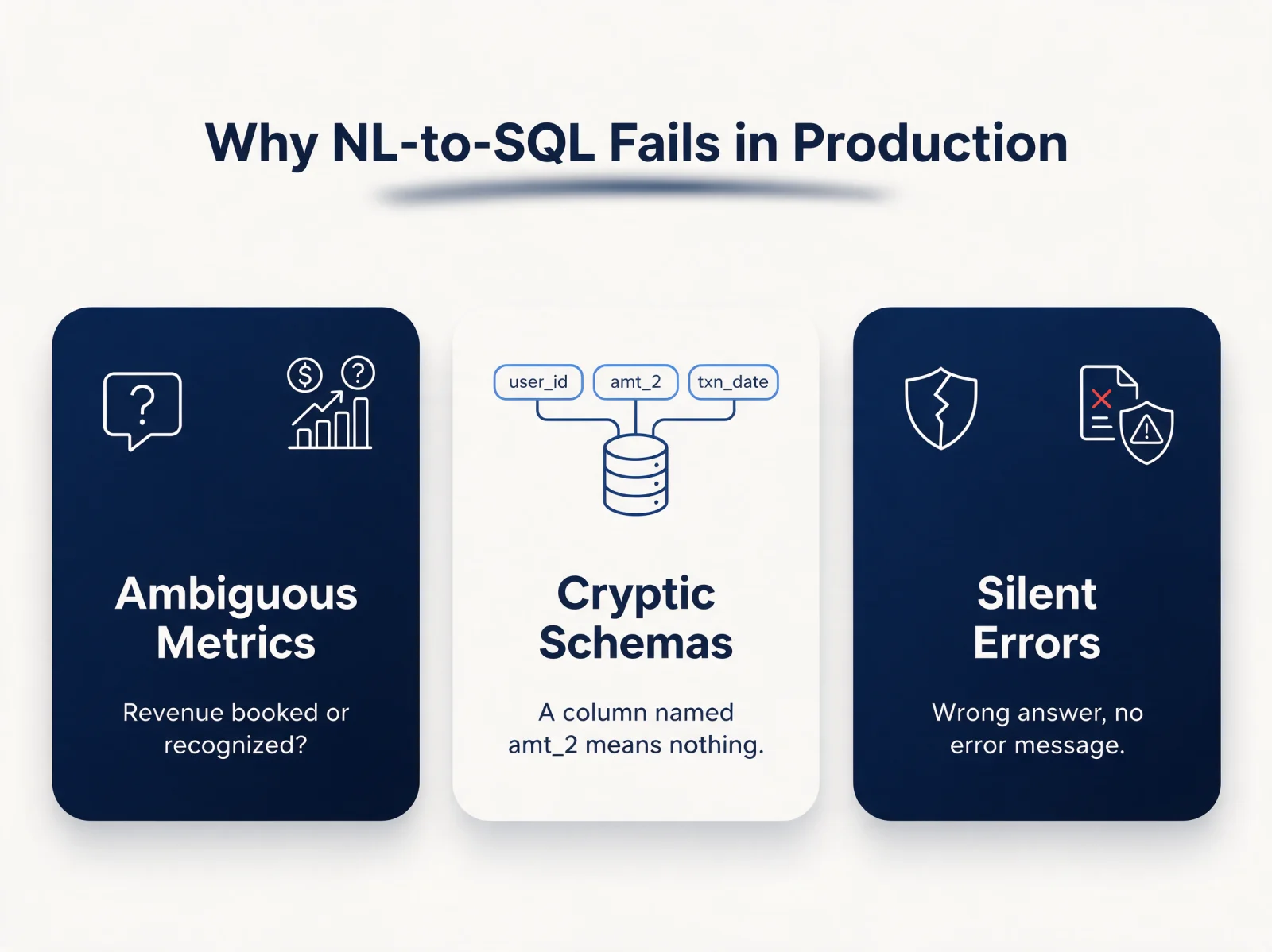
- Ambiguous metrics. "Revenue" could be booked, recognized, or invoiced. Without a single definition, the model picks one, and it may not be yours.
- Cryptic schemas. A column named
amt_2means nothing to a model. It needs a business description to query it correctly. - Silent errors. A wrong query returns a number, not an error. Nobody notices until a decision is already made on it.
This is why a raw model plugged into a raw database is risky for anything that matters. The reliability comes from the layer around the model.
What Makes Natural Language to SQL Reliable?
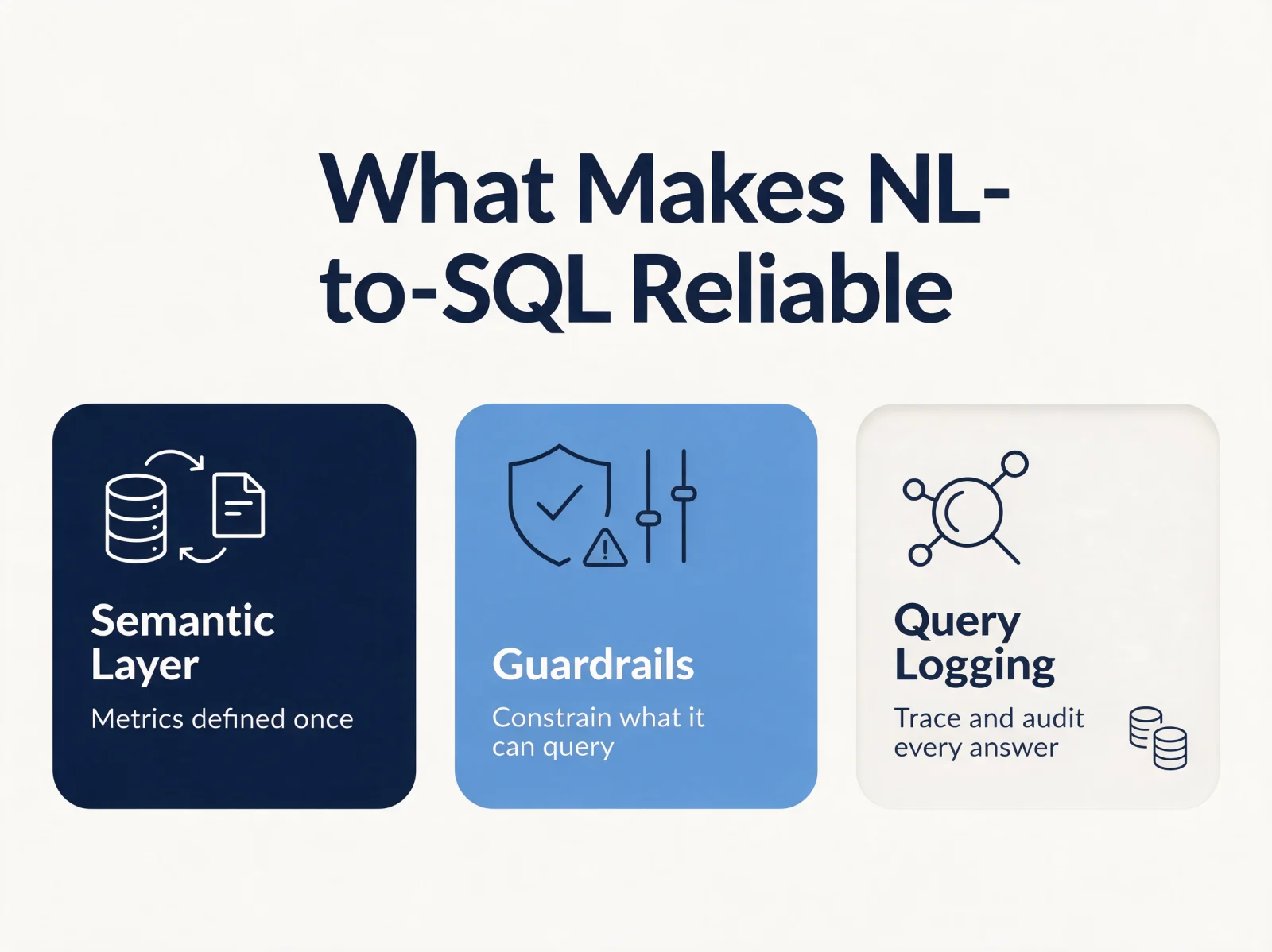
A semantic layer and guardrails. Define your metrics once, describe your schema in business terms, and constrain what the model can query, so every answer is consistent and auditable.
Reliable systems do not trust the model to improvise. They give it a governed map: metrics with fixed definitions, tables with plain-language descriptions, and rules for what it can and cannot touch. They also keep a human in the loop for sensitive queries, and they log every question and query so answers can be traced. That discipline, part of sound AI operations design, is the difference between a party trick and a system your finance team will actually use.
Natural Language to SQL vs. Writing Queries by Hand
Hand-written SQL is precise but slow and gated behind a skill. Natural language to SQL is fast and open to everyone, but only as accurate as the governed model behind it.
Writing SQL by hand gives an analyst full control and predictable results. The cost is time and access: every question waits on someone who knows the language. Natural language to SQL flips that. Anyone can ask, and answers come back in seconds. The tradeoff is that accuracy now depends on how well the system understands your schema, rather than on one careful person.
The two are not rivals. The best setups let analysts define the governed model and guardrails, then let the whole business self-serve on top of it. Analysts move from writing repetitive queries to owning the definitions that keep every answer correct.
What Can Natural Language to SQL Connect To?
Any structured source your business runs on: a data warehouse, a CRM, a finance system, or a product database. The value grows as it spans more of them.
A single-source setup answers questions about one system. The real payoff comes when the layer reads across sources, so a question like "which high-value customers reduced usage last quarter" pulls from the CRM and the product database at once. That cross-system reach is what turns querying into genuine business intelligence rather than a lookup tool.
How Do You Roll Out Natural Language to SQL Safely?
Start with a read-only setup on one well-modeled database, keep a human in the loop for anything sensitive, and log every query so you can audit answers.
A safe rollout is deliberate. Begin read-only, so the agent can answer but never change data. Point it at one database you have already modeled cleanly. Require human review before any answer drives a high-stakes decision, and keep a full log of questions and generated queries so a wrong result can be traced and fixed. As confidence grows, widen the scope. This measured path is part of disciplined AI operations design, and it is the difference between a tool people trust and one they quietly stop using.
Is Natural Language to SQL Secure?
It is as secure as the controls you build around it. A well-designed system inherits your existing permissions and never lets the model touch data a user is not cleared to see.
Security is a design decision, not a property of the model. A responsible deployment runs queries under the asking user's existing access rights, so the agent only returns data that person is already allowed to see. It stays read-only for anything sensitive, keeps credentials out of the model's reach, and logs every query for audit. Built this way, natural language to SQL is no less secure than your current BI tool, and often more auditable, because every question and generated query is recorded. Skip these controls and you have handed an ungoverned model a direct line to your database, which is exactly the risk to design out.
Key Takeaways
- Natural language to SQL converts plain-English questions into database queries automatically.
- It removes the SQL skill barrier, so business users self-serve and analysts stop repeating work.
- Production failures come from ambiguity: undefined metrics and cryptic schemas make models guess.
- A governed semantic layer, guardrails, and query logging are what make the answers trustworthy.
Deploying Natural Language to SQL You Can Trust
The technology has crossed the threshold from novelty to useful, but only when it is grounded in your real data model. The hard, valuable work is the semantic layer and the guardrails, not the language model, which you can rent from any provider.
See how a B2B SaaS company cut preventable churn 27% with an AI operating layer.
Twelverays builds natural-language querying on your existing databases, with the governed definitions and guardrails that keep the answers correct. If your team waits in line for data that a plain-English question could return, book a discovery call and we will scope it against your stack.


