

Salesforce audit services provide a scoped review of your configuration, access, automation and data, with documented findings your team can investigate or fix. A Salesforce org audit should answer the business question that prompted it. A Salesforce configuration audit before a migration, for example, needs different evidence from a review of unreliable opportunity reporting.
Start by naming that question in the proposal. You might need to explain repeated assignment failures, assess an inherited environment, or decide which maintenance work belongs in next quarter's budget. The review should produce evidence for that decision, with explicit limits on what the auditor inspected.
An audit of a customer relationship management (CRM) system can cover several disciplines. Agree which ones apply before comparing prices. A configuration assessment, penetration test and compliance review have different methods and deliverables; none should be assumed to include the others.
Define the Salesforce org audit scope
Specify the Salesforce organization, products, business processes and integrations under review. Include the environment and date of the assessment. An org is the Salesforce environment containing your organization's configuration and records; findings from a sandbox may not describe the current production environment.
Give bidders a short problem statement, the available documentation and a list of relevant systems. For a sales handoff problem, that might include lead assignment, duplicate handling, the marketing connector and the reports used by sales managers. A complete review of every installed application may add little to that decision.
Ask each provider to identify the evidence it can inspect, the access it needs and the areas it will sample. Require an explanation of how it chooses those samples. Looking at the most recently modified flows answers a different question from tracing every automation affecting a particular record change.
Record exclusions alongside the included work. Examples include custom application security testing, historical data repair, licensing advice or integrations operated by another supplier. Exclusions help the buyer identify a second workstream where needed.
Twelverays' Salesforce service describes assessment and roadmap work across workflows, integrations and reporting. Use the scoping conversation to confirm which review activities and deliverables would apply to your environment.
Build a Salesforce audit checklist around observable evidence
A checklist should tell the reviewer what to demonstrate. Organize it around the processes you need to trust, then connect each process to the relevant configuration.
| Review area | Evidence to request | Decision it supports |
|---|---|---|
| User access | Relevant object, field and record access for representative roles | Whether users can perform approved work without unnecessary access |
| Automation | Active automation inventory, affected objects and selected execution examples | Which dependencies need investigation before a change |
| Integrations | System owners, connection identities, mapped fields and available failure records | Who can diagnose missing or incorrect transfers |
| Data quality | Defined checks, sample population and reproducible exceptions | Whether cleanup is needed before migration or reporting work |
| Reports | Filters, source records, calculation definitions and reconciliation examples | Whether the reported number answers the intended question |
Salesforce distinguishes access at the organization, object, field and record levels. Permission sets and sharing mechanisms serve different parts of that model. An auditor should explain the relevant combination for the selected user and record, rather than infer access from a role name alone. Salesforce data security overview
For automation, ask about older components as well as current flows. Salesforce ended support and bug fixes for Workflow Rules and Process Builder on December 31, 2025; its notice says existing active automation can continue running. An inventory finding therefore calls for an assessment and migration plan, not a claim that all older automation has stopped. Salesforce retirement notice
Your team can use the Salesforce security tips guide as preparation for access questions. The purchased review should still provide evidence from your own configuration.
Specify Salesforce audit deliverables before fieldwork
Request a sample findings register before choosing a provider. Remove any client information from the sample. You need to see how the auditor connects an observation to its evidence, impact and recommended action.
A usable register contains a stable finding identifier, the affected component, evidence location, assessment date, sampling limits and a named business owner. It should distinguish an observed defect from a plausible risk or a maintainability recommendation. Those categories can justify different spending decisions.
Severity needs an explanation. An access issue affecting confidential information and a confusing report label should not receive the same treatment merely because both are easy to detect. Ask the provider to describe the affected users, process consequences and conditions under which the issue occurs.
The following example is illustrative, not a finding about any customer's Salesforce environment:
| Register field | Example content |
|---|---|
| Observation | The selected opportunity report excludes a record type used by one sales team |
| Evidence | Saved report filter and an approved sample record that meets the business reporting definition |
| Business effect | The team's opportunities are omitted from this report |
| Confidence and limit | Confirmed for the selected report and sample; other dashboards remain untested |
| Recommended action | Confirm the intended reporting population, then revise the filter if approved |
| Acceptance check | Reconcile the revised report to the agreed sample and verify existing teams remain included |
This gives the owner a decision to make. It also allows a different implementation team to reproduce the issue without buying the same discovery work again.
Request editable deliverables and an evidence index. If screenshots contain sensitive records, agree how to minimize or mask that information while retaining enough detail to locate the issue.
Agree inspection access and change authority
Some configuration reviews need permissions beyond ordinary record viewing. Ask the provider to explain each requested permission and whether it enables changes, data export or access to sensitive records. A blanket promise of a dedicated read-only profile may not fit the required inspection work.
Distinguish technical capability from authorization. An account that can change settings should still be governed by a written restriction on making changes during assessment. State who may approve a change, how that approval is recorded and which exceptions, if any, apply.
Choose the environment according to the question. A sandbox can support investigation and later remediation tests, but its configuration and data may differ from production. Require the reviewer to identify that difference when presenting a finding. Where production inspection is needed, agree named access, a defined review window and activity oversight.
Salesforce documents several auditing features, including login history, field history and Setup Audit Trail. Their purposes differ. Ask which records will be available for this engagement and what they cannot show; the existence of an audit feature does not establish a complete record of every action. Salesforce auditing overview
Also document who can access collected evidence, where it is stored and when it will be returned or deleted. A screenshot archive should have an owner and retention terms just as the final report does.
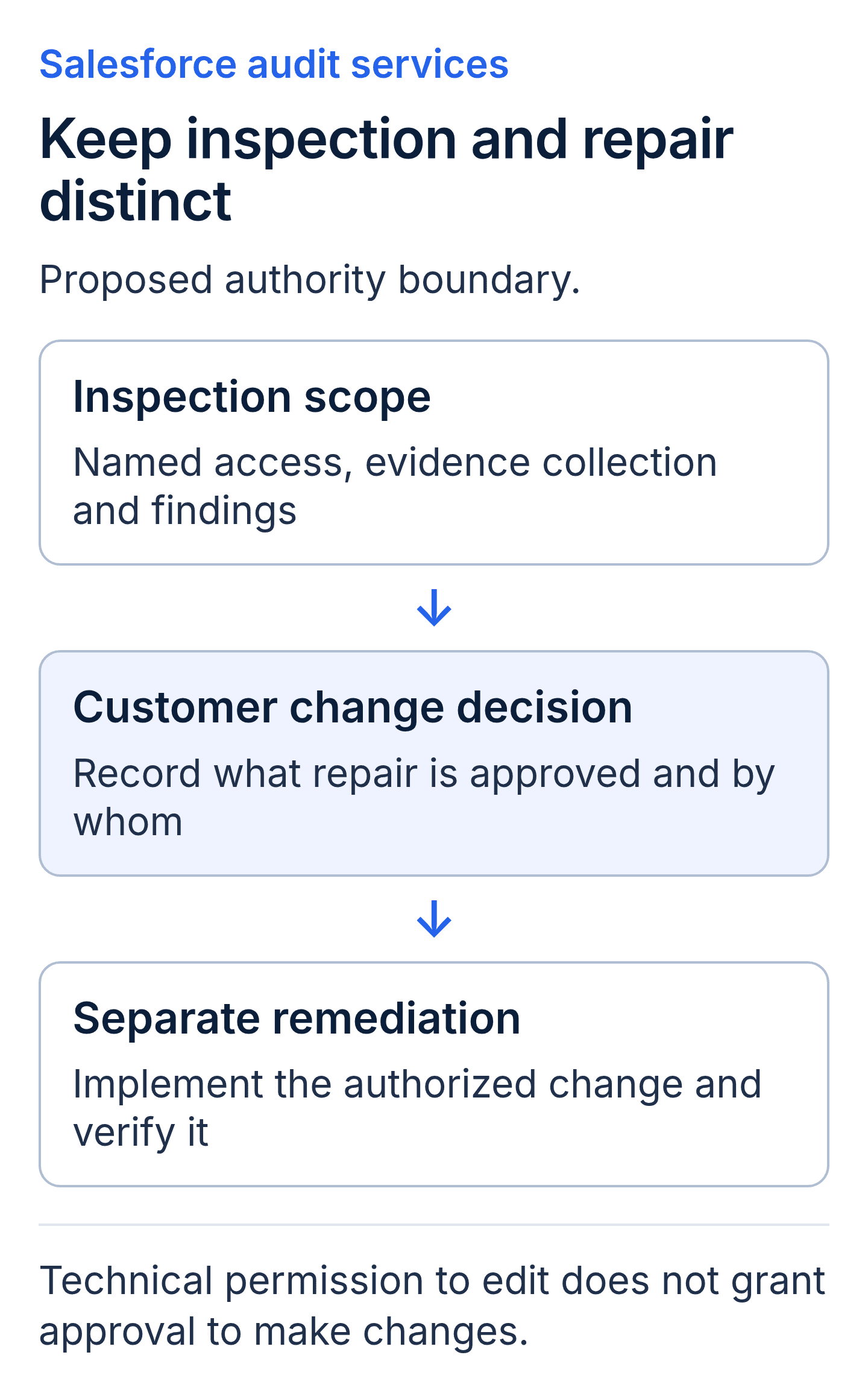
Make the inspection restriction and change-approval route explicit. Treat repair work as a separate authorized scope.
Separate the Salesforce configuration audit from remediation
A proposal may include assessment alone or assessment followed by approved repairs. Read the commercial terms instead of assuming the audit fee covers either arrangement.
For each finding, ask whether the next step is investigation, configuration work, development, data cleanup, training or acceptance of a known limitation. A technical recommendation can depend on a business decision, such as which team owns a record or how an opportunity should be qualified.
Request a prioritized remediation backlog with dependencies and an estimate basis. An estimate made from a sampled review should identify remaining uncertainty. Avoid treating it as a fixed commitment for work the provider has not yet inspected.
For changes you approve, require a test method, deployment owner and recovery approach. Salesforce's org development guidance describes using development and testing environments, source control, change lists and deployment run lists. Those practices provide useful subjects for a delivery proposal; they are not proof that a particular provider follows them. Salesforce change planning
The Salesforce implementation guide covers the wider delivery process. Keep that build scope separate enough that your team can approve, defer or assign each remediation item.
Accept Salesforce health check services against a handover standard
A final presentation should include a walkthrough of representative findings. Have your administrator locate the cited configuration and ask the business owner whether the described consequence matches the process.
Use these acceptance checks:
- Every finding has a traceable evidence reference and a stated assessment date.
- Confirmed issues, inferred risks and optional improvements are distinguishable.
- Sampling, inaccessible areas and unresolved questions appear in the report.
- Each proposed action has an owner, dependency and verification method.
- Your team receives usable files and can access them without the auditor's account.
Do not turn acceptance into a demand that the provider discover every possible defect. A scoped review cannot establish that. Require completion of the agreed method and disclosure of its limits.
Include the people who will act on the report in the handover. If a recommendation changes everyday record handling, identify the training and process documentation it needs. The CRM adoption guide provides context for that work.
After the walkthrough, record accepted findings, disputed items and any evidence still due. Assign decisions to the appropriate internal owners before authorizing remediation. This prevents an accepted report from being mistaken for approval to change production.
Salesforce audit services buyer FAQs
What should an audit include?
It should include the agreed review scope, evidence collection method, findings register and handover. The technical areas depend on your reason for buying it. Ask for coverage of the process you need to assess, with explicit sampling and exclusions.
Is an org audit a security assessment?
An org audit may include access and security configuration, but the term alone does not establish a security testing method. If you need penetration testing or a specific compliance assessment, name that requirement and verify the provider's proposed method separately.
Can the auditor also implement the fixes?
Yes, if you agree that scope. Keep findings and proposed repairs reviewable as separate decisions. Ask for evidence and priorities that your internal team or another supplier can use, and approve remediation through the normal change process.
How should we compare prices?
Compare the inspected environments, processes, sampling depth, evidence quality and handover obligations. Ask which access delays or discoveries can change the estimate. A lower price may represent a narrower review, which can be appropriate if it answers your question.
Terms used in an audit proposal
Findings register: The structured record of observations, evidence, impact and proposed actions.
Sampling: Reviewing a selected subset of records or components. The selection method and limits affect what conclusions you can draw.
Remediation: Work approved to address a finding, followed by an agreed verification check.
Acceptance criteria: The observable conditions your team uses to decide whether a deliverable is complete.
Key takeaways
- Define the business decision and review boundaries before requesting prices.
- Require traceable evidence, sampling limits and a severity rationale.
- Agree inspection permissions separately from authority to change production.
- Accept an editable findings register with owners and verification checks.
- Approve remediation after reviewing its scope, dependencies and test plan.
Scope the evidence you need
Bring the symptoms, planned change and available system documentation to a Twelverays discovery call. Use them to agree which Salesforce questions the review should answer and what evidence your team should receive.


