

Salesforce Service Cloud implementation is the configuration of support processes, case handling, data access, channels and reporting. A Salesforce Service Cloud implementation plan defines the work, sequence, dependencies and acceptance evidence for that configuration. Use a Salesforce Service Cloud implementation checklist to compare proposals against the same cases, users and operating hours. The buying decision is whether a partner's proposed work covers the service your team must deliver, including exceptions and responsibilities after launch. A feature list cannot tell you whether a billing query will reach the right team or whether an agent can see information they should not access.
Start with one representative customer request. Follow it from arrival to closure, then repeat the exercise for a difficult exception. Those two journeys give you a practical basis for the scope, acceptance tests and commercial discussion.
Define the operating model before selecting features
According to Salesforce, Service Cloud is its customer service platform for capabilities including case management, knowledge, automation and analytics. Its current service materials also use the Agentforce Service name. Confirm the actual products and entitlements in your proposal rather than assuming a familiar product label defines everything included.
Describe who receives a request, which information they need and when another team takes responsibility. Record service hours, priority definitions, approval points and the evidence required to close a case. For a billing enquiry, that might mean identifying the correct customer, checking invoice information and recording an approved answer. It does not automatically mean replacing the billing system.
Name the people who can decide these rules. Service managers should approve operational requirements, while administrators and security owners review access and technical constraints. Agents should help test whether the process works during an actual shift.
Discuss this operating model when evaluating Salesforce consulting services. Keep the broader programme sequence in the Salesforce implementation guide; this scope should focus on customer service decisions.
Build a Salesforce Service Cloud implementation plan around case journeys
Ask each prospective partner to complete the same scope matrix. The following rows are examples to adapt, not proposed service commitments or a claim that every channel is licensed.
| Proposed case journey | Requirement to define | Exception to test | Acceptance evidence |
|---|---|---|---|
| Support email | Required customer details and destination queue | Sender cannot be matched | Case has an owner and a documented review path |
| Website enquiry | Required form fields and acknowledgement | Repeated or incomplete submission | Agreed handling occurs without losing the request |
| Agent-recorded phone request | Information captured during the call | Caller identity is uncertain | Agent follows the approved identification process |
| Escalated service issue | Trigger, business hours and receiving owner | Receiving team is unavailable | Agreed escalation and fallback are recorded |
According to Salesforce's service implementation guidance, foundational work covers users and security, case data, queues, automation and the console. Use that guidance to identify configuration decisions, then price the selected work. Its implementation stages are recommendations that organisations can adapt.
Separate knowledge management, entitlement rules and reporting into their own deliverables. A knowledge requirement needs an author, reviewer, intended audience and maintenance process. A reporting requirement needs definitions for measures such as backlog and resolution, including which statuses and dates count.
Define what your organisation means by closed and resolved. Do not accept a proposal that assumes those labels establish a universal Salesforce reporting distinction without checking your configured process.
Use a Salesforce Service Cloud implementation checklist for routing
Routing requirements need more detail than “send cases to the right agent.” Specify the destination, priority, capacity assumptions and fallback when no suitable person is available. Include what happens when information changes after initial assignment.
According to Salesforce's Omni-Channel documentation, routing uses work priority, configuration and representative capacity. It also states that changing field values after routing does not automatically reapply that routing logic. Make the behaviour your team needs an explicit design and test question.
The same documentation records Standard Omni-Channel's retirement with Summer '26 and the upgrade to Enhanced Omni-Channel. A proposal using older terminology should identify the current configuration it will deliver and any existing routing behaviour that needs review. Avoid accepting an outdated setup checklist without that reconciliation.
Test an unavailable agent, a misclassified request and a case transferred across teams. Agree who notices an unassigned case and how quickly someone should review it. These are proposed operating rules to negotiate, not response promises supplied by the software or by Twelverays.
Ask for a record of routing decisions that your administrator can maintain. A successful demonstration is useful; your team also needs to understand which settings produce the result and who can change them.
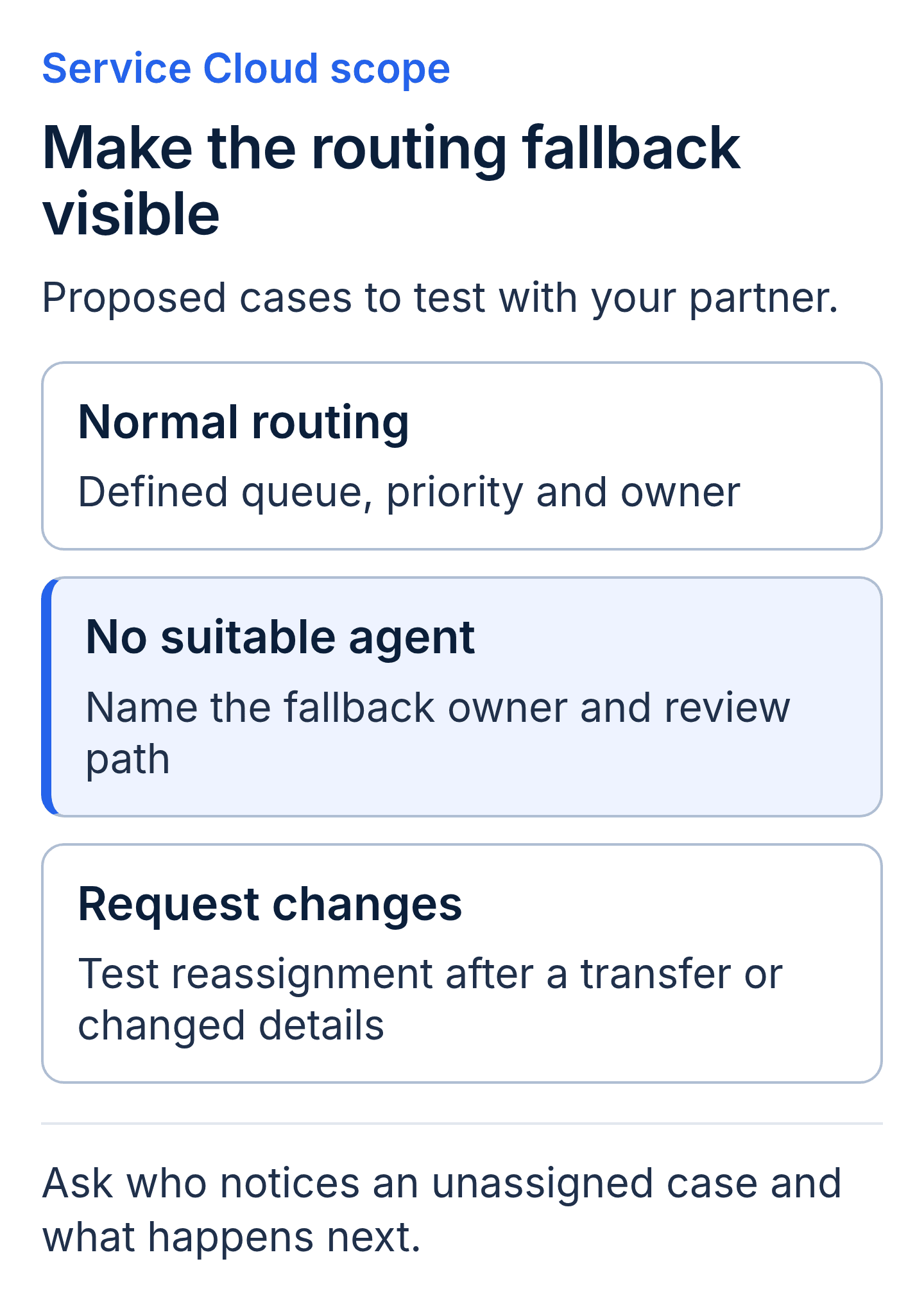
Proposed routing acceptance cases. Agree the destination, fallback owner and review response in the implementation scope.
Compare service cloud implementation services by data responsibilities
A historical data migration and an ongoing integration are separate pieces of work. Migration is the transfer of agreed historical records into Salesforce. Integration is the continuing exchange of selected information between systems under defined rules. A proposal may include either or both, with different dependencies and acceptance evidence.
List the customer records, case history, attachments and external reference information agents need. For each, name the authoritative system, required fields, matching method and owner. Specify whether information must be stored in Salesforce, displayed from another system or available through a documented manual process.
Use a known customer to test the design. Their request should connect to the intended record; authorised agents should see the required history; restricted information should remain inaccessible. If something fails, investigate the cause. It may involve mapping, configuration, permissions, source quality or an unavailable external service.
Agree how to reconcile migrated records. Counts alone will not establish that account relationships, attachments or key dates are correct. Select representative records for business review and record exceptions before accepting the migration.
For recurring connections, request ownership of authentication, failed transfers, retries and reconciliation. Have the external system's owner confirm access and constraints before a partner commits to an integration design or estimate.
Select a Salesforce Service Cloud implementation partner with acceptance tests
Give competing partners the same service scenarios and ask what evidence they will provide. A configuration demo can show intended behaviour. User acceptance testing (UAT) is the business team's assessment of whether the delivered behaviour satisfies agreed requirements.
A useful test set covers correct assignment, restricted access, an escalation under defined conditions, retrieval of an approved knowledge article and a completed closure record. Write expected results in terms a service manager can assess. “The system works” is too broad to resolve a disagreement.
Include negative cases. An agent without permission should not see a restricted record. An incomplete request should follow an agreed handling path. A failed integration should produce an issue that an assigned owner can investigate, rather than disappearing from the review process.
The proposal should state who prepares test data, executes scenarios, records defects and approves fixes. Define which unresolved issues block launch and which can be accepted with an owner and deadline. Specify retesting effort in the quote instead of assuming unlimited revisions.
Ask how acceptance affects project completion and payment under the proposed agreement. Evidence, review periods and sign-off authority need to be explicit; a demonstration does not establish those commercial terms by itself.
Include a reporting test that follows the same case through the agreed dashboard. If a manager measures resolution time, document when that clock starts, when it stops and whether waiting on the customer pauses it. Compare the reported value with the case history using the agreed calculation. This exposes differences between an operational expectation and a configured measure before managers use it to assess the team.
Also agree who supplies safe test records and reviews sensitive fields. Test access using the actual roles intended for launch, including supervisors and temporary staff where relevant. An administrator's successful test does not establish what a restricted agent will be able to do.
Confirm licenses, rollout and support before approving the quote
Entitlements are the product capabilities and usage rights available under the purchased agreement. Request a feature-to-entitlement list covering each selected channel, routing capability, knowledge requirement and optional AI feature. Have the partner identify the relevant Salesforce product, edition or add-on and validate it against your order and current vendor terms. Use the Salesforce pricing overview as background, then confirm the actual quote.
If AI is proposed, describe the specific task and its acceptance criteria. The introduction to Salesforce Agentforce can help frame that discussion. An AI product name should not substitute for a decision about permissions, reviewed knowledge, escalation or consumption costs.
Choose a rollout boundary your team can supervise, such as one service team or selected case types. Document channel activation, record reconciliation, launch authority and conditions for pausing expansion. Ask what recovery can actually restore. Reverting configuration may not reverse messages already sent or changes made in connected systems.
Training should cover the tasks agents perform and the exceptions supervisors handle. Specify materials, attendance expectations and responsibility for training later hires. Include administrator documentation and a transfer of the access needed for the agreed operating responsibilities.
Identify responsibility for knowledge updates, queue membership, integration errors and future changes after launch. Support may be included for a defined period or contracted separately. According to Salesforce's Success Plans, vendor support is offered through Standard, Premier and Signature plans with different coverage. Compare your purchased vendor coverage with the configuration and integration responsibilities in the partner agreement. Confirm both before approving ongoing support costs.
Salesforce Service Cloud implementation glossary
- Case: the record used to track a customer request or issue through the agreed service process.
- Queue: a shared destination for work awaiting handling by an eligible team.
- Routing rule: the logic that directs work to an intended destination under defined conditions.
- Escalation: the transfer of attention or responsibility when an agreed condition is met.
- Acceptance evidence: the recorded result used to decide whether a requirement has been delivered.
Key takeaways
- A Salesforce Service Cloud scope should name the case journeys, channels and exceptions the partner will deliver.
- Routing, data and access requirements need recorded acceptance results that service managers can inspect.
- Each selected capability needs confirmation against the purchased Salesforce products and entitlements.
- The implementation agreement should assign launch authority and ongoing service ownership to named roles.
Salesforce Service Cloud implementation buyer FAQs
What should a Salesforce Service Cloud implementation proposal include?
It should define the processes, users, channels, data, integrations and reports in scope, with customer dependencies and exclusions. Ask for acceptance scenarios, a rollout approach and responsibility after launch. A proposal should also explain the assumptions that could change its fee or schedule.
Can Salesforce Service Cloud work with our existing systems?
Potentially. Decide which systems must remain and what information Salesforce needs from them. Then verify available interfaces, permissions, commercial entitlements and support ownership. Coexistence may use an integration or an agreed manual handoff. Do not assume every existing platform has a suitable native connector.
Who approves Service Cloud routing and escalation rules?
Name a service leader with authority over the process, supported by the agents and supervisors who test it. Technical and security owners should review their respective requirements. The partner should document and demonstrate the configuration, while the agreement identifies who can accept it.
What affects Salesforce Service Cloud implementation time and cost?
Selected channels, data quality, integration dependencies, routing complexity, access reviews and the availability of business testers all affect the estimate. Ask the partner to show those assumptions and identify decisions needed from your team. A date without dependencies is difficult to assess.
Discuss your Service Cloud scope with Twelverays
Bring your current case channels, a representative service journey and the exceptions that concern your team. Include any systems that must remain and commitments the new process must support. Contact Twelverays to discuss Salesforce implementation scope and the evidence you will need to accept the work.


