

Webflow agency pricing is the fee for the design, development and related delivery work specified in a website agreement. A Webflow project quote is useful when it identifies the deliverables, assumptions and customer responsibilities behind that fee. Compare Webflow agency cost against a shared scope before comparing totals, including the platform charges and ongoing services your organisation will also need to fund.
Start with what the completed site must let visitors and editors do. A visitor may need to find a relevant service and submit an enquiry. An editor may need to publish a case study without changing its layout. These outcomes create assessable requirements for the proposal.
If the platform decision remains open, use the Webflow and Framer comparison separately. This guide concerns the work and responsibilities behind a Webflow delivery quote.
Define the Webflow website development cost by workstream
Prepare one inventory for all candidates. Count distinct layouts, content types and integrations as well as pages. A page using an existing template creates different work from a new layout with a new interaction, even if both add one URL to the sitemap.
A content management system (CMS) stores structured content for editors to manage. In Webflow, Collections organise content types such as articles or case studies. Define the fields, relationships and editorial tasks your proposed Collections need, then ask the agency to demonstrate the intended editing process.
Use a scope matrix to make those decisions visible. The rows below are proposed procurement questions, not standard agency inclusions.
| Workstream | Quantity or boundary to state | Completion evidence |
|---|---|---|
| Discovery and structure | Stakeholders, sitemap and required user journeys | Approved requirements and unresolved decisions |
| Design | Distinct layouts, states and feedback rounds | Approved designs and responsive requirements |
| Build | Templates, components and selected interactions | Working pages tested against requirements |
| CMS and content | Collections, fields and entries to prepare | Correct content and demonstrated editor tasks |
| Forms and connections | Forms, destinations and required data | Test submissions received by the intended system |
| Migration and launch | Source URLs, redirects and launch responsibilities | Reconciled content, tested destinations and launch approval |
Identify customer-supplied work alongside agency work. Copywriting, image selection, product information and stakeholder approval all need owners and dates. A proposal can exclude these activities if your team will provide them; the exclusion becomes a dependency to plan around.
Bring the inventory to a discussion about Twelverays web development services. Ask what the proposed engagement covers and what your team would need to supply.
Separate design approval from Webflow build acceptance
Design approval confirms the selected visual direction and agreed states. Build acceptance checks whether the delivered site performs the required tasks. Record both decisions, even when one agreement includes the entire project.
For design, identify the layouts and responsive behaviours being reviewed, the feedback process and the person who can approve a round. Clarify whether a round means one consolidated response or separate comments from several departments. Specify how new layouts or changed requirements affect the estimate.
For the build, agree representative browsers, devices and user journeys. Test forms, navigation, content editing and any selected interactive behaviour. Define accessibility requirements and the review method in the proposal rather than assuming a design mockup proves the implemented site meets them.
A correction to work that misses an approved requirement differs from a request for new behaviour. Use the approved designs and scope to assess that distinction. Ask how disagreements, retesting and additional requests will be handled under the commercial agreement.
The website redesign checklist offers broader preparation questions. Keep this quote explicit about the evidence your reviewers need before accepting each workstream.
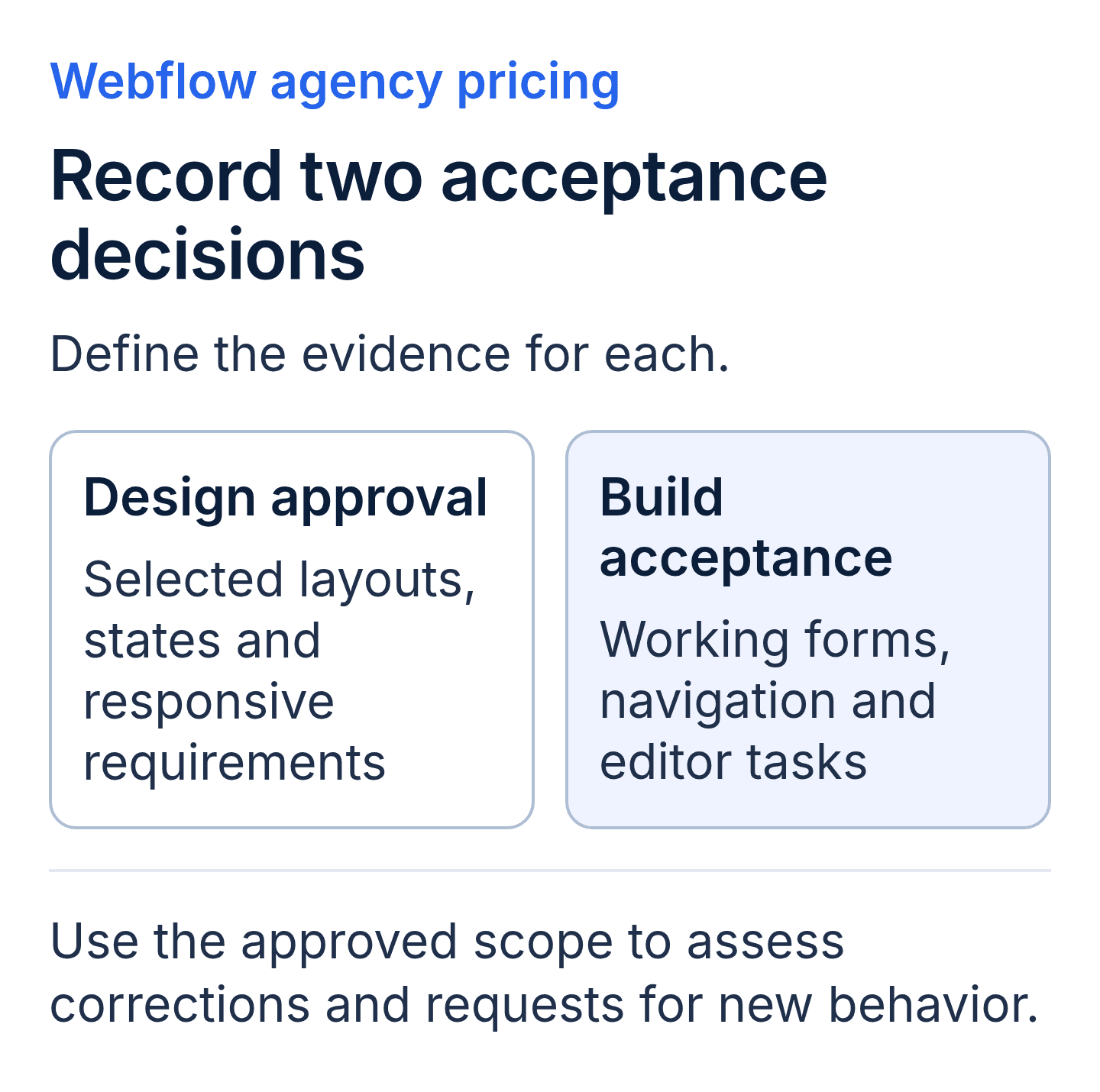
Design approval and build acceptance are separate decisions. Identify the reviewer and completion evidence for each in the quote.
Make Webflow CMS migration cost visible
A migration scope should identify what moves, how it is transformed and who accepts the result. A new site without existing content may need little migration work. A content-rich site may require mapping, formatting, media handling and decisions about material that will be archived.
List the source content types and destination Collections. Define required fields, relationships, metadata and image treatment. Ask the agency to inspect representative entries before assuming the entire archive follows the simplest example. Include long articles, unusual embeds and records with missing information where they exist.
Agree who corrects source content and who approves changes in meaning. Moving an outdated service page does not resolve whether its claims remain accurate. An agency can prepare the content, while the customer's responsible reviewer approves the business information.
Create a source-to-destination URL map. A proposed move from /services/old-name to /solutions/new-name needs a confirmed destination and a post-launch check. Specify the URLs included, intentionally removed content and responsibility for investigating a redirect that reaches the wrong page.
Use the website migration SEO checklist for the broader search engine optimisation (SEO) review. Redirect validation and content checks provide evidence about the delivered migration; they do not guarantee rankings or eliminate every traffic risk.
Require reconciliation of the agreed content and important relationships. Counts help establish coverage, but editors also need to open representative entries and confirm that titles, images, links and fields are usable. Record exceptions and the person authorised to accept them.
Check the platform charges behind a Webflow project quote
Agency delivery fees and Webflow platform charges are different cost categories. They may be purchased through different arrangements, including a bundle. Ask who invoices each item, what period it covers and how renewal is handled.
According to Webflow's Workspace and Site plans overview, a Site plan applies to an individual site, while a Workspace plan governs staging and collaboration across its sites. A paid Workspace upgrade is not automatically required just because a site has a paid Site plan. Confirm the actual publishing and collaboration requirements before budgeting for both upgrades.
The current Webflow pricing page also describes Platform plans that bundle a site, Workspace and additional capabilities. Compare the proposed purchase with the current offering and your account terms. Avoid counting a bundled capability again as a separate charge.
Ask for a dated plan and dependency estimate showing currency, billing period, seats and relevant usage assumptions. Include domain renewal, selected add-ons and third-party services where applicable. A monthly price displayed for annual billing does not establish a month-to-month commitment.
Keep ongoing agency support visible as another scope. It may cover agreed content updates, investigation or maintenance for a defined period. Confirm the tasks, charging basis and coverage instead of assuming platform support includes changes to your particular site.
Verify ownership and billing in the Webflow agency proposal
Billing responsibility and site ownership are separate decisions. According to Webflow's site transfer guidance, client payments can put Site plan and add-on charges on the client's card while the site remains in the agency's Workspace. Paying a subscription therefore does not, by itself, establish that the site has moved into your Workspace.
Name the intended Workspace owner, site access, publishing roles and billing contact in the proposal. If a transfer is planned, ask the agency to confirm the requirements for the source and destination accounts. Webflow documents plan-dependent transfer conditions, so do not assume every account combination follows the same procedure.
The same transfer guidance says recipients must reauthorize app access. It also identifies settings that do not transfer, including form notification settings. Include those connections and notifications in the handover test plan. A transferred page can look correct while an enquiry notification still needs attention.
Distinguish a Webflow site transfer from exporting code to host elsewhere. Webflow's pricing FAQ states that dynamic content requires separate Collection exports and that forms stop working after code export. An exported site is therefore a different handover from continued editing and hosting in Webflow. Ask what remains functional and what would need replacement before treating the two options as equivalent.
Store account access through the customer's approved process. The handover document should identify owners, settings and recovery contacts without embedding passwords or secret keys in an ordinary shared file.
Compare exclusions, changes and the first-year commitment
Request a list of assumptions behind each proposal. Examples include customer-ready copy, an approved brand system, access to the current site and available integration credentials. Ask what happens if those inputs arrive late or differ from the sample used for estimation.
Have candidates identify excluded work such as new copy, custom integrations, localization or an expanded content archive. An exclusion is not automatically a defect in a proposal. It tells the buyer what to fund elsewhere or negotiate into the engagement.
For a change request, require a description, fee basis, schedule impact and approving person. A proposed resource filter, for example, may alter the CMS model, design and acceptance tests. Assess those consequences before treating it as a small visual revision.
Build a first-year comparison with one-time delivery fees, approved variable work, platform subscriptions, other paid dependencies and contracted support. Show internal staff effort separately from vendor cash costs. Use consistent currency and periods so the comparison does not mix one month of one service with a year of another.
Ask what evidence closes the engagement and when any included support ends. Record the treatment of unresolved defects and later changes. The quoted fee becomes easier to assess when your team understands both the accepted deliverables and the responsibilities that remain.
Webflow agency pricing glossary
- Scope inventory: the agreed list of layouts, content, functionality and delivery work being priced.
- Site plan: the Webflow plan that applies to an individual website's capabilities and hosting.
- Workspace plan: the Webflow plan governing staging and collaboration for the Workspace.
- Acceptance criterion: an observable condition used to assess an agreed deliverable.
- Change request: a proposed alteration to the approved work, with its consequences submitted for approval.
- Handover: the agreed transfer of access, documentation and operating responsibility after delivery.
Key takeaways
- Webflow agency quotes should price the same layouts, content, integrations and customer dependencies.
- Design approval and build acceptance need their own evidence and responsible reviewers.
- Platform billing, Workspace ownership and app access require separate confirmation at handover.
- A first-year comparison should show delivery, subscriptions, paid dependencies and contracted support.
Webflow agency pricing buyer FAQs
Does a Webflow agency fee include the platform subscription?
It can, depending on the purchase arrangement. Ask the agency to identify the relevant plans, add-ons, billing owner and renewal terms. Separate those costs in your comparison even if they appear in one invoice. Do not assume the client always pays Webflow directly.
What affects Webflow CMS migration cost?
The work depends on content volume, structure, source quality, transformations, media and review requirements. Ask for a sample assessment and a clear responsibility split. A small archive with unusual relationships can need careful work, while a larger consistent dataset may use a repeatable process.
How should Webflow design revisions be priced?
Define what feedback each quoted round covers, who consolidates it and what counts as a new request. Ask for the charging and approval process for additional work. There is no universal round count or mandatory hourly model for every agency agreement.
What should remain editable after Webflow handover?
Specify the tasks your editors need to perform and test them with the intended roles. Confirm access to the relevant content, components and publishing functions. Custom code or constrained layouts may require different expertise, so avoid assuming every element is editable by every user.
Discuss the scope behind your Webflow quote
Bring your sitemap, content inventory and the user journeys the site must support. Include candidate proposals, required connections and the intended ownership arrangement after launch. Contact Twelverays to discuss the Webflow delivery scope and acceptance evidence your budget needs to cover.


