

Will AI Replace Data Analysts? What Actually Happens to Reporting
No, AI will not replace data analysts, but it will change the job. Generative AI for data analysis automates routine report-pulling, and analysts move up to defining metrics, governing data, and answering the harder questions that require judgment. The reporting bottleneck disappears; the analyst does not.
The fear is understandable. AI tools for data analysts now write queries, draft charts, and answer data questions in plain language, so it is fair to ask whether the analyst role survives. The honest answer is that the low-value part of the job, the endless queue of "can you pull this number" requests, is exactly what AI is good at removing. What remains is the part that was always the real work: deciding what to measure, making sure the numbers are right, and turning results into decisions.
Will AI Replace Data Analysts Entirely?
No. AI automates the repetitive query work but cannot own metric definitions, data governance, or the judgment calls that make analysis useful. Those stay human, and they are the bulk of a good analyst's value.
A language model can write a query and return a number. It cannot decide that "active user" should exclude trialists, notice that last month's spike came from a data pipeline bug, or tell a leader which of three plausible interpretations of the data actually matters for the decision in front of them. Those are analyst jobs, and they get more important as raw query-writing gets cheaper. The labor data agrees: the World Economic Forum's Future of Jobs Report has consistently listed data analysts among the fastest-growing roles, even as it projects that 39% of core job skills will change by 2030. The role is not disappearing; its skill mix is. The same dynamic plays out in natural language to SQL: generating the query is now easy, and getting it reliably right is where the skill moved.
Will ChatGPT Replace Data Analysts?
Not on its own. ChatGPT and other LLMs are powerful assistants for exploration and drafting, but they cannot reach your governed data, enforce metric definitions, or take accountability for a number a board acts on.
People asking "will ChatGPT replace data analysts" are really asking "can LLMs replace data analysts if we just point one at our database?" In practice, that experiment fails in a predictable way. A general-purpose model like ChatGPT works from what you paste into it or from an ungoverned connection, so it improvises joins and definitions, and it answers fluently whether or not it is right. Generative AI for data analysis becomes reliable only inside a governed system: connected to live sources, constrained to one definition per metric, and auditable after the fact. Building that system is what separates an AI capability from an AI liability, and it is precisely the analyst-plus-AI pairing that works: the model handles volume, the human owns truth.
What Parts of the Analyst Job Does AI Actually Take Over?
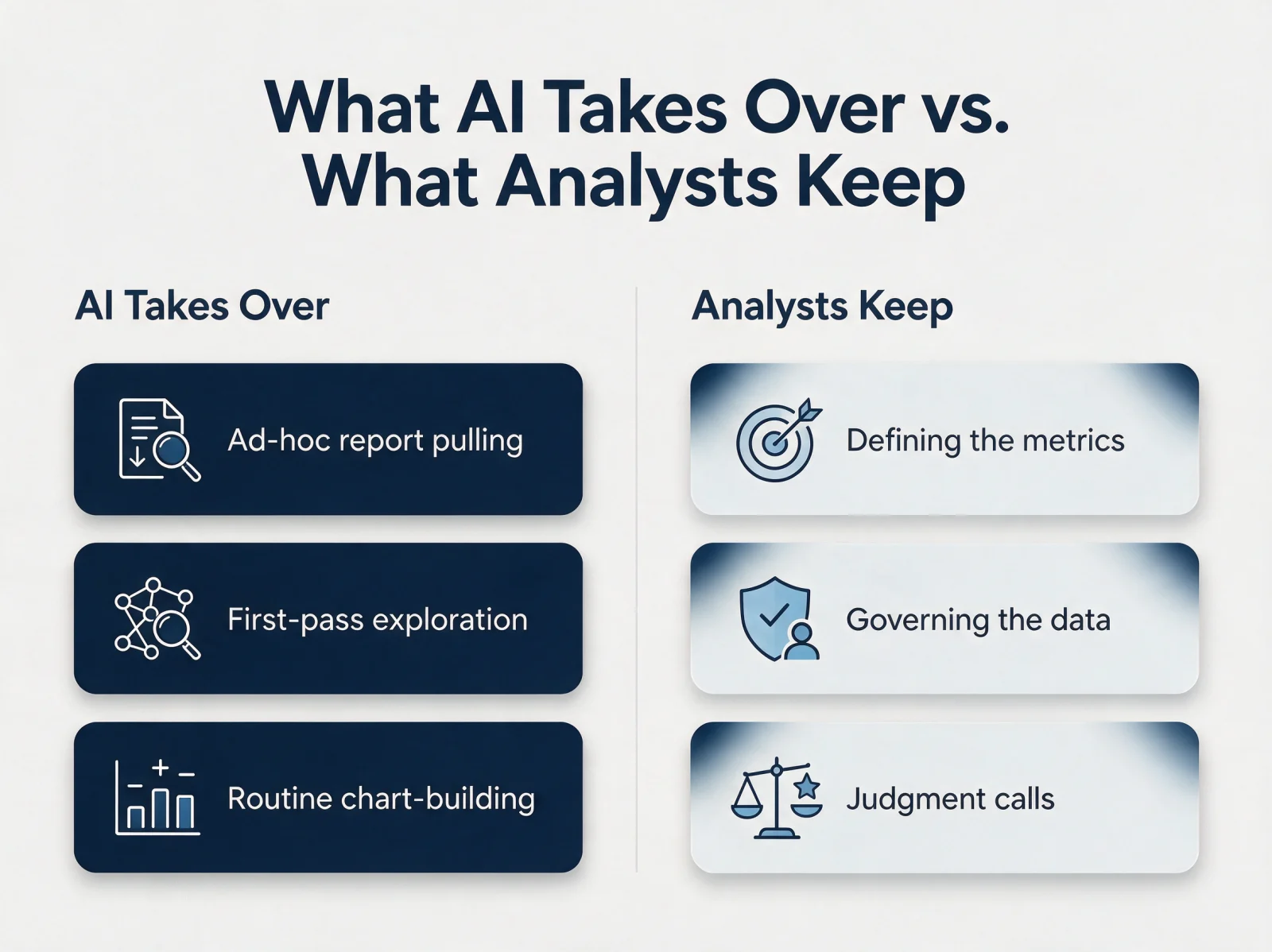
AI takes over ad-hoc report pulling, first-pass data exploration, and routine chart-building. It handles the requests that used to fill an analyst's day and add little strategic value.
Most analyst time historically went to a reporting help desk: someone asks for a number, the analyst writes a query, formats a chart, and sends it back. Multiply that across a company and a skilled analyst spends most of the week on work that requires no real analysis. Even the vendors agree on the division of labor: Microsoft's own Copilot in Power BI documentation positions the assistant as a report-drafting aid, with the analyst still validating the model underneath. AI tools for data analysts absorb that layer. A self-service analytics capability lets the business ask directly and get a governed answer, which frees the analyst from being a query vending machine. The requests do not stop; they stop landing on one person's desk.
What Does the Data Analyst Role Become?
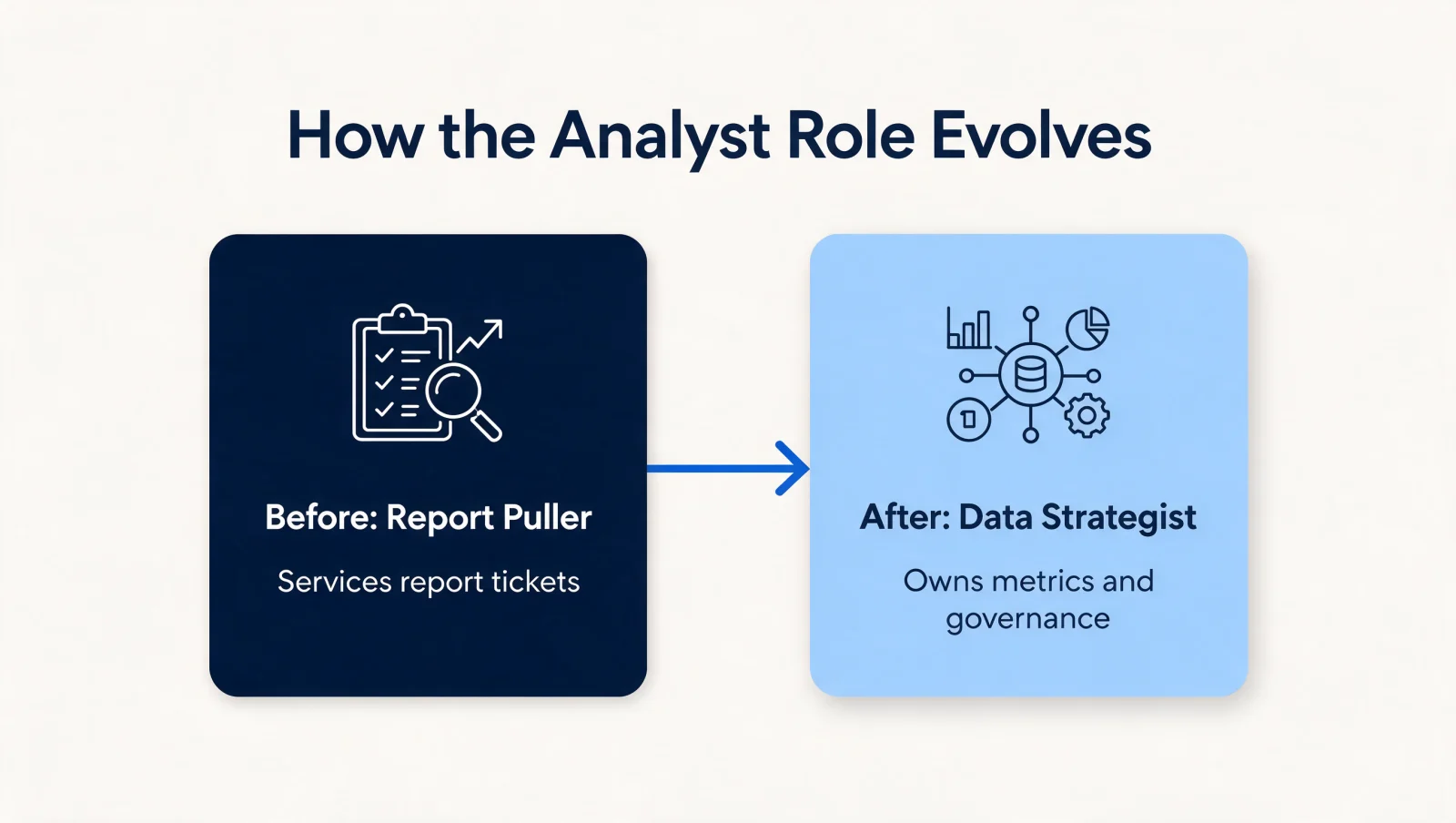
The analyst becomes the owner of the data model and the arbiter of what is true. They define metrics, govern access, validate the AI's answers, and tackle the ambiguous questions no tool can resolve alone.
As routine work automates, the role shifts up the value chain. Someone has to decide how revenue is defined and enforce that definition everywhere. Someone has to audit what the AI returns and catch the plausible-but-wrong answer before it reaches a board deck. Someone has to take a vague executive question and turn it into a rigorous analysis. That is the analyst, now operating as a data strategist rather than a report factory. Companies that make this shift well get more from their analysts, not fewer of them.
Why Do Wrong Answers Make Human Analysts More Important, Not Less?
Because a confident wrong answer is worse than a slow one. As AI makes answers instant, someone has to guarantee they are correct, and that responsibility raises the value of human judgment.
Speed without accuracy is a liability, especially as AI in business decision-making moves from experiments to daily operations. A language model pointed at ungoverned data returns fluent, wrong numbers, and fluency hides the error. The faster and more accessible the answers, the more damage a wrong one can do, because more people act on it without checking. That is precisely why the analyst who owns the governed semantic layer becomes central. The layer defines the truth once; the analyst maintains it. This is core AI operations design: the human sets the guardrails, and the AI operates inside them.
How Should a Team Prepare for This Shift?
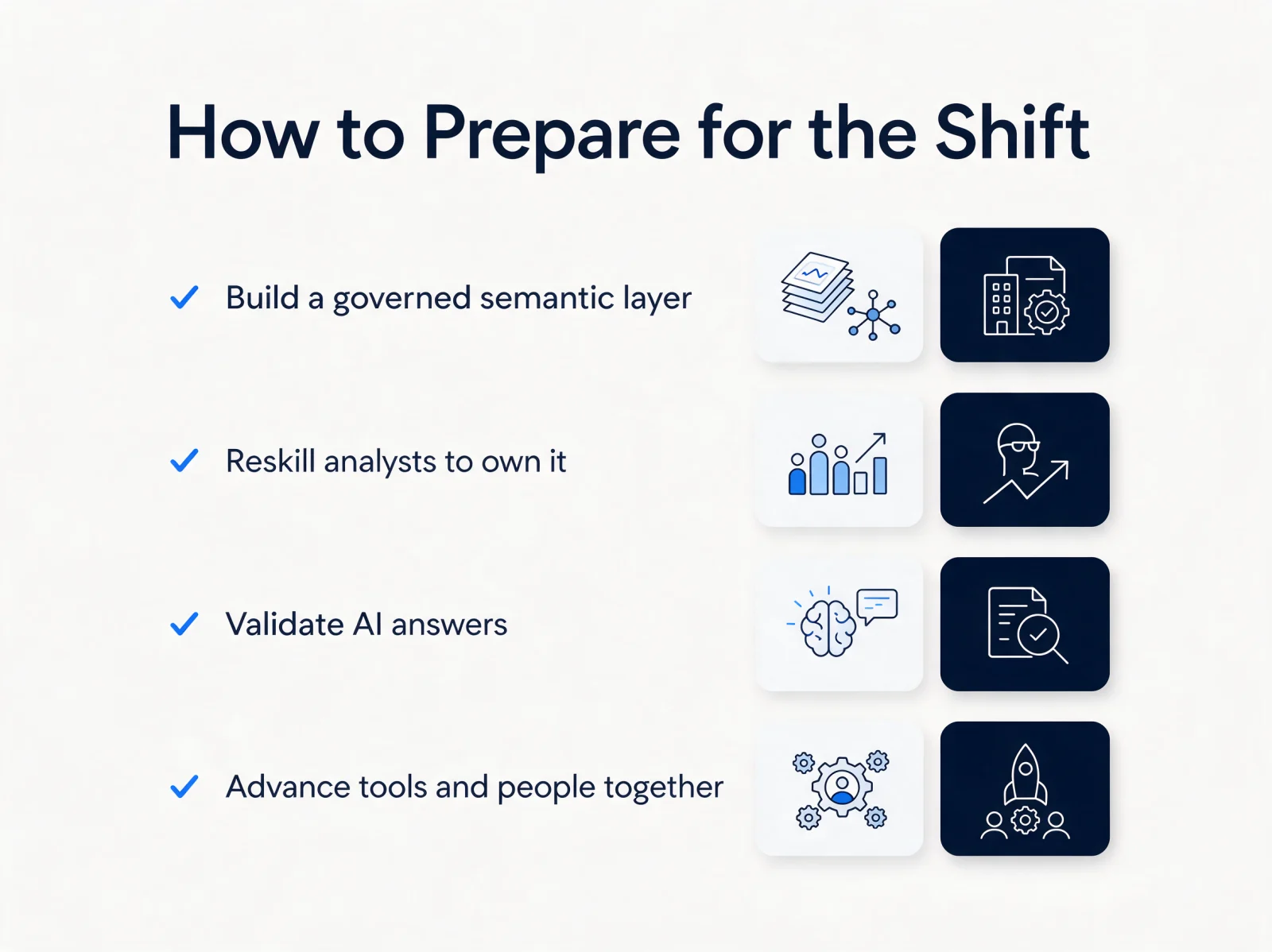
Invest in your data model and your analysts' new skills at the same time. Build the governed semantic layer, then retrain analysts to own it and to validate AI output rather than hand-pull reports.
The teams that handle this transition well do two things together. They build the governance layer that makes AI answers trustworthy, and they move their analysts into owning that layer instead of servicing report tickets. The tooling and the people advance in step. Teams comparing the best AI tools for data analysis sometimes skip the people question entirely, buy a tool, and wonder why nothing changed. The tool was never the whole answer. The organizational shift is.
Which Analyst Skills Matter Most Now?
Data modeling, metric governance, and the ability to translate a business question into a rigorous analysis. Pure query-writing speed matters less every year; judgment and ownership matter more.
The skill mix is shifting in a clear direction. Writing SQL fast used to be a differentiator, and it is becoming a commodity the AI handles. What rises in value is the work around it: designing a semantic layer that defines metrics correctly, governing who can see what, spotting when a number is wrong before anyone acts on it, and turning a fuzzy executive question into an analysis that actually answers it. Analysts who lean into modeling, governance, and business judgment become more valuable as AI tools for data analysts improve. Analysts who define themselves by report-pulling feel the squeeze. The practical move is to invest in the durable skills now, while the routine work is the part getting automated.
What Happens if You Ignore the Shift?
Your analysts stay stuck on low-value report pulling while competitors free theirs for strategic work. You also risk deploying AI reporting without governance, which spreads wrong numbers at machine speed.
There are two failure modes. The first is doing nothing: analysts remain a bottleneck, the business waits on reports, and the talent you pay for judgment spends its time on clerical queries. The second is worse: rushing generative AI for data analysis into place with no semantic layer, so it confidently answers with numbers nobody governs. That does not just waste money. It actively erodes trust in data across the company. Pairing AI reporting with real workflow automation and governance is what avoids both traps.
Key Takeaways
- AI will not replace data analysts; it automates the routine query work and moves analysts up to governance and judgment.
- ChatGPT and other LLMs cannot replace analysts on their own; they become reliable only inside a governed system with one definition per metric.
- The role becomes owning the metric definitions, validating AI answers, and resolving ambiguous questions, and labor projections still rank data analysts among the fastest-growing roles.
- Instant answers raise the stakes on accuracy, which makes human oversight more valuable, not less.
- Prepare by building a governed data model and retraining analysts to own it, at the same time.
Making the Shift on Your Stack
The question is not whether AI takes over data analytics. It is whether your team uses AI in business decision-making to free analysts for higher-value work or lets it spread ungoverned numbers unchecked. The deciding factor is the same either way: a governed data model with a human who owns it.
See how a B2B SaaS company cut preventable churn 27% with an AI operating layer.
Twelverays builds that governed layer on the systems you already run and helps your analysts step into owning it. If your analysts are stuck pulling reports instead of driving decisions, book a discovery call and we will map the shift for your team.


