

The Best AI Tools for Data Analysis in 2026 (and When You Need More Than a Tool)
The best AI tool for data analysis depends on where your data lives. Standalone assistants like ChatGPT and Julius are strong for one-off analysis on a file, while embedded AI inside Power BI, Tableau, Snowflake, and Databricks is better when your data already sits in those platforms. The hard part is not picking a tool. It is connecting it to your real, multi-system data and making its answers trustworthy.
The market split into two camps, and choosing the right camp matters more than any feature list. Below is an honest map, followed by the gap no tool closes on its own.
What Are the Main Categories of AI Data Analysis Tools?
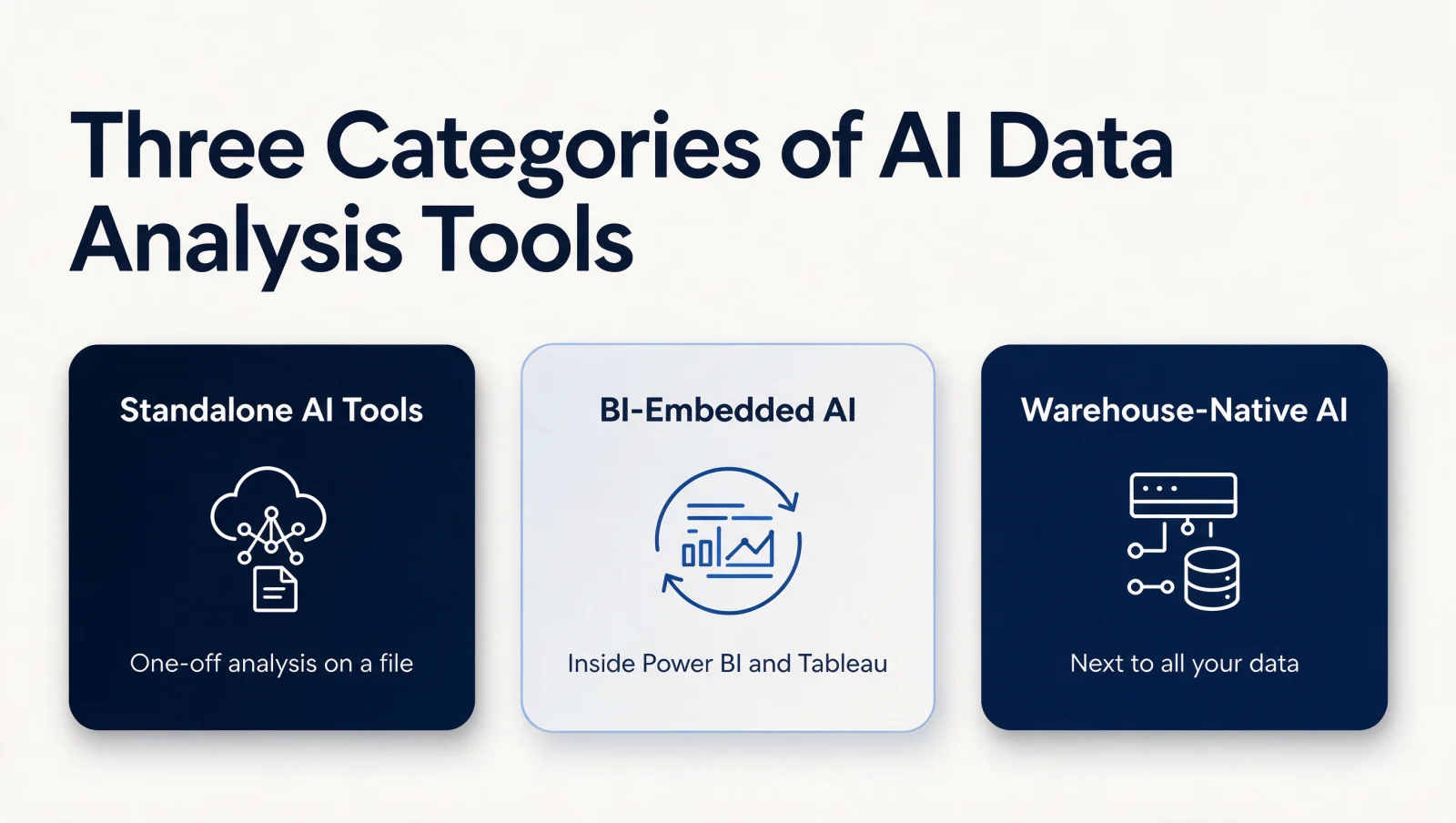
They fall into three groups: standalone AI analysts, AI built into BI platforms, and AI built into data warehouses. Each fits a different starting point.
- Standalone AI analysts. Tools like ChatGPT Advanced Data Analysis and Julius let you upload a file and ask questions in plain language. They are excellent for fast, one-off exploration. Their limit is scope: they work on the data you hand them, not your live systems.
- AI inside BI platforms. Microsoft Power BI Copilot and Tableau's AI features add plain-language questions and generated visuals on top of your existing reports. They fit teams already standardized on that platform. The value depends on how well your underlying model is built.
- AI inside the data warehouse. Snowflake, Databricks, and similar platforms now offer natural-language querying directly against warehoused data. This is the strongest option for larger, multi-system companies, because the AI sits next to all the data at once.
The right choice follows your stack. If your data lives in Power BI, start there. If it is consolidated in a warehouse, that is where AI analysis belongs.
Which AI Data Analysis Tool Should You Choose?
Choose based on three questions: where does your data live, who needs to use it, and how much do the answers need to be trusted.
A single analyst exploring a CSV is well served by a standalone assistant. A whole team that needs governed, repeatable answers across several systems needs AI grounded in a shared data model, not a tool that reasons over whatever file it was given. The higher the stakes and the more systems involved, the more the answer shifts from "buy a tool" to "connect and govern your data." This is the same lesson behind reliable natural language to SQL: the model is commodity, the grounding is not.
Why Isn't a Tool Enough on Its Own?
Because no tool connects your systems, defines your metrics, or guarantees the numbers. That work sits between the tool and a result your team will act on.
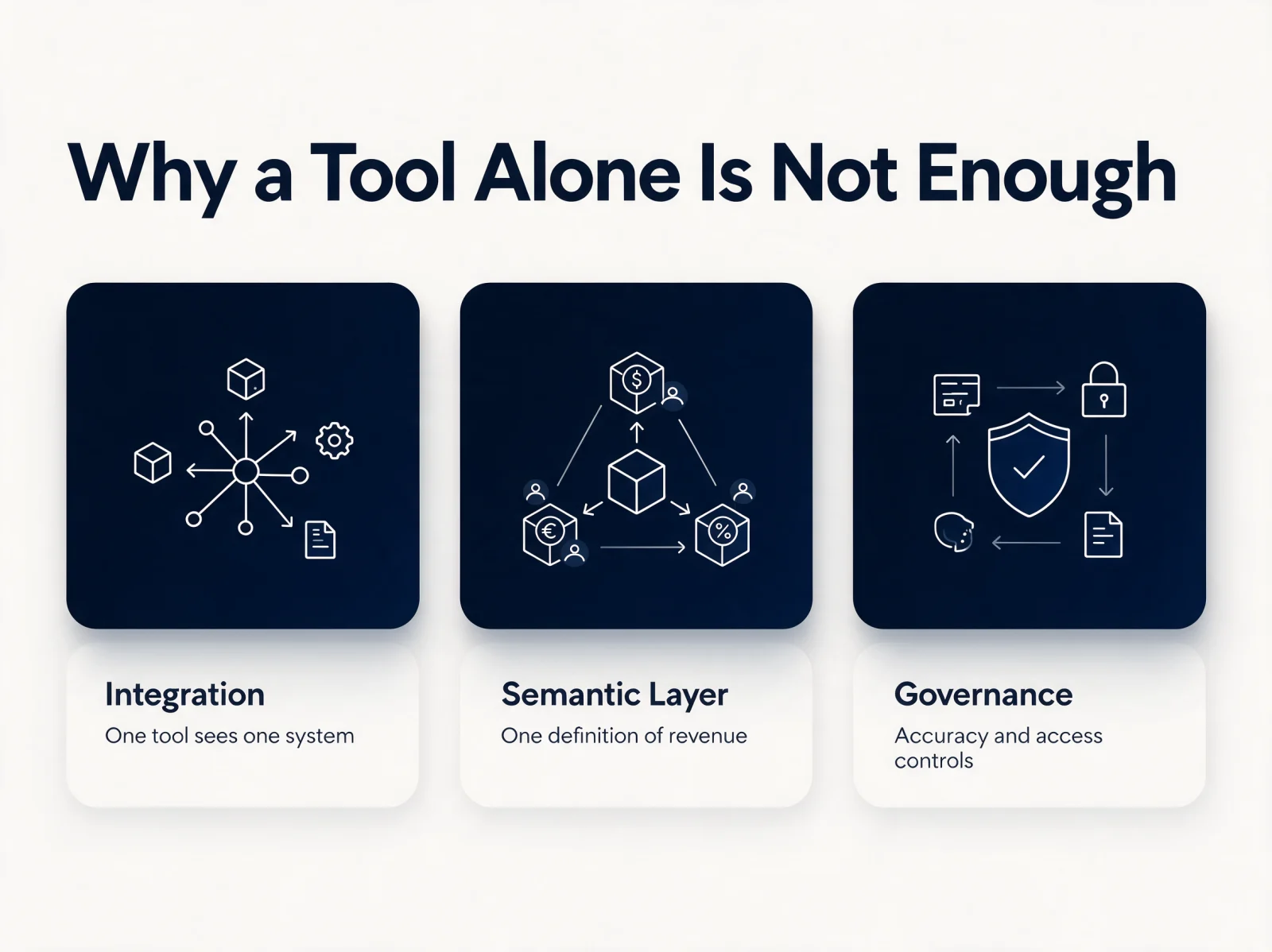
Every tool assumes clean, well-defined, accessible data. Most companies do not have that. The real project is the connective layer:
- Integration. Your answers span the CRM, finance, and operational systems. A tool pointed at one of them sees a fraction of the picture.
- A semantic layer. "Revenue" and "active customer" need one governed definition, or every answer is a debate.
- Governance and accuracy. A wrong number ends trust instantly, so access controls, human review, and query logging are prerequisites, not extras.
That is why two companies can buy the same tool and get completely different results. The tool is the easy 20 percent. The AI operations design around it is the other 80. It is the same gap we see in conversational BI projects that stall after the demo.
How Should You Evaluate an AI Data Analysis Tool?
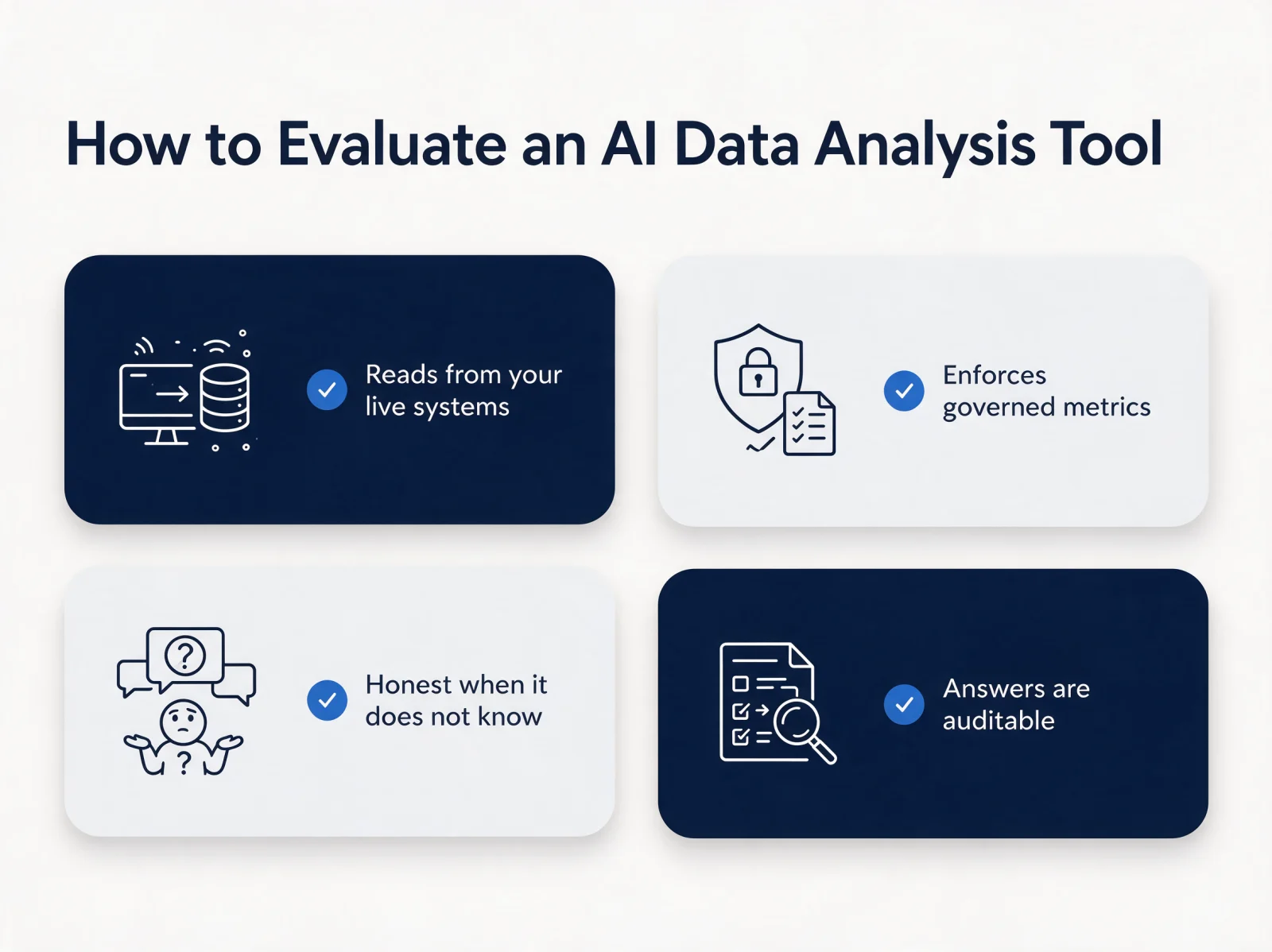
Score it on four things: where it reads data from, how it defines metrics, how it handles what it cannot answer, and whether you can audit a result. Features come after.
Use a short checklist that cuts through the demo:
- Data reach. Does it work on your live systems, or only on a file you upload? Multi-system reach is the difference between exploration and reporting.
- Governed metrics. Does it enforce one definition of "revenue" and "active customer," or improvise each time?
- Honesty under uncertainty. When it does not know, does it say so or invent a confident answer?
- Auditability and access. Can you trace an answer to its query and source, and does it respect who is allowed to see what?
A tool that scores well here will hold up in production. One that scores on interface polish alone will not. The same evaluation logic applies whether you are choosing an analysis tool or scoping natural language to SQL on your own database.
Where Is AI Data Analysis Heading?
Toward agents that do not just answer a question but run a whole analysis, and toward AI that lives next to the data in the warehouse rather than bolted on top.
Two shifts are underway. First, single answers are giving way to agents that chain steps: pull the data, analyze it, flag what matters, and surface the next question, much like AI agents in the CRM act rather than just respond. Second, the intelligence is moving closer to the data, into the warehouse layer, where it can reason across everything at once instead of one connected source. Both trends reward companies that get their data model and governance right now. The groundwork you lay today is what the next generation of tools will run on.
Are Free AI Data Analysis Tools Enough?
Free and low-cost tools are fine for personal, one-off analysis on a single file. They fall short the moment you need governed, multi-system answers a team can trust.
Free tiers of AI analysis assistants are genuinely useful for an individual exploring a spreadsheet. Their limits show up at the business level. They do not connect to your live systems, enforce shared metric definitions, or provide the access controls and audit trails a company needs. For a one-person question, free is enough. For reporting that leadership acts on across several systems, the cost was never the tool. It is the integration, the semantic layer, and the governance around it, none of which a free tier provides.
Key Takeaways
- AI data analysis tools split into standalone assistants, BI-embedded AI, and warehouse-native AI.
- Choose by where your data lives, who uses it, and how much the answers must be trusted.
- Standalone tools suit one-off file analysis; governed, multi-system reporting needs a shared data model.
- No tool connects your systems, defines your metrics, or guarantees accuracy. That implementation work is the real project.
Getting Real Answers From Your Data
Picking a tool is the start, not the finish. The value shows up when the tool is connected to your actual systems, grounded in governed metrics, and trusted enough that leaders act on what it says.
See how a B2B SaaS company cut preventable churn 27% with an AI operating layer.
Twelverays implements AI data analysis on the stack you already run, handling the integration, semantic layer, and governance that turn a promising tool into answers your team relies on. If you are evaluating AI for reporting and want it to work beyond the demo, book a discovery call and we will map the right approach for your data.


