
What Is an AI Customer Support Agent?
An AI customer support agent is a reasoning engine that understands context, resolves ambiguity, and acts autonomously, the mechanism behind what most teams now call AI customer service automation. It is not a chatbot with better branding.
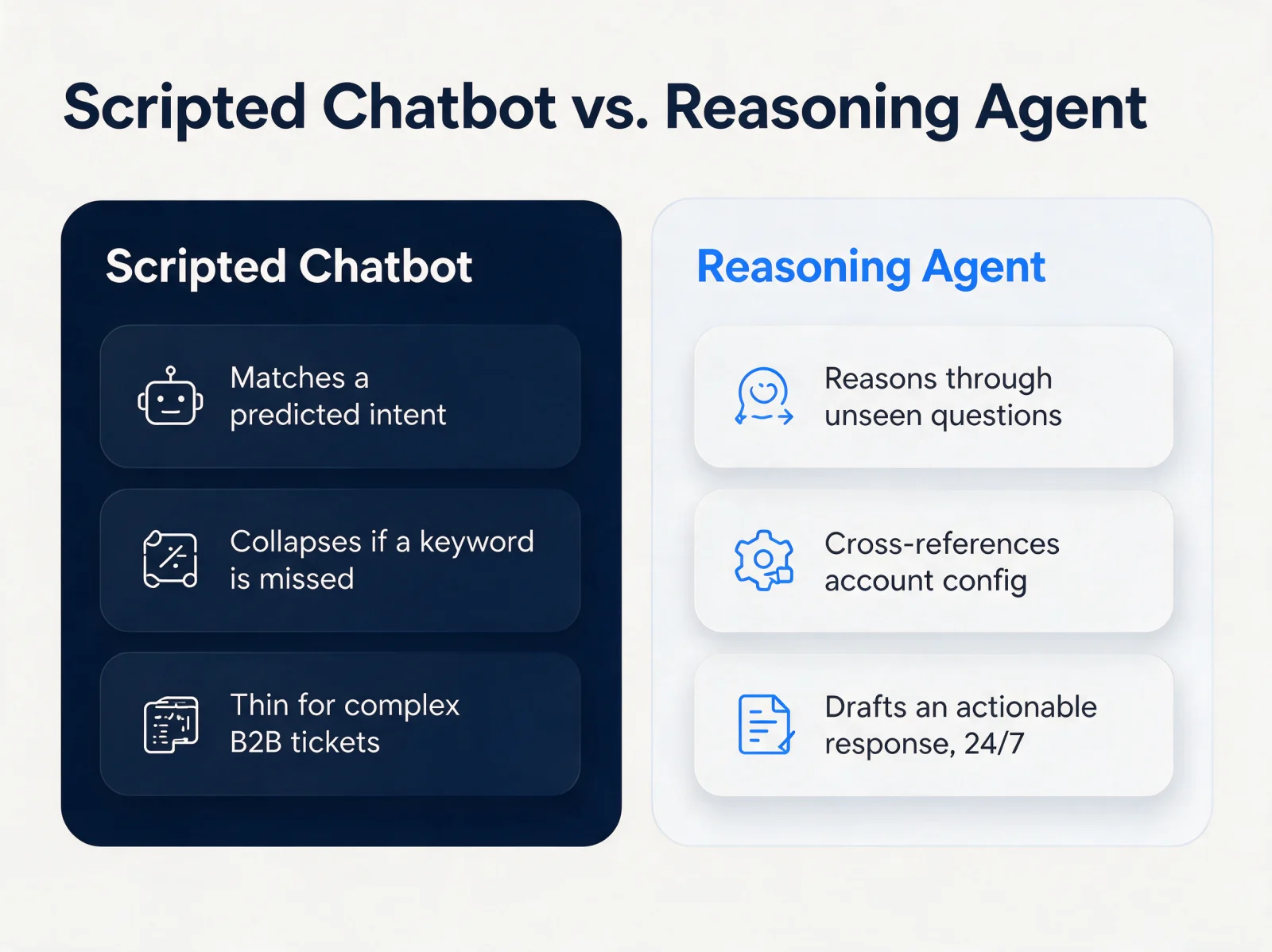
Early support automation ran on decision trees: rigid, rule-based flows where a user's input had to match a predicted intent for anything useful to happen. Miss a keyword, and the interaction collapsed. That approach was thin even for simple consumer queries. For B2B, where a single ticket can involve licensing tiers, API configurations, multi-stakeholder approvals, and SLA obligations, it was essentially useless.
The defining shift is from intent matching to generative reasoning. As IBM's analysis of AI agents in customer service explains, modern agents use large language models to reason through complex queries rather than follow pre-defined scripts. An agent that reasons handles a question it has never seen before; an intent-matcher cannot.
For mid-market B2B teams, that difference has immediate consequences. When a client's technical lead opens a ticket at 11 PM about a failed data sync during a quarterly close, response quality matters to the relationship. A reasoning agent surfaces relevant documentation, cross-references account-specific configurations, and drafts an actionable response without waiting for a human to clock in.
Agentic AI in Customer Service: Why Mid-Market B2B Leaders Are Prioritizing It
Agentic AI in customer service means connecting an autonomous reasoning agent to live account data so it resolves requests, not just discusses them. Mid-market B2B companies face a support paradox: client expectations scale with revenue, but headcount budgets do not.
Conversational AI for customer support has moved past scripted dialogue into systems that act: querying records, updating tickets, and closing the loop without a human touch. Growth creates support volume that outpaces hiring, and an agent breaks that linear relationship, serving far more accounts without a proportional rise in staff. For B2B specifically, a stalled technical inquiry does not just frustrate a user, it threatens a renewal.
Gartner predicts that by 2029, agentic AI will autonomously resolve 80% of common customer service issues without human intervention, cutting operational costs 30%, according to Gartner's newsroom.
There is also the coverage problem. Global clients in different time zones do not wait for business hours, and staffing overnight shifts to close that gap is rarely economical. What mid-market leaders consistently find is that the real return is not cost reduction, it is reallocation: when routine inquiries are handled autonomously, human agents shift into proactive outreach, account reviews, and relationship management that actually moves retention.
The strategic benefits compound quickly:
- Elastic capacity: absorb volume spikes without emergency hiring or quality loss.
- Faster resolution: cut mean time to resolution on technical inquiries through contextual, multi-source reasoning.
- Always-on coverage: serve global clients across time zones without staffing overhead.
- Human focus shift: redirect skilled agents toward high-value account management and escalation.
None of this happens by deploying an agent in isolation. The agents that deliver these outcomes share one trait: they are deeply connected to the systems that hold customer context. If you are weighing whether your organization is ready, a structured look at your AI foundations surfaces the gaps before deployment does.
Why CRM Integration Decides Whether AI Customer Service Automation Works
AI customer service automation is only as intelligent as the data it can reach. In B2B, a siloed agent is a liability, not an asset.
A disconnected agent is a hallucinating agent. When an AI system cannot read live CRM records, it fills gaps with approximations. In B2C that might cause minor friction. In B2B, where contract terms, renewal dates, and account hierarchies vary by client, an inaccurate answer can damage a relationship worth six figures.
CRM integration turns generic responses into account-aware resolution. As Salesforce notes, platforms like Agentforce rely on deep integration with CRM data to deliver accurate, contextual answers rather than educated guesses, and on its own Help site Agentforce resolves over 75% of visitor issues without a human touching the ticket. The same principle applies across HubSpot, Microsoft Dynamics, and any other system of record your team relies on; a deeper platform-by-platform walkthrough lives in our guide to AI agents for CRM.
The data flow is a closed loop:
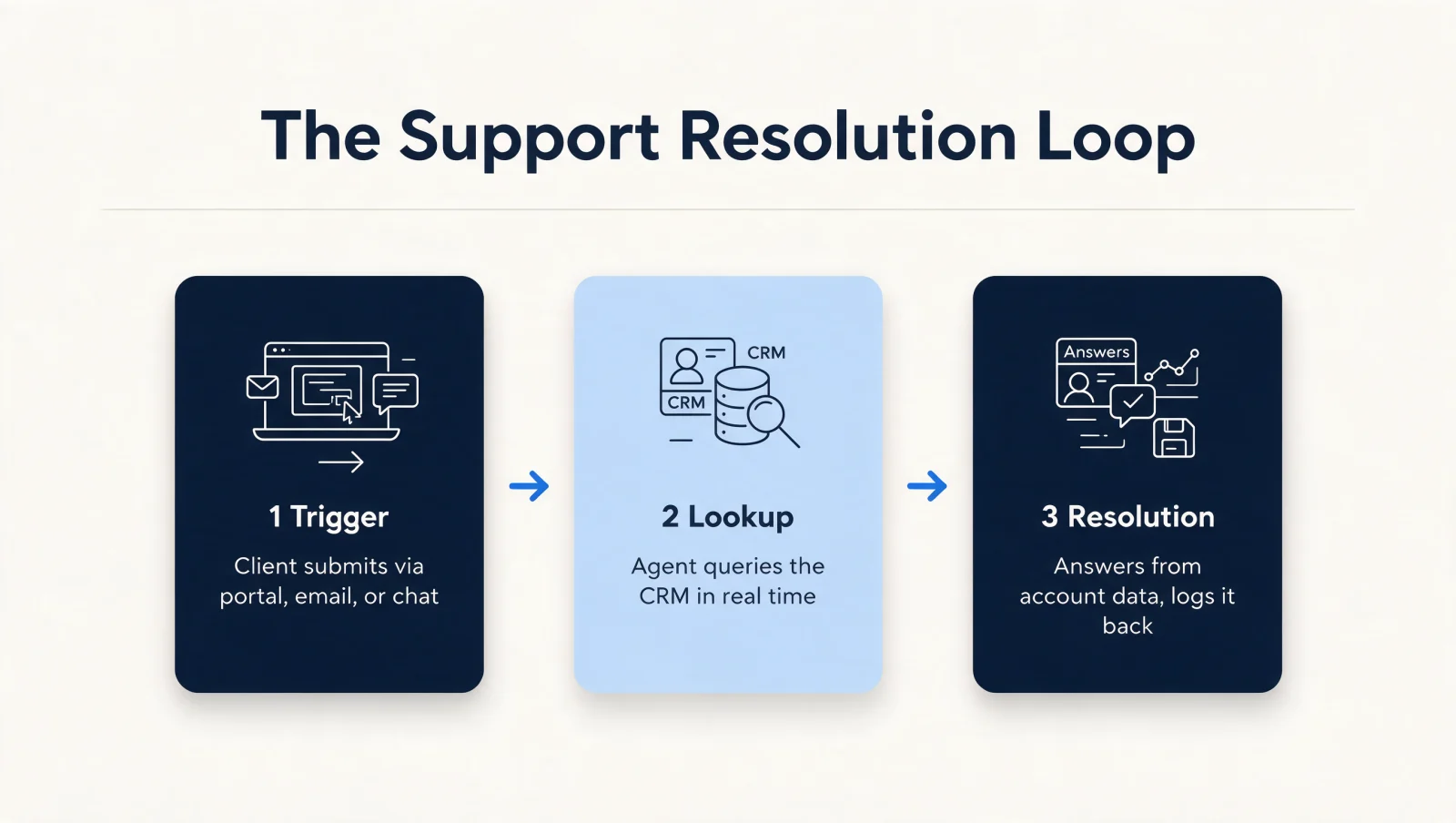
- Trigger: a client submits a request via portal, email, or chat.
- Lookup: the agent queries the CRM in real time, pulling account tier, open tickets, entitlements, and recent interactions.
- Resolution: the agent generates a response grounded in that account's data, then logs the interaction back to the CRM automatically.
That loop eliminates drift between your support history and your customer record, and it gives human agents a cleaner handoff on escalation. If your infrastructure has data-maturity gaps, understanding them early prevents costly rework later.
Best AI Agents for Customer Service in 2026
The best AI agents for customer service are chosen by complexity ceiling, not ticket volume. Here is how the leading platforms break down, channel by channel.
Text and Chat-First Platforms
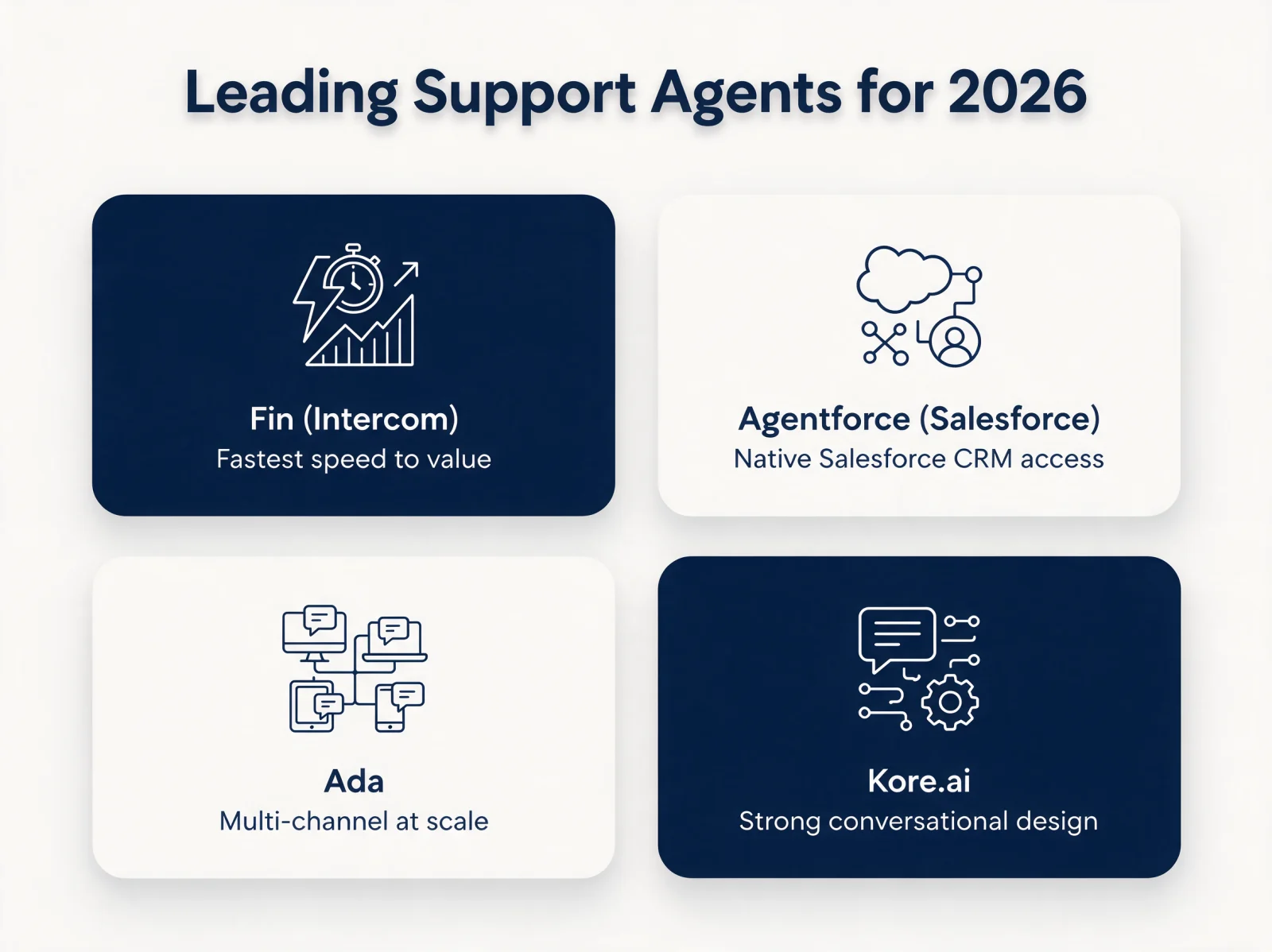
Fin (Intercom) is positioned for speed to value: a capable agent live within weeks, not quarters.
Agentforce (Salesforce) suits organizations already running deep Salesforce workflows, with native access to CRM data, opportunity records, and service history.
Ada targets high-complexity, multi-channel deployments where a single thread moves across email, chat, and SMS, with brand customization at scale.
AI Voice Agents for Customer Support
An AI voice agent for customer support handles the channel text-first platforms miss: the inbound phone call. Kore.ai stands out on conversational design, handling ambiguous, multi-intent queries across voice and chat well, which matters when clients ask nuanced questions that do not fit a standard tree. Gartner projects that by 2028, at least 70% of customers will use a conversational AI interface, voice included, to start their customer service journey, according to Gartner's customer service AI research, so voice coverage is no longer an edge case to defer.
| Platform | Best fit | Standout strength |
|---|---|---|
| Fin (Intercom) | Fast time-to-value teams | Live in weeks, low setup overhead |
| Agentforce (Salesforce) | Salesforce-native orgs | Deep CRM and opportunity data access |
| Ada | High-complexity, multi-channel | Brand customization at scale |
| Kore.ai | Voice and ambiguous queries | Conversational design across channels |
Selecting among these is a strategic exercise. A structured evaluation of your deployment readiness clarifies what your stack can support today, and our platform comparison guide covers the broader field.
The Hidden Risks: Hallucinations and Governance
Deploying a capable support agent takes more than picking a platform. It demands a governance framework that keeps the technology honest, on-brand, and supervised.
Generative models can produce confident, fluent answers that are factually wrong. In a support context, an agent might misquote a return policy, invent a product specification, or promise a discount that does not exist. The damage to trust compounds quickly when those errors reach hundreds of customers before anyone notices.
Human-in-the-loop oversight is the primary safeguard. Rather than fully automating every interaction, well-designed systems flag low-confidence responses, sensitive topics, and escalation triggers for human review before a reply goes out. That is a sign of a mature deployment, not a weak one.
Guardrails and brand-voice rules form the second layer: explicit, system-level constraints on what the agent can and cannot say. As part of a disciplined AI operations design, those boundaries keep the agent inside brand safety limits. Regular auditing closes the loop, reviewing conversation logs and escalation patterns to catch drift before it becomes a crisis.
How to Implement an AI Support Agent
A successful rollout is an organizational-readiness decision made long before any platform is selected.
- Assess readiness first. Audit your data foundation. Inconsistent knowledge bases, outdated FAQs, and fragmented CRM records will undermine even the most capable system. Successful deployments start with a readiness phase that identifies high-impact workflows, not with tool selection.
- Choose the right pilot. Order tracking, shipping status, and account lookups are high-volume, low-ambiguity workflows that make ideal entry points. Technical troubleshooting carries higher failure costs, so start narrow and build confidence.
- Resolve build vs. buy vs. implement. Building custom gives maximum control but demands engineering resources. Buying off-the-shelf is faster. Partnering with a specialist balances both, which is where most mid-market firms land.
- Leverage an implementation partner. Firms consistently underestimate the configuration complexity of a capable agent. A partner reduces time-to-value, manages vendor relationships, and builds internal capability at the same time.
Measuring Success Beyond the Deflection Rate
Deflection rate alone is a vanity metric. The KPIs that move B2B decisions reveal whether AI is creating value or just the illusion of efficiency.
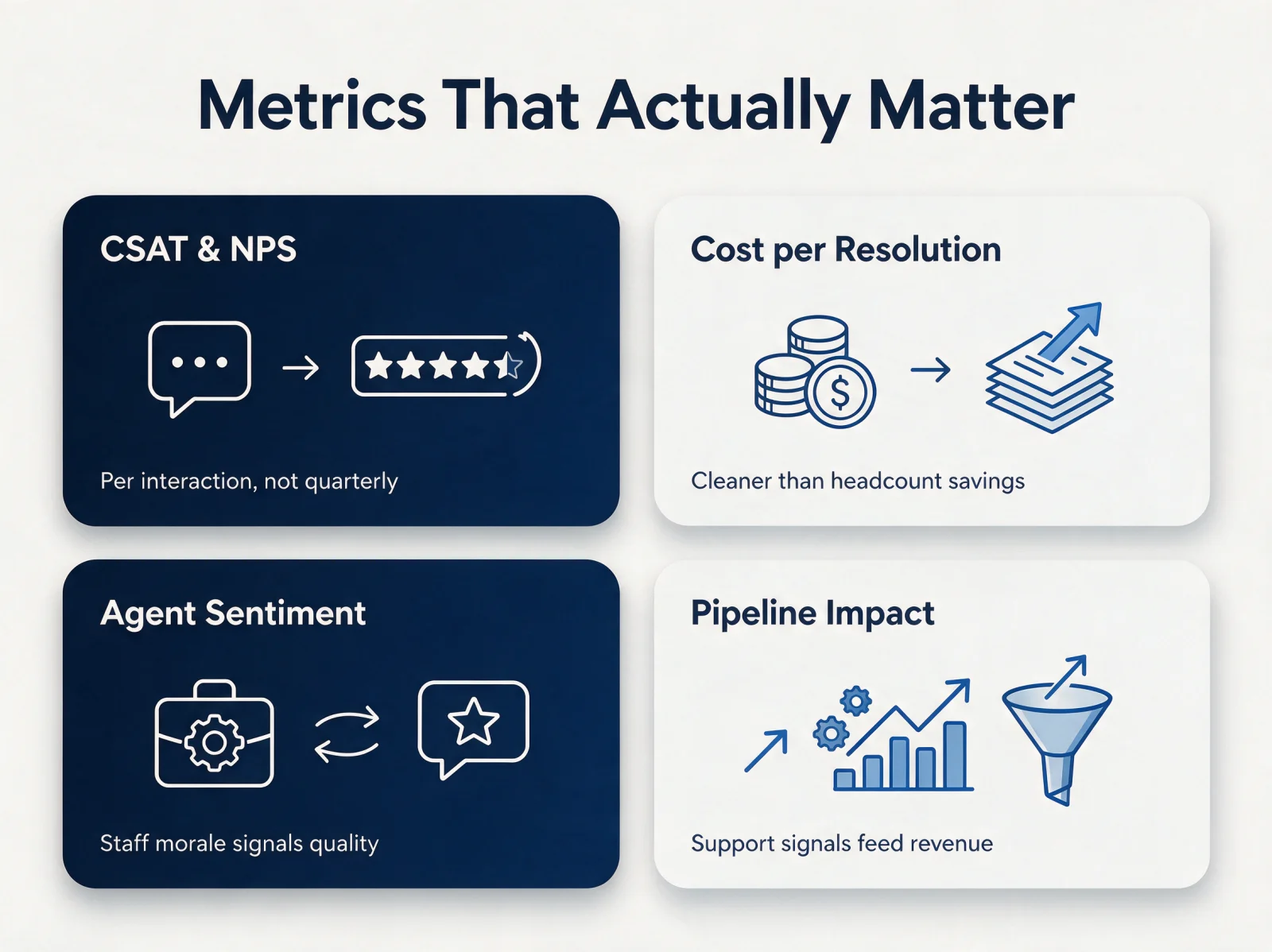
The real measure of a support agent is resolution quality, not tickets avoided. Four metrics are worth tracking:
- CSAT and NPS at the interaction level. Automation that frustrates users is worse than no automation. Watch satisfaction per interaction, not just quarterly, to catch friction before it becomes churn.
- Cost per resolution. Compare the fully loaded cost of AI-handled tickets against agent-handled equivalents, the same math behind our guide to what an AI agent actually costs. It is a cleaner ROI indicator than headcount reduction.
- Agent sentiment. Human staff morale is a leading indicator of service quality. When AI absorbs repetitive volume well, engagement rises; messy handoffs accelerate burnout.
- Pipeline impact. The most overlooked metric: a well-integrated agent surfaces intent that signals churn risk or expansion, turning support interactions into revenue intelligence.
Key Takeaways
An AI customer support agent is an autonomous reasoning engine, not a glorified chatbot, and that distinction changes every deployment decision that follows.
- AI agents reason, retrieve, and act. They evaluate context, query live data, and execute multi-step resolutions, unlike scripted bots that match keywords to canned replies.
- CRM integration is non-negotiable. An agent disconnected from your customer data produces answers that are generic at best and damaging at worst.
- Governance is not optional. Human oversight, escalation triggers, and confidence thresholds are what keep your brand promise intact when the model hits an edge case.
- Deflection is a byproduct, not the goal. Resolution quality, handle-time reduction, and CSAT are the metrics that prove operational value.
Turning Potential into Operating Results
The gap between AI potential and operating results is almost never a technology problem. It is an execution problem.
Leaders who treat a support agent as a plug-and-play purchase consistently underperform those who treat it as a systems initiative. The software is the starting point, not the solution. Connecting an agent to your CRM, ticketing platform, and escalation workflows takes technical depth and an understanding of how your revenue engine works. One without the other produces a capable tool nobody trusts.
See how a wealth advisory firm cut client-review prep 68% with governed, CRM-connected AI agents.
What separates a durable deployment from an expensive experiment is the partner behind it: a team that bridges AI reasoning with CRM architecture, maps workflow opportunities, defines governance guardrails, and builds toward measurable ROI before a single conversation is automated. If your organization is ready to move from evaluation to execution, start with a scoped AI agent build and readiness assessment.


