

Generative BI: AI-Powered Reporting for Mid-Market Teams
Generative BI (sometimes shortened to gen BI) is AI powered business intelligence where you describe what you want in plain language and the system generates the report, chart, or answer for you. You ask for the analysis instead of building it, and you get it on demand instead of waiting on the data team.
Traditional BI assumes someone will build the report first. Generative BI flips that. The reporting function stops being a backlog of dashboard requests and becomes a service anyone can use by asking. For mid-market teams that run real data but cannot staff a full analytics department, that shift is the difference between reporting that scales and reporting that bottlenecks on one overloaded person.
What Is Generative BI, Exactly?
Generative BI uses a language model to turn a plain-language request into a real query, then returns the result as a number, a chart, or a short written summary. The generation happens against your governed data, not a canned template.
Business intelligence automation is the broader shift this sits in: reporting that produces itself instead of waiting on a build queue. The word "generative" matters. The system is not picking from pre-built reports. It interprets your intent, writes the query, runs it, and composes the output. Ask for "monthly recurring revenue by segment for the last year" and it produces that view, even if nobody built it before. This is the same engine behind conversational BI, applied to reporting artifacts rather than a running chat.
How Is Generative BI Different From Traditional BI?
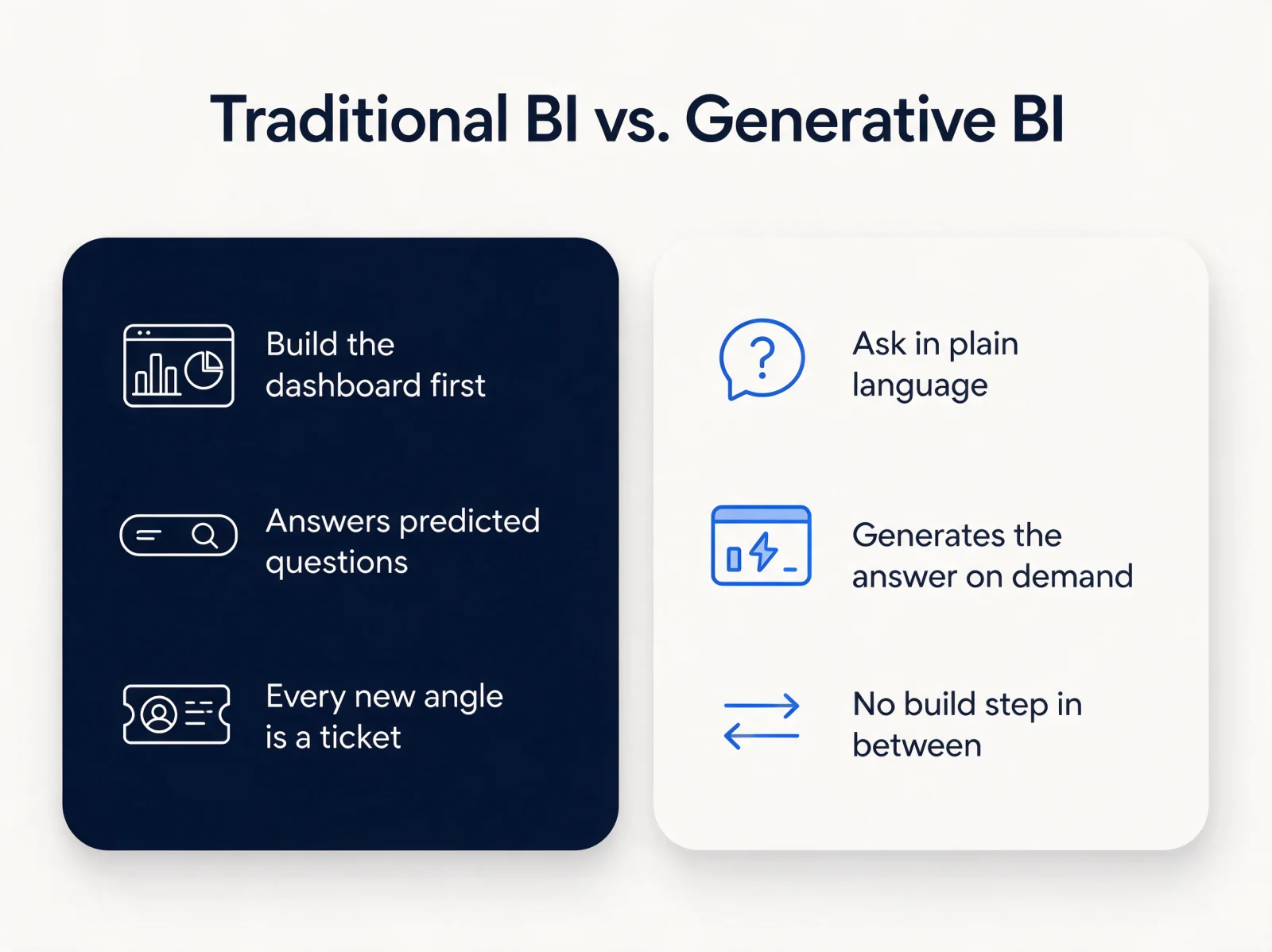
Traditional BI delivers fixed dashboards built in advance. Generative BI produces the answer to whatever you ask, in the moment, without a build step in between.
In a traditional stack, a request becomes a ticket, a ticket becomes a dashboard, and the dashboard answers one predicted question. Every new angle restarts the cycle. Generative BI collapses that loop. The request and the answer happen in one step. Your team spends its time reading results and deciding, not queuing report requests and waiting days for them.
The catch is accuracy. A fixed dashboard was validated once by a human. A generated answer has to be right the first time, every time, which puts all the weight on the data model underneath.
Why Does AI Powered Business Intelligence Matter for Mid-Market Teams?
Mid-market companies have enterprise-level data spread across several systems but rarely have an enterprise analytics team. Generative BI closes that gap by letting existing staff self-serve answers.
The pattern repeats across the mid-market, and the context makes it urgent: McKinsey's State of AI research finds 78% of organizations already use AI in at least one function, while most mid-market reporting still routes through one or two overloaded people. A company runs a CRM, a finance platform, and a few operational tools, so the data exists, but every cross-system question needs a person to assemble it. One or two analysts become a permanent bottleneck. Generative BI lets a finance manager, a sales lead, or an operations head ask directly and get a governed answer, the same conversational analytics motion that made chat-with-your-data tools credible. The reporting capacity of the business stops being capped by headcount. This is the same self-serve promise that self-service analytics has chased for a decade, finally made workable by language models. Self service analytics is the promise; gen BI is that promise with the build step removed.
What Makes a Generative BI Deployment Actually Work?
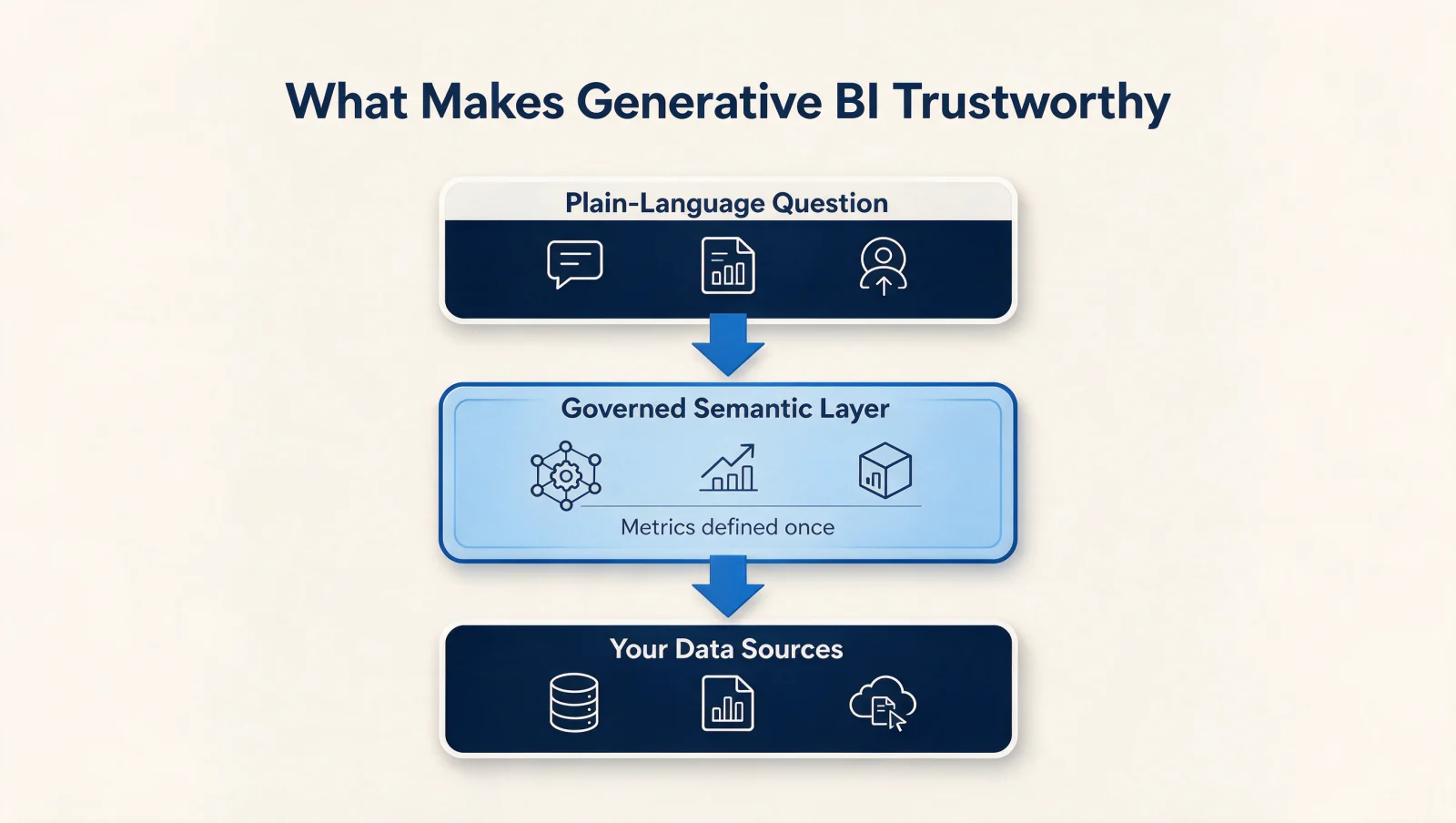
A governed semantic layer is what separates a useful AI reporting tool from a confident liar. Metrics have to be defined once, in a model the system is required to use.
| Foundation | Without it | With it |
|---|---|---|
| Semantic layer | Confident, inconsistent answers | One definition per metric |
| Evaluation loop | Errors found by executives | Errors found by the system |
| Access controls | Data leaks across teams | Everyone sees what they should |
This is where most deployments succeed or fail. Point a language model at a raw warehouse and it will guess at table joins and metric definitions. It will guess fluently, which is the danger, because a wrong number wrapped in a clean sentence looks exactly like a right one. When "active customer" means one thing in the CRM and another in billing, the generated answer is quietly incorrect and nobody notices until a decision goes sideways.
The semantic layer fixes this. Revenue, churn, and pipeline are each defined one way, and the system must query through those definitions. The answer becomes consistent and auditable. Building that layer on your data is an AI operations design problem, not a feature you switch on.
What Should You Look for in Business Intelligence Automation?
Judge an AI reporting tool on how it defines metrics, how it behaves when unsure, and whether you can audit any answer. The quality of the chat interface is the least important part.
A serious evaluation gets specific. Does the tool enforce governed definitions or improvise them? When a question is ambiguous, does it ask for clarification or return a guess? Can you trace any figure back to the exact query and source rows? Does it honor your existing access controls, so people see only the data they are cleared to see? Tools that answer these cleanly are built on real governance. Tools that dodge them are demos that break the first time a leader acts on a wrong number. Pairing the reporting layer with durable workflow automation is what turns one-off answers into a reliable operating rhythm.
How Do You Roll Out Generative BI Without Losing Trust?
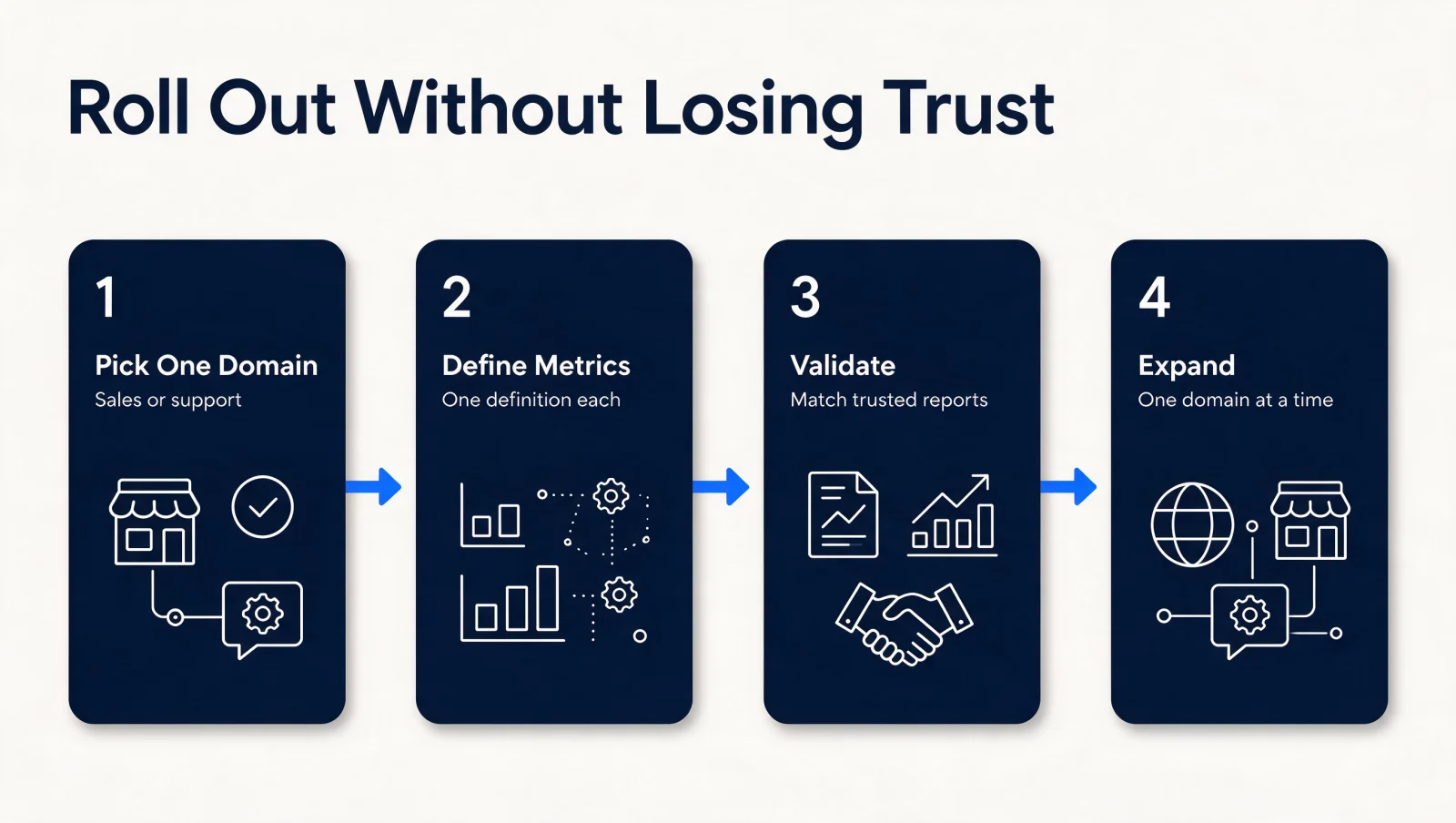
Start with one governed domain, validate its answers against reports you already trust, then expand. Trying to cover every system at once is how these projects stall.
Prove it on one domain
Trust is the currency, and it is easy to spend. The disciplined rollout picks a single, well-understood area first, such as sales pipeline or support volume. You connect the source, define its metrics, and check the generated answers against known-good reports until they match every time.
Expand on evidence
Only then do you widen the scope. A first correct-by-design deployment on a narrow slice earns the credibility that a broad, half-modeled launch never recovers from. Speed comes from controlling scope, not from skipping the validation that makes the answers safe to act on. Teams weighing the best AI tools for data analysis often learn this the hard way: the tool was never the constraint, the data model was.
What Data Does Generative BI Need to Work Well?
Clean, connected data with clearly defined metrics. Generative BI does not need perfect data, but it needs the metrics that matter defined once and the sources it queries reachable and reliable.
The common mistake is assuming you need a pristine warehouse before you start. You do not. You need the handful of metrics behind your real decisions defined consistently, and you need the systems that hold them connected. Revenue, pipeline, churn, and cost are usually enough to launch a valuable first deployment. The data does not have to be flawless everywhere. It has to be trustworthy in the domain you are opening up first, which is why a narrow, well-modeled start beats waiting for a company-wide data cleanup that never finishes.
Key Takeaways
- Generative BI turns a plain-language request into a real, governed query and returns the answer on demand.
- It removes the build-a-dashboard-first step that bottlenecks traditional BI.
- Mid-market teams with multi-system data and no analytics headcount gain the most.
- A governed semantic layer, not the chat interface, is what makes the answers trustworthy.
Bringing Generative BI to Your Stack
Generative BI is easy to demo and hard to deploy well, because the value lives in the data model and the governance, not the generation. Done right, anyone in the business gets a trustworthy answer without filing a request. Done carelessly, it manufactures confident numbers that erode trust faster than any slow dashboard.
See how a B2B SaaS company cut preventable churn 27% with an AI operating layer.
Twelverays connects your data sources, builds the governed semantic layer, and stands up AI-powered reporting on the systems you already run. If your reporting depends on one or two overloaded people, book a discovery call and we will scope where generative BI fits your stack.


