

Salesforce implementation cost is the price of delivering an agreed customer relationship management (CRM) setup, including the configuration, data work, integrations and adoption activities in scope. Comparing Salesforce implementation pricing requires a shared description of that work. A Salesforce implementation cost breakdown should expose deliverables, assumptions and customer responsibilities before you compare totals. Otherwise, two proposals may price different projects while appearing to answer the same request.
Start by deciding what must work when the project is accepted. For a sales team, that could mean a qualified lead reaching the correct owner, an opportunity following agreed stages and a manager seeing a reconciled pipeline report. Those outcomes give each partner something concrete to estimate.
This article focuses on delivery quotes. Use the separate Salesforce pricing guide for subscription background and the implementation guide for the broader rollout sequence.
Separate Salesforce implementation cost from software subscriptions
Implementation fees are charges for the delivery work specified in your agreement. Software subscriptions are charges for access to the products and entitlements you purchase. Ongoing administration, support and later enhancements may be included for a defined period or priced separately. Request enough detail to distinguish these categories even when one supplier bundles them.
Do not assume every Salesforce charge follows the same unit. According to the official Salesforce sales pricing page, editions and separately offered capabilities have different charging structures. Confirm your actual products, seats, usage allowances, currency, billing term and add-ons against the vendor quote. A published monthly unit does not, by itself, establish a monthly cancellation right.
Ask who supplies and invoices each item. Avoid treating direct vendor billing, partner resale or bundled procurement as universal. The estimate should identify the commercial arrangement applicable to your purchase and prevent the same subscription from appearing twice in the budget.
Keep the licensing decision connected to delivery. A feature assumed during estimation may require an entitlement your organisation has not purchased. Resolve that dependency before accepting a configuration price based on it.
Request the same Salesforce implementation cost breakdown from each partner
Send candidates one requirements summary and one comparison table. Ask them to state the effort or fee basis, what they assume you will provide and what evidence establishes completion. The example below defines questions rather than standard industry inclusions.
| Workstream | Scope to identify | Customer dependency | Evidence to request |
|---|---|---|---|
| Discovery | Processes, decisions and stakeholder groups | Available decision makers | Approved requirements and unresolved questions |
| Configuration | Objects, fields, permissions and workflows | Agreed process rules | Demonstrated scenarios and configuration record |
| Data migration | Sources, selected records and relationships | Access and approved cleanup decisions | Reconciliation and exception report |
| Integration | Systems, directions and failure handling | External system owner and access | End-to-end tests and operating instructions |
| Testing | Scenarios, environments and retesting effort | Named business testers | Results, defects and acceptance decision |
| Training and handover | Audiences, materials and administrator knowledge | Scheduled users and operational owner | Delivered materials and agreed handover checklist |
Then ask each partner to list exclusions. “Customer provides clean data” needs an agreed definition, a way to assess the sample and an owner for corrections. “Integration included” needs named interfaces, record flows and assumptions about external access.
Compare uncertainty as well as fee. One proposal may have investigated the source data while another relies on a record-count estimate. Ask what happens commercially if those assumptions prove wrong. For example, Salesforce's Data Export Service guidance states that export completion time is not guaranteed. A delivery estimate that depends on a particular export window should identify its extraction method, preparation and schedule assumption. A higher estimate may include more work, different expertise or additional risk allowance; the price gap alone cannot establish the reason.
Build a Salesforce implementation budget from your own inputs
Use a worksheet with separate columns for quoted cash cost, internal effort, recurring charges and contingency. Record currency and the period covered by each input. A first-year total should not silently combine a one-month subscription with twelve months of another service.
Include fixed delivery fees and any estimated hourly work that sits outside them. Identify rates, estimated hours, approval limits and how actual usage will be reported. Separate third-party tools, migration utilities, connectors and additional environments where required. Verify each charge against a current quote rather than copying a figure from a generic implementation example.
Internal work deserves a budget owner even when no supplier invoices it. Your staff may prepare records, approve requirements, test workflows and train colleagues. Record the expected hours and when those people must be available. If you assign an internal cost rate, show it separately from cash paid to vendors.
Contingency is a budget reserve for identified uncertainty. It is not a promised overrun or a universal percentage. Document the risks it covers and who can authorise its use. A data sample with unresolved duplicates may justify a specific cleanup allowance; it does not justify automatically adding the same percentage to every line.
For a simple calculation, use: agreed delivery fees, plus approved variable work, plus applicable software and third-party charges, plus separately valued internal effort and contingency. Check tax treatment with your finance team. Avoid presenting a total until the currency, period and assumptions are consistent.
Compare Salesforce implementation pricing models and change controls
A fixed fee, time and materials arrangement and phased programme can each suit a different level of certainty. Phasing describes how work is divided; an individual phase can itself use fixed or variable pricing. Ask what the proposed combination means for your approval rights and exposure to additional charges.
| Commercial approach | Question it should answer | Buyer control to request |
|---|---|---|
| Fixed fee for defined scope | What deliverables and assumptions does the fee cover? | Written treatment of exclusions and scope changes |
| Time and materials | Which roles and activities are billed at which rates? | Estimates, usage reporting and approval thresholds |
| Phased delivery | What must be accepted before the next phase starts? | Phase boundaries, decision criteria and funding approval |
A fixed price does not remove every budget risk. Customer delays, changed requirements or excluded work may still have commercial consequences under the agreement. Time and materials does not have to mean unrestricted spending: discuss caps, review points and authority to proceed.
Ask whether meetings, documentation, testing, revisions and defect correction count against the quoted capacity. Define the difference between correcting work that misses an agreed requirement and requesting a new behaviour. That distinction should be assessed against the approved scope, with a clear route for resolving disagreements.
For changes, request a description of the requested work, fee impact, schedule impact and approving person before it proceeds. Decide how urgent issues will be handled without leaving routine scope decisions to verbal assumptions.
Assess Salesforce consulting partner fees against acceptance evidence
Evaluate fees alongside the work you can inspect. Useful proposed milestones include approved requirements, a reconciled migration, passed user acceptance testing and an agreed handover package. User acceptance testing (UAT) is the business team's check that the delivered system meets its documented requirements.
According to Salesforce's organisation change guidance, planning and tracking changes across development and testing environments are part of managing delivery. Ask how the quote funds the relevant preparation, validation and release work. Do not assume those activities are included in a single “configuration” line.
For each proposed milestone, name the evidence, reviewer, review period and handling of unresolved issues. A migration record count should be accompanied by checks of important fields and relationships. A training session should specify its audience and materials. “Project complete” needs a definition tied to what the customer agreed to buy.
Discuss how these milestones relate to invoices and payment terms. Payment timing follows the negotiated agreement; it does not automatically pause whenever a buyer raises an issue. Have the commercial document explain acceptance, disputes and any effect on invoicing clearly enough for your responsible reviewers to assess.
Compare the first-year commitment and ongoing responsibilities
Build one view of the first year that includes implementation, subscriptions, paid dependencies, internal effort and the support you intend to buy. Show one-time and recurring costs separately so decision makers can also understand the following year's commitment.
According to Salesforce's Success Plans, Premier is priced at 30% of net license fees and is bundled with Unlimited Edition. Check the applicable order before adding Premier as an extra budget line. This is vendor support pricing, not a rate for a consulting implementation. Compare your purchased coverage with the operating work you need, such as maintaining business-specific configuration, investigating a connected system or preparing a new workflow. Do not assume a vendor plan and a consulting support agreement cover the same tasks.
Ask who owns permissions, data quality, failed integrations and future requests once implementation ends. The answer may involve your team, a partner and software vendors. Record the boundary, contact route and charging basis for each responsibility. A support retainer is one possible arrangement, not a required component of every rollout.
Review the cost of a poorly scoped CRM implementation as background for your risk discussion. For the current decision, ask candidates to explain specific assumptions in their own proposals rather than using an unrelated project's outcome as evidence about your likely costs.
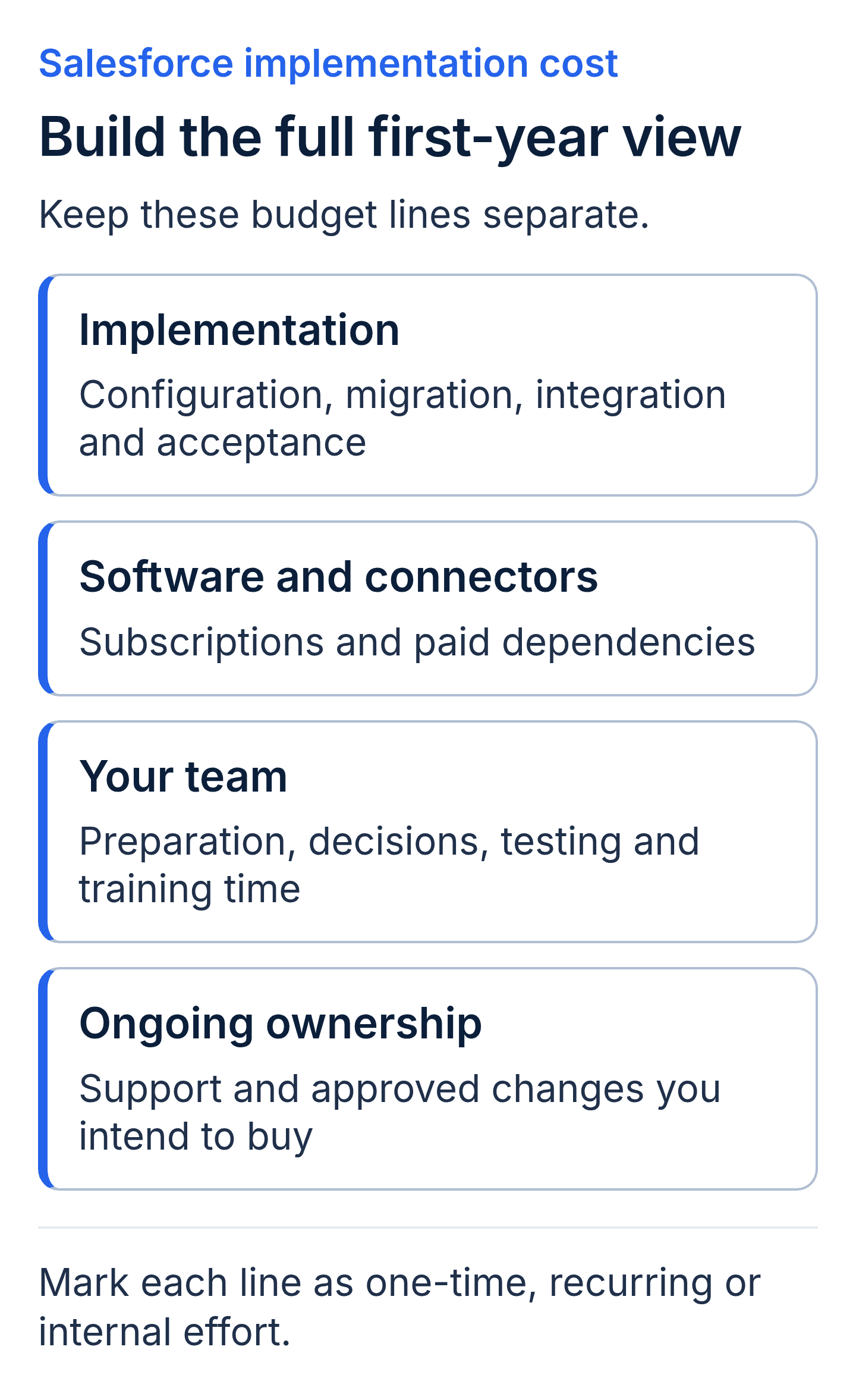
A comparison worksheet for the first year. Request the amount, billing basis and owner for each applicable line.
Salesforce implementation cost glossary
- Fixed fee: an agreed charge for work within stated scope and assumptions.
- Time and materials: charges based on agreed rates and the work actually recorded, subject to the contract's controls.
- Phased delivery: work divided into defined stages with review and funding decisions between them.
- Customer dependency: an input, decision or access requirement the customer must provide for delivery to proceed.
- Change request: a proposed alteration to agreed scope, with its fee, schedule and approval consequences documented.
- Acceptance criterion: an observable condition used to decide whether a deliverable meets the agreed requirement.
Key takeaways
- Salesforce implementation quotes are comparable only after their deliverables, assumptions and customer dependencies are clear.
- A first-year implementation budget separates software, delivery, internal effort and ongoing support.
- Variable work and requested changes need documented estimates and an authorised buyer decision before proceeding.
- Consulting fees should be assessed alongside acceptance evidence and the responsibilities that continue after launch.
Salesforce implementation cost buyer FAQs
Are Salesforce licenses included in an implementation quote?
They may be included, bundled or purchased separately. Ask the supplier to identify products, quantities, billing periods and invoice responsibility. Confirm the subscriptions against the actual vendor terms. Do not infer the licensing arrangement from the implementation fee or the partner's role.
Why do implementation proposals cost different amounts?
Possible reasons include scope, assumptions, staffing, delivery method, expertise and risk allowance. Ask each candidate to explain the differences using your common requirements table. Request clarification on excluded cleanup, integration dependencies, testing and support before deciding what the price difference represents.
How should data cleanup and integrations be priced?
Ask for enough separation to see what each workstream covers. That may be a defined fee, estimated effort or a discovery phase followed by a delivery estimate. Establish sample quality, systems, mappings, ownership and acceptance criteria before comparing prices. A line item without those assumptions offers limited clarity.
When is fixed-price delivery appropriate?
Consider it when requirements and dependencies are understood well enough for both parties to agree what the fee covers. Review change provisions and customer obligations. If important unknowns remain, a bounded discovery or phased approach may help establish a more credible estimate before committing to wider delivery.
Discuss Salesforce implementation scope with Twelverays
Bring your requirements, candidate proposals and unresolved assumptions to a discussion about Twelverays Salesforce consulting services. Include the systems, data and acceptance outcomes behind the estimate. Contact Twelverays to discuss the delivery scope your implementation budget needs to support.


