

AI Analytics Platforms: Buy, Build, or Connect What You Already Have?
An AI analytics platform lets people ask questions of company data in plain language and get analyzed answers back. For most mid-market teams the smartest move is not to buy a new AI powered analytics platform or build one from scratch, but to connect an AI layer to the systems you already run.
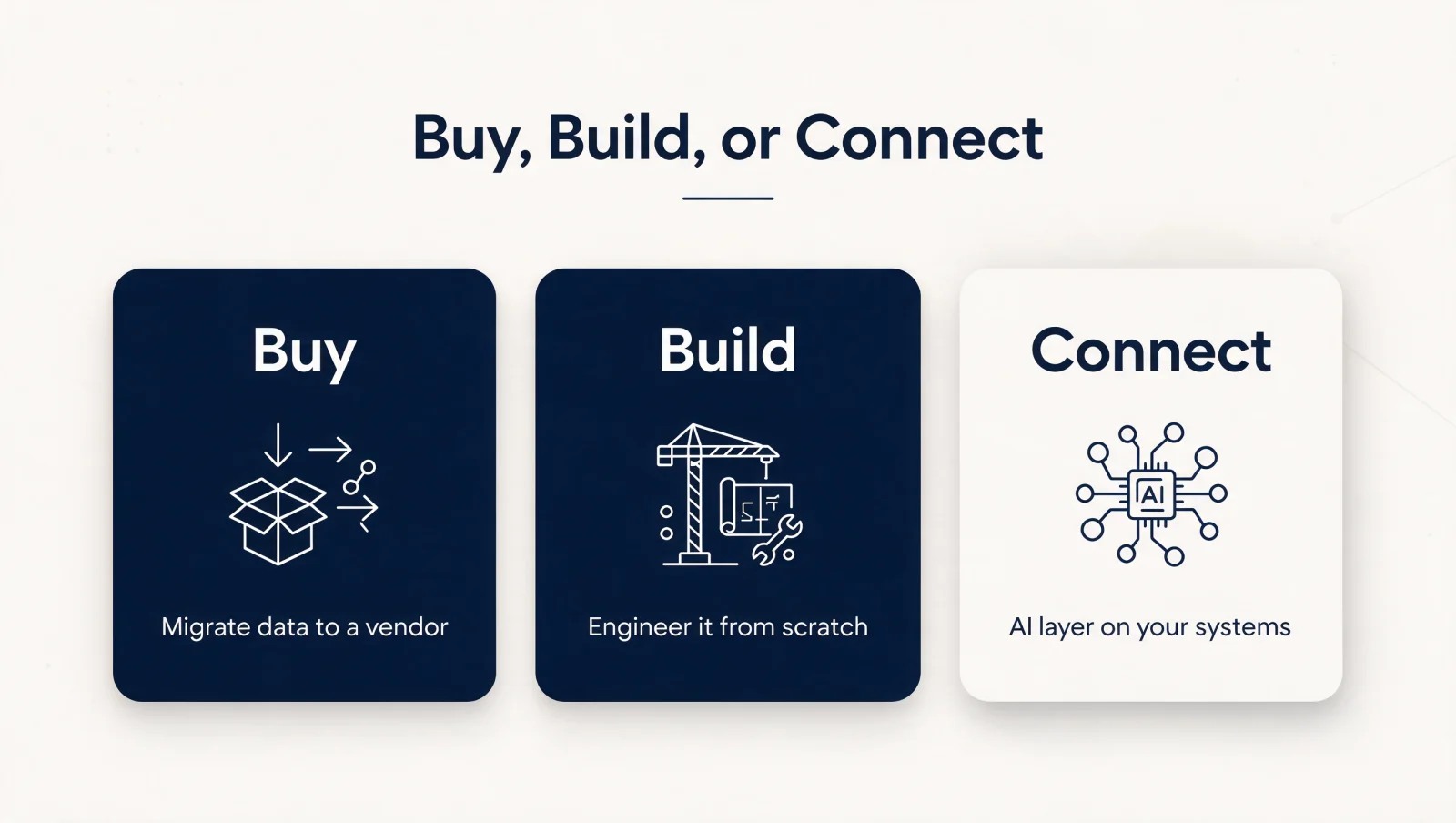
The market pushes two options: buy one of the shiny new AI analytics tools, or build something custom. Both usually overshoot. Buying means migrating your data into someone else's walled garden. Building means committing engineering you do not have to a problem that is mostly solved. The third path, connecting AI to your existing stack through a governed layer, gets you the outcome without the migration or the multi-quarter build.
What Is an AI Analytics Platform?
An AI analytics platform is software that connects to your data, interprets plain-language questions, and returns governed answers or reports. The valuable part is not the interface. It is the connection to your data and the model that keeps answers correct.
Strip away the marketing and every AI analytics platform does the same three things: it reaches your data, it understands a question, and it returns an answer. Vendors compete on the chat experience, but that is the easy part now. The hard parts, and the ones that decide whether you can trust the output, are how completely it connects to your systems and how rigorously it governs metric definitions. Those are the same foundations behind any real self-service analytics capability, and they apply to every category of AI data analytics software on the market.
Should You Buy an AI Analytics Platform?
Buy only if a vendor's platform natively covers your exact stack and you are willing to move your data to it. For most mid-market teams with data across several systems, a bought platform means a migration and a new silo.
Buying looks simple until you check where your data lives. A packaged platform wants your data in its world, so you migrate the CRM, the finance system, and the operational tools into it, or you accept partial coverage. Either way you have added a system rather than unified the ones you have. For a company already juggling several data analytic platforms and operational tools, that is a step sideways. The exception is a business whose data already sits in one place the vendor supports end to end. That is rarer than the sales deck implies.
How Do AI Analytics Tools Like Salesforce Einstein Fit In?
Embedded AI analytics tools, such as Salesforce Einstein analytics inside your CRM or Copilot inside Power BI, are strong within their own system and blind outside it. They answer questions about the data their platform holds, not the questions that span your whole business.
The embedded tier deserves a clear-eyed look, because you may already own some of it. Salesforce Einstein brings prediction and conversational analytics to CRM data; Microsoft's Copilot in Power BI drafts reports over what Power BI can reach. If your question lives inside one of those systems, embedded AI is the cheapest answer available. The limit is the boundary: ask "which marketing spend produced our most profitable customers" and the answer spans CRM, finance, and ad platforms, which no single embedded tool sees. Embedded AI is a feature of one system. Your business runs on several.
Should You Build Your Own AI Analytics Platform?
Almost never from scratch. Building the model, connectors, and governance in-house is a large, ongoing engineering commitment for a problem that off-the-shelf language models and a semantic layer already solve.
Building sounds like control, and control is real, but so is the cost. You are committing to maintain data connectors, a query-generation engine, a governance layer, and an interface, forever, with the engineers you would rather point at your actual product. The parts that used to justify building, the language understanding and query generation, are now commodity capabilities from natural language to SQL engines. What is left to build is the governance and connection specific to your data, and that is an implementation project, not a platform-from-zero project.
What Does "Connect What You Already Have" Mean?
It means deploying an AI layer on top of your current systems, with a governed semantic layer in the middle, so nothing migrates. Your data stays where it lives, and the AI reads across it to answer questions.
This is the path that fits most mid-market teams. You keep your CRM, your finance platform, and your operational tools exactly where they are. On top of them sits a governed semantic layer that defines your metrics once, and an AI agent that queries through that layer to answer questions spanning all of it. No migration, no new silo, no rip-and-replace. You get the outcome that conversational analytics software promises, an answer to any question in plain language, on the stack you already paid for. This is what AI operations design delivers: the intelligence layer, built onto your existing systems.
How Do You Decide Between the Three?
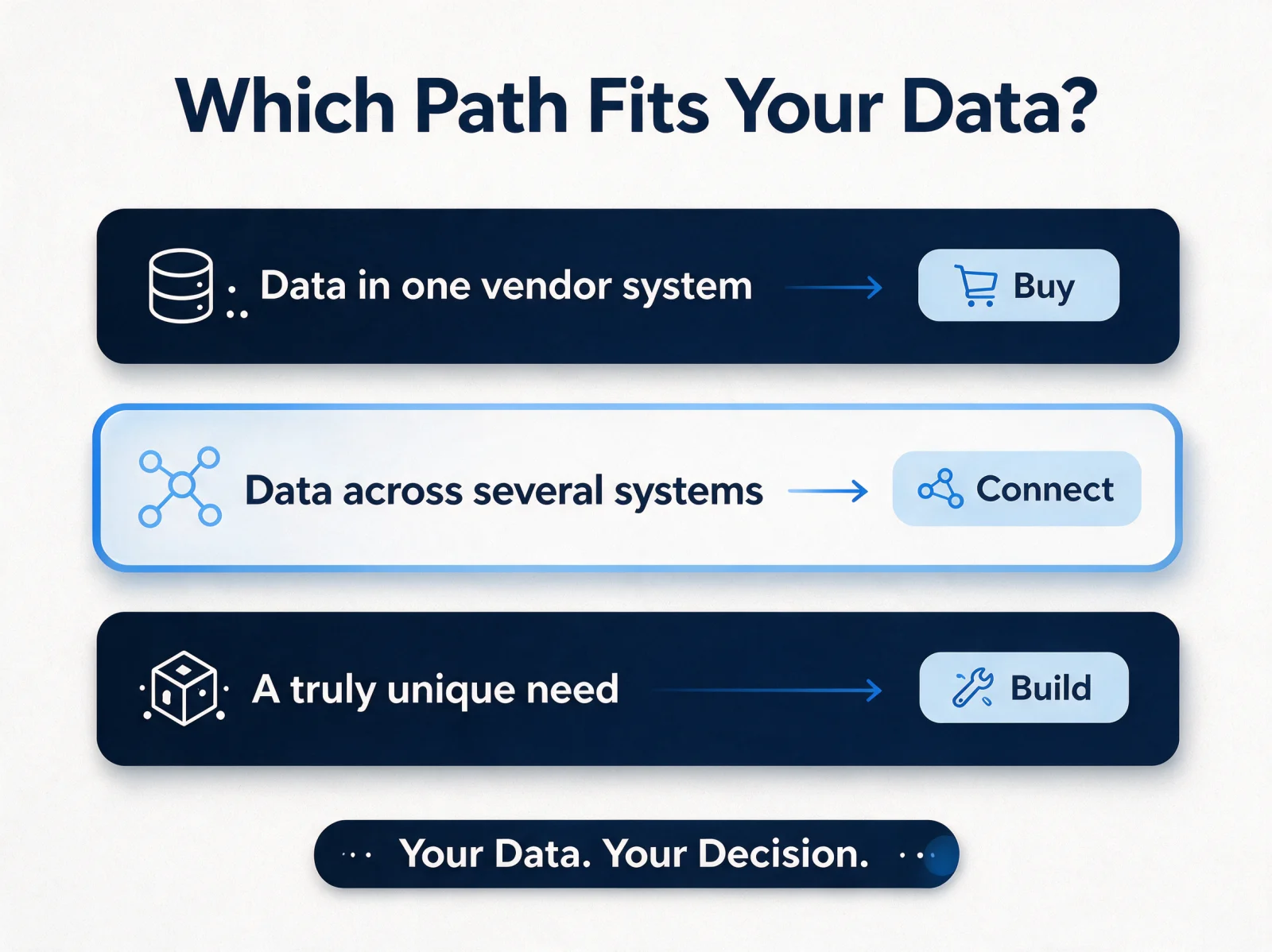
Map where your data actually lives. One vendor-native system points to buy, a genuinely unique need with real engineering to spare points to build, and data spread across several systems, the common case, points to connect.
The decision is less about ambition and more about your data topology. If everything already lives in one platform a vendor covers, buying is reasonable, and the embedded AI analytics tools you already license may be enough. If you have a genuinely novel requirement and engineering capacity to burn, building is defensible. If your data is scattered across a handful of systems and you have no analytics team to spare, connecting is the clear answer. Most mid-market companies are in that third bucket, which is why "connect" wins more often than the vendor pitches admit. Evaluating the best AI tools for data analysis is downstream of this call, not a substitute for it.
What Makes Any of These Options Actually Reliable?
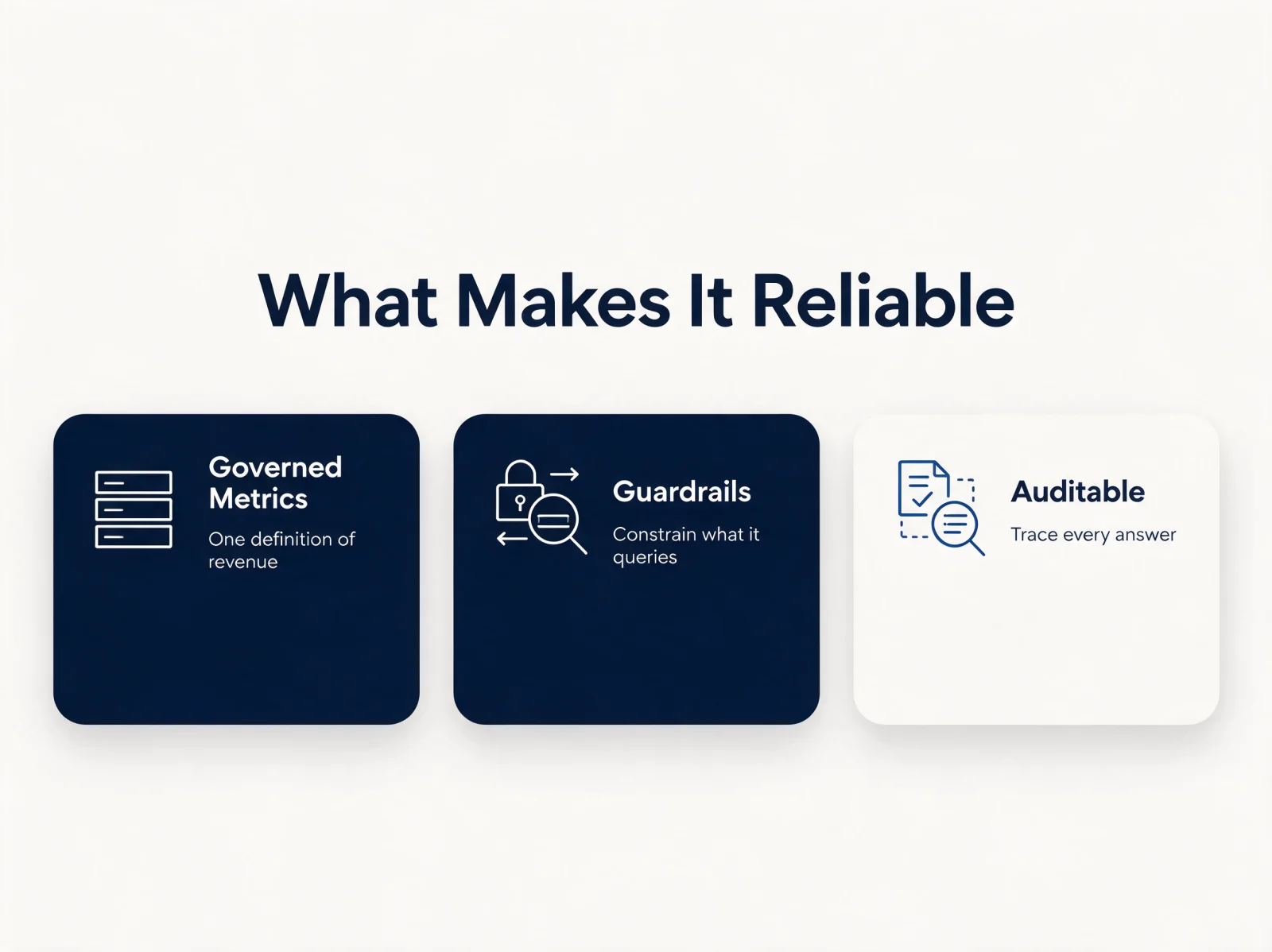
A governed semantic layer and clear guardrails. Whichever path you pick, answers are only trustworthy if metrics are defined once and the AI is constrained to use them.
Buy, build, or connect, the reliability question is identical. Without a governed layer, any AI powered analytics platform will generate confident, inconsistent answers, because it improvises what "revenue" or "active account" means. With one, every answer traces back to a single definition and an auditable query. The governance is the product. Wrapping it in dependable workflow automation is what turns trustworthy answers into a repeatable operating rhythm rather than a series of one-off lookups.
How Long Does Connecting an AI Layer Take?
A focused first deployment on one governed domain takes weeks, not the months a platform migration or a ground-up build demands. That speed is the practical argument for connecting over buying or building.
Timeline is where the connect path pulls ahead. Buying means a data migration measured in months and a change-management project to match. Building means standing up connectors, a query engine, and governance before you answer a single question. Connecting starts from what you already have. You point the AI layer at one well-understood domain, define its metrics, validate the answers, and open it up, and that first useful deployment lands in weeks. You expand one domain at a time from there. The gain is not just speed for its own sake. Shipping a correct answer early earns the trust that carries the rest of the rollout, which is exactly what a migration-first or build-first approach spends months without.
Key Takeaways
- An AI analytics platform's real value is data connection and governance, not the chat interface.
- Embedded AI analytics tools like Salesforce Einstein and Copilot in Power BI are strong inside their own system and blind across systems.
- Buying usually forces a data migration and creates a new silo; build it only for a genuinely unique need.
- For most mid-market teams with multi-system data, connecting an AI layer to existing systems wins.
- A governed semantic layer is what makes answers reliable under any of the three approaches.
Choosing the Right Path for Your Stack
The buy-build-connect decision is really a question about where your data lives and who will keep the answers correct. For companies with data across several systems and no room to migrate or build, connecting an AI layer to the existing stack is the fastest route to trustworthy answers.
See how a B2B SaaS company cut preventable churn 27% with an AI operating layer.
Twelverays assesses your data topology, builds the governed semantic layer, and connects an AI analytics layer to the systems you already run, no migration required. If you are weighing buy versus build versus connect, book a discovery call and we will help you make the call for your stack.


