

Defining the AI Sales Agent in a Post-Automation World
Sales development reps are burning out, and static automation sequences aren't fixing it. They're accelerating it. An AI sales agent reasons through a goal instead of firing a scripted sequence, and that's exactly why AI agents for sales are moving from pilot budgets into core RevOps infrastructure this fast.
An AI sales agent is an autonomous software system that observes context, evaluates options, and takes action without a human pressing "go." Unlike a chatbot that follows a fixed decision tree, an AI powered sales agent reasons through context and picks the next best action on its own. As IBM puts it, that is what separates a true agent from a decision-tree bot: the ability to analyze data, form a plan, and execute it.
Automation vs. agents, the core distinction:
- Traditional automation is static. If a prospect opens an email, send a follow-up. Every path is scripted in advance.
- Agentic AI is dynamic. It reads signals, reasons through them, and chooses the next best action, even in situations no one anticipated.
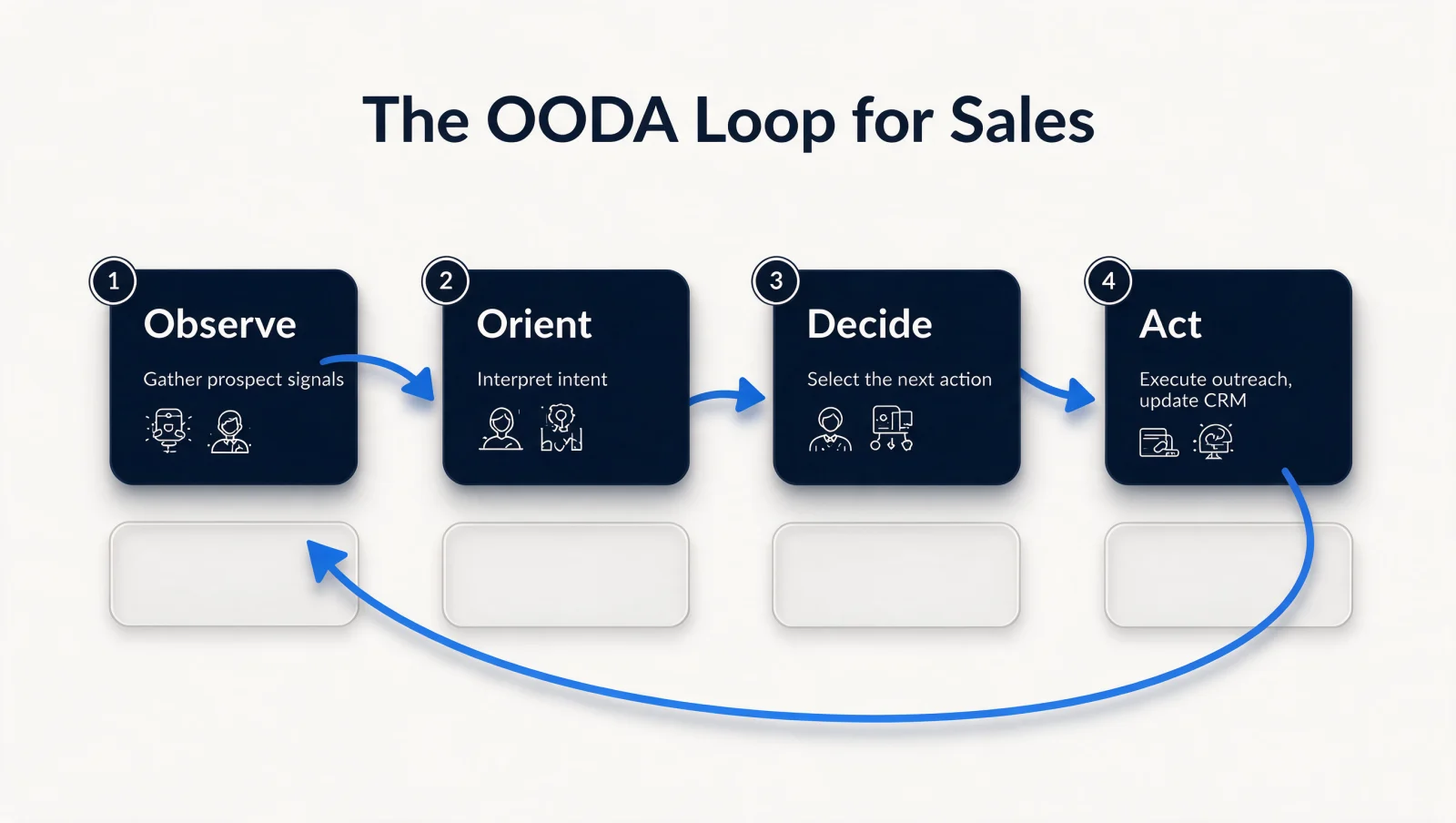
That reasoning follows what strategists call the OODA loop: Observe (gather prospect signals), Orient (interpret intent), Decide (select the right action), Act (execute outreach or update the CRM).
The "why now" is simple. Large language models finally make non-scripted, natural conversation possible at scale. Earlier AI tools lacked the contextual fluency to feel human. Today's agents don't, which unlocks capabilities that go far deeper than sequence automation.
The Core Capabilities: What Modern AI Agents Actually Do
An AI-powered sales agent doesn't just automate tasks. It runs the full top-of-funnel workflow that used to require an entire SDR team, and the time it frees up is real: Salesforce puts actual selling time at just 28% of a rep's week, with the rest lost to admin work.
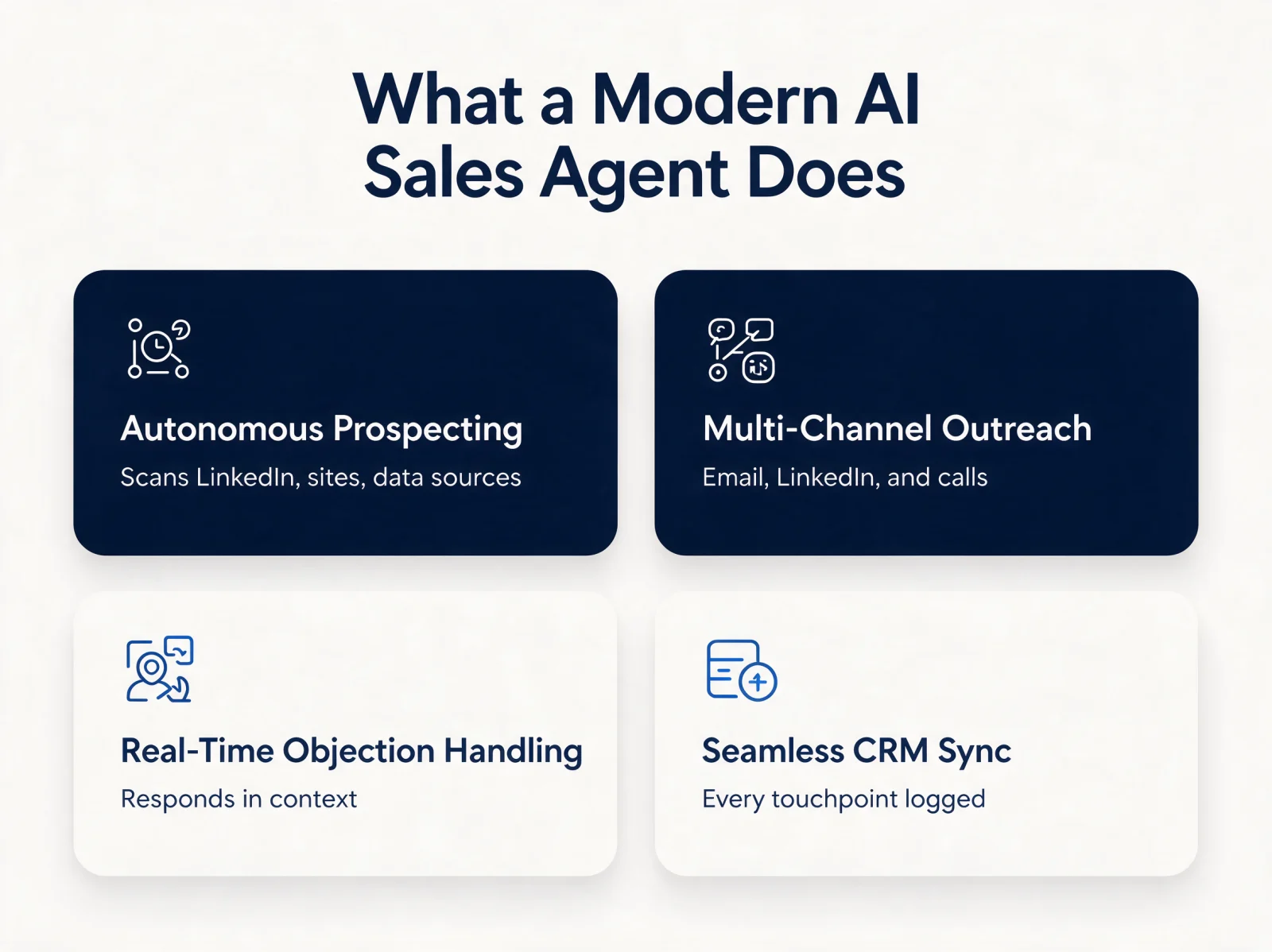
What a mature AI sales agent handles autonomously today:
- Prospecting and lead research. Agents scan LinkedIn, company sites, and third-party data to build enriched prospect lists without a human running a single search.
- Personalized multi-channel outreach. Agents craft and send individualized emails, LinkedIn messages, and calls, adjusting tone and timing to prospect behavior instead of a fixed drip sequence.
- Real-time objection handling. This is where AI sales agent cold calling deployments earn trust or lose it. Unlike static chatbots, agentic AI recognizes objections in live replies and responds contextually, without escalating every thread to a rep.
- Seamless CRM synchronization. Every touchpoint, including emails, responses, and call summaries, logs automatically. This is where reliable CRM data matters, because agents are only as effective as the data behind them.
Pro tip: Audit field mapping and deduplication rules before activating any agent workflow. An agent that logs to a cluttered Salesforce or HubSpot instance surfaces the same bad data faster.
These capabilities free account executives to focus where human judgment matters most: negotiation, relationship nuance, and closing. That shift in labor allocation is what mid-market RevOps leaders are building their roadmaps around.
Why Mid-Market RevOps Leaders Are Prioritizing Agentic AI
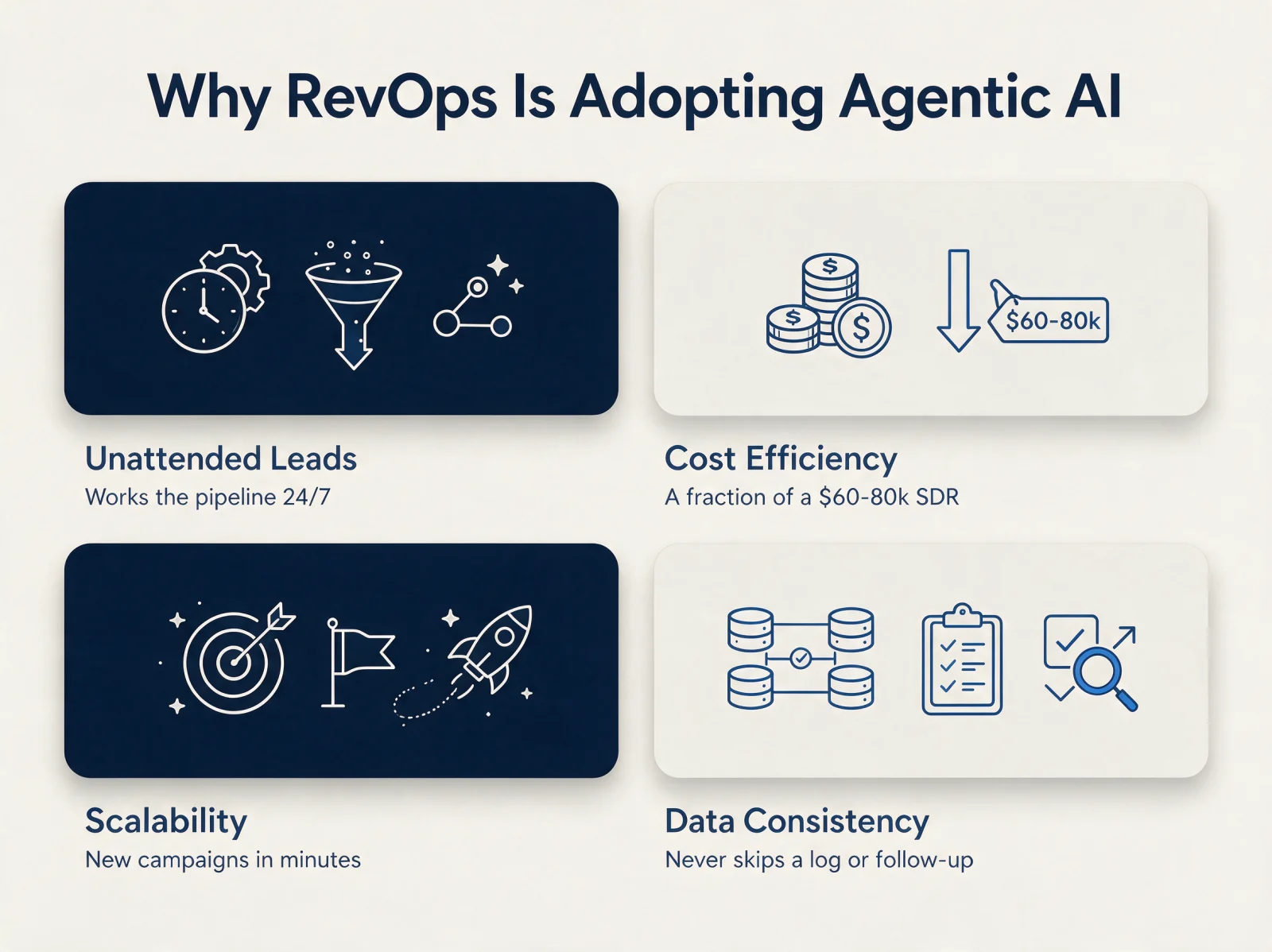
The business case for AI agents for sales isn't theoretical. It answers four operational failures that quietly drain revenue every quarter.
The unattended lead problem hits first. A prospect fills out a demo request at 11 PM on a Friday. Without an AI agent, that lead sits until Monday, cold, maybe already talking to a competitor.
Cost efficiency is the second driver. A mid-market SDR costs roughly $60,000 to $80,000 annually in base salary alone, before benefits and ramp time. A capable AI agent subscription typically runs a fraction of that, with no quota-miss risk or turnover cost.
Scalability widens the gap further. Hiring and onboarding a new SDR takes weeks. Launching a new outbound campaign with an AI agent takes minutes: new sequences, personas, and messaging, deployed without a single training session.
Data-driven consistency closes the argument. Agents never forget to log a call or skip a follow-up. The result is a pipeline that reflects reality, not what a rep remembered to enter on a Thursday afternoon.
Knowing why to adopt agentic AI is only half the equation. The harder question is which platform delivers, and what it costs to get there.
Evaluating the Landscape: Best AI Sales Agent Software for 2026
Choosing the right AI sales agent software comes down to one question: does your team need a pre-built solution that runs out of the box, or a flexible system that bends to your existing stack?
The market has split into two camps. Full-stack agents, like Artisan's Ava, bundle prospecting, personalization, and outreach into one system: you configure goals, and the agent executes. Workflow builders like Gumloop and Workato let RevOps teams construct custom agents that connect directly to their tech stack, a better fit when off-the-shelf logic doesn't match your sales motion.
Human-in-the-loop controls matter in high-stakes environments. Enterprise platforms surface approval queues and message previews before anything reaches a prospect. Teams that skip this run into compliance issues or off-brand outreach.
Specialization is accelerating too. Purpose-built agents for real estate handle property inquiries and scheduling. On the post-sale side, AI customer support agents show the same pattern applied after the deal closes. CRM fit shapes everything else: a platform that syncs natively with your system beats a feature-rich tool that creates data silos.
How to Build an AI Sales Agent: Buy, Build, or Partner
There are three real paths to deploying an AI sales agent, and the right one depends on your timeline, your engineering bench, and how much control compliance needs over what reaches a prospect.
Buy: Deploy a Pre-Built Platform
The buy route trades flexibility for speed. Plug-and-play platforms ship with pre-built prospecting, outreach, and qualification workflows that go live within days. Pricing typically follows a subscription model with tiers based on seats or contact volume, which keeps budgeting predictable. This is the right call for teams that need results now and lack spare engineering headcount.
Build: Assemble a Custom Framework
The build route trades speed for control. Frameworks like LangChain, or no-code workflow tools, let a technical team construct agents with custom logic tuned to a specific industry or compliance requirement. Someone still has to own that architecture long term, including every prompt update and integration break.
A middle path exists: partnering with an implementation team that customizes an existing platform around your CRM and brand voice. It avoids the full engineering burden while keeping control over what the agent says and what data it touches. That control question, more than budget, should decide the path you take.
AI Sales Agent Pricing: What It Actually Costs
AI sales agent pricing is the total cost of running an autonomous agent, not just the number on its subscription page. The model you pick changes what you actually pay for.
| Pricing model | How it works | Best for |
|---|---|---|
| Per-seat | Fixed monthly cost per user | Predictable budgets, small teams |
| Per-lead | Pay per contact the agent engages | Volume-driven pipelines |
| Usage-based | Cost tied to AI compute or call minutes | Voice and high-volume outbound |
Usage-based pricing is the common model for voice and high-volume cold-calling programs, where cost scales with call minutes and speech-to-text/text-to-speech compute rather than seats.
The software license is only part of the real cost. Implementation and workflow setup routinely add as much again to the first-year investment. Weigh that against the $60,000 to $80,000 a mid-market SDR costs in salary alone, and a mid-tier agent running outreach around the clock compares favorably, as long as the CRM data it operates on is clean.
The Integration Reality: Connecting Agents to Your CRM
An AI sales agent without CRM access isn't an asset. It's a liability that generates noise and erodes the data integrity your RevOps function depends on.
The real value lives in the connection between the agent and your system of record, whether that's Salesforce, HubSpot, or Dynamics 365. Salesforce's own agentic framework makes this explicit: agents must be grounded in CRM data to be effective and accurate. Without that grounding, an agent reaches out to a prospect who closed last Tuesday or creates duplicate contact records that take hours to clean up.
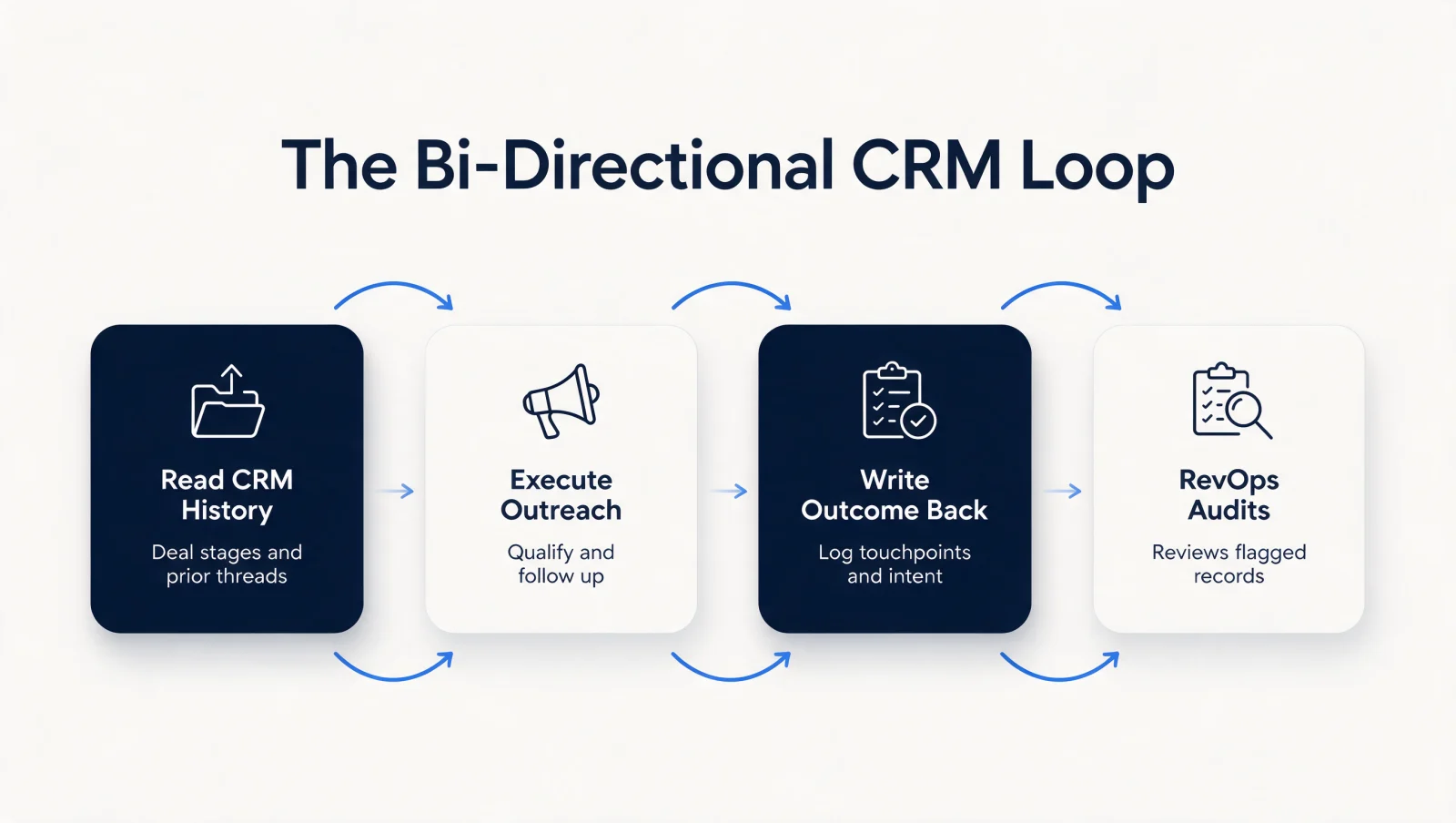
Bi-directional sync is the non-negotiable foundation. Before sending a message, the agent needs to read historical deal stages, prior threads, and contact properties. After the interaction, it writes back: updating the deal stage, logging the touchpoint, flagging intent signals. If you're building this for the first time, understanding what an AI-powered CRM actually is offers a starting framework, and how AI agents plug into your CRM fills in the platform detail.
RevOps governs the rules; the agent executes them. Field mapping, data hygiene standards, and escalation triggers all need defining before an agent touches live pipeline, so the CRM doesn't become a polluted dataset.
The diagram below illustrates the core data flow:
[Inbound Lead] → [Agent reads CRM history + enrichment data]
              → [Agent executes outreach or qualification call]
              → [Agent writes outcome back to CRM]
              → [RevOps reviews flagged records + audits data quality]
              → [Deal stage updated; next action triggered]
Getting this infrastructure right is the prerequisite for everything that follows, and it determines whether your pilot scales into production.
Implementation Strategy: Moving from Pilot to Production
Getting the best AI sales agent results doesn't happen by deploying everything at once. It happens by starting narrow, measuring honestly, and scaling deliberately.
The lowest-risk entry point is appointment setting and lead qualification: well-defined, easily measured, and low downside if an interaction underperforms.
- Start with low-stakes tasks. Deploy on inbound lead follow-up and calendar scheduling first. This builds confidence and surfaces edge cases before you expand scope.
- Define success metrics upfront. Reply rate signals messaging quality. Meetings booked signals conversion. Data accuracy, how cleanly the agent logs back to your CRM, signals whether the system is sustainable.
- Keep humans in the loop on messaging. Sales leaders should review AI-generated sequences regularly. Tone drift compounds quietly over time.
- Scale to a fleet only after validating one agent. A cold outreach agent, a re-engagement agent, and a qualification agent each perform better with focused prompting than one generalist agent. This is where an agentic AI strategy pays off.
That caution is not optional. Gartner projects that over 40% of agentic AI projects will be canceled by the end of 2027, mostly from unclear ROI and weak governance, not bad models. Clean data and clear process ownership matter more than how many agents you run.
The Bottom Line: What You Need to Know About AI Sales Agents
AI sales agents are autonomous revenue workers, not glorified chatbots or messaging templates. That distinction determines whether you extract real ROI or just add a line to the software budget.
Key takeaways:
- Autonomy over automation. A genuine AI sales agent reasons, prioritizes, and acts across your pipeline without waiting for a human trigger on every step, a fundamentally different capability than a scheduled email sequence.
- CRM integration is the ROI multiplier. Outreach volume and response quality are secondary. An agent that writes cleanly to your CRM and reads context from it outperforms one that doesn't, regardless of how sophisticated its model is.
- Agentic workflows beat additional seats. Mid-market teams need orchestrated workflow automation where AI handles prospecting and follow-up so sellers focus on high-value closing. As IBM notes, AI agents cut manual data entry and prospecting time, reclaiming hours for revenue-generating work.
- Evaluate AI sales agent pricing against workflow scope, not feature count. A lower-cost tool covering one channel rarely outperforms a higher-investment platform with native CRM sync across your full pipeline.
The core goal is augmentation, not replacement. Deployed correctly, AI agents handle the volume-intensive groundwork, giving sellers back the cognitive space to build relationships and close.
Operationalizing AI: Why Strategy Trumps Software
Buying an AI sales agent is only 20% of the work. The remaining 80% is governance, integration, and the operational discipline to make it produce real revenue outcomes.
Companies that treat AI adoption as a software procurement decision underperform compared to those that treat it as an operational transformation. The tool creates the capability. The strategy determines whether that capability becomes pipeline.
AI readiness, meaning clean CRM data, defined handoff logic, and compliant outreach workflows, is the foundation every successful deployment shares. Without it, even the most sophisticated AI sales agent software becomes expensive noise. If you're still comparing options, our platform comparison is a good next stop before you commit.
That's the gap Twelverays bridges. From aligning your CRM infrastructure to designing autonomous workflows that hold up under real sales conditions, the focus stays on operating results, not AI potential. If you're ready to move, start with a scoped AI agent build mapped to your pipeline and system of record.
See how a wealth advisory firm cut client-review prep 68% with governed, CRM-connected AI agents.
Next step: Audit your current sales stack for AI readiness. Identify where data quality breaks down, where handoffs stall, and where autonomous agents could compress your sales cycle. That audit is where revenue transformation actually begins.


