

What Is an AI Data Analyst? (And How to Deploy One on Your Stack)
An AI data analyst is a system that connects to your company's data, understands questions asked in plain language, runs the analysis, and returns governed answers, the way a human analyst would, but on demand. It is the clearest example of how AI is transforming data analytics: not a chatbot bolted onto a dashboard, but an analysis layer that reads across your systems and answers.
The phrase sounds like hype, so it is worth being precise, especially when McKinsey's State of AI research finds 78% of organizations already use AI somewhere and most still lack trustworthy answers from their data. An AI data analyst does the repeatable work of a junior-to-mid analyst: pulling numbers, building a first-pass view, answering "what happened and why" across your data. It does not replace the senior judgment that defines metrics and interprets results. Deployed well, it removes the reporting bottleneck. Deployed carelessly, it becomes a fast way to circulate wrong numbers. The difference is entirely in the data model underneath.
What Does an AI Data Analyst Actually Do?
It takes a plain-language question, translates it into a query against your governed data, runs it, and returns the answer with the reasoning. It handles follow-ups in context, so one question leads naturally to the next.
A real AI data analyst covers the full loop. You ask "how did enterprise renewals trend last quarter," it returns the number and the trend. You follow with "which segments dragged it down," and it drills in without you restating context. That conversational drill-down is what makes it feel like working with an analyst rather than querying a tool. It is the same capability described in conversational BI, packaged as a role rather than a feature.
How Is an AI Data Analyst Different From a Dashboard or a BI Tool?
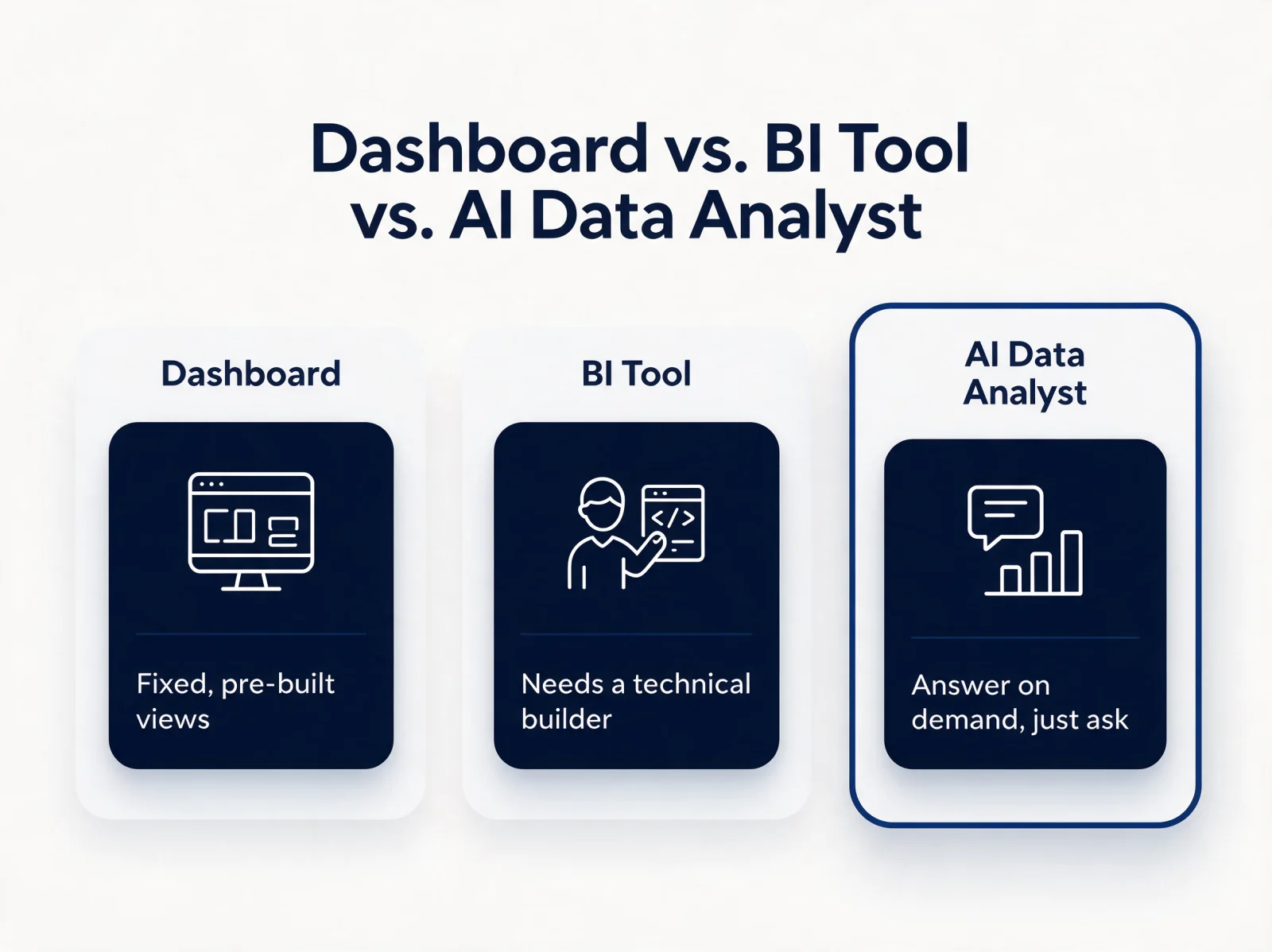
A dashboard shows metrics someone built in advance. A BI tool still needs someone technical to build the view. An AI data analyst answers the question you have right now, without a build step and without routing through a person.
Using AI for data analysis through a dashboard or a BI tool still leaves a build step in the way. Dashboards are fixed and BI tools are powerful but gated behind skill. Both put a wait between the question and the answer. An AI data analyst removes that wait. It is the difference between requesting a report and getting an answer. This is the promise self-service analytics has chased for years, now deliverable because language models can finally bridge a plain question to a correct query.
How AI Is Transforming Data Analytics Under the Hood
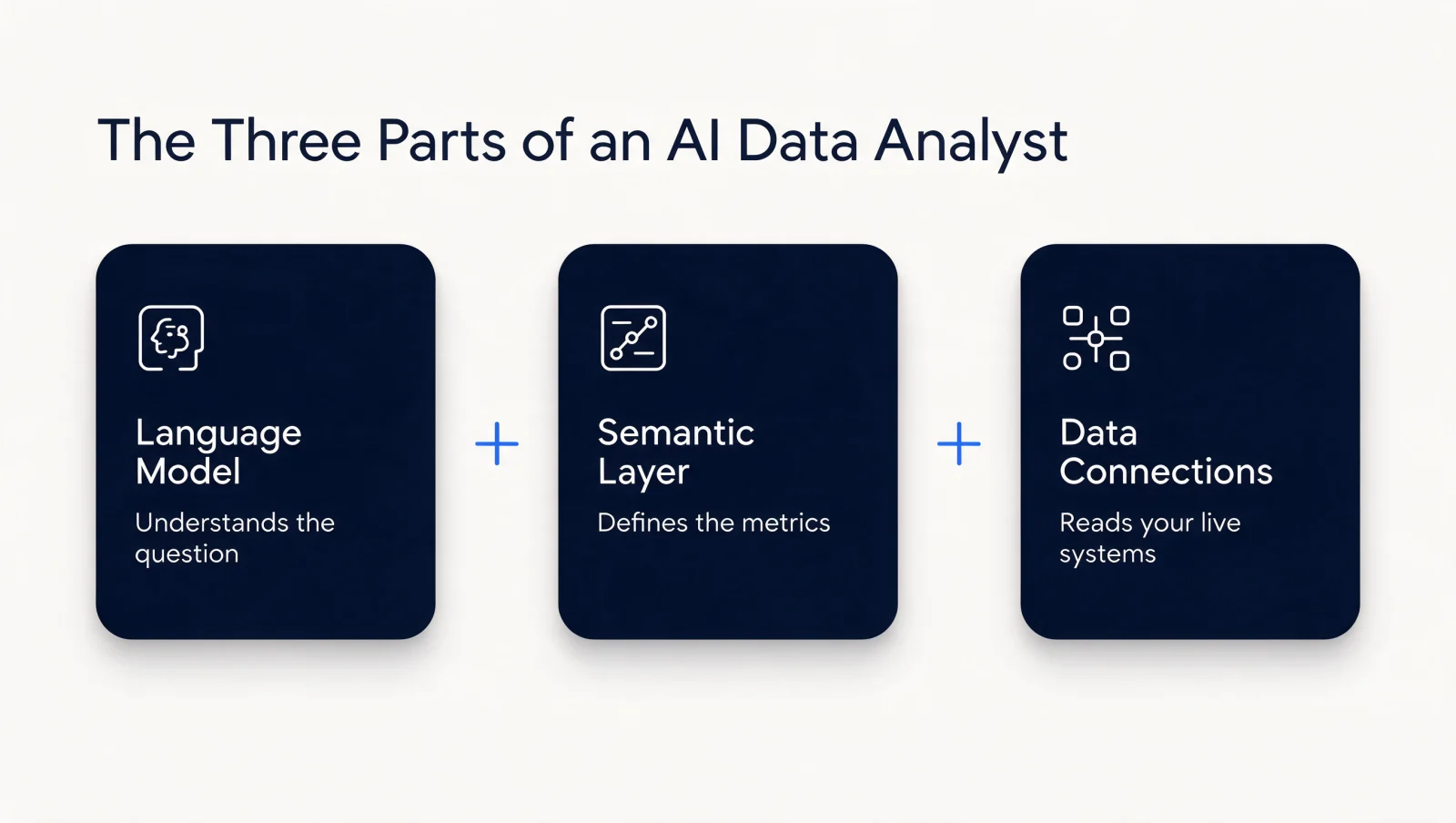
It combines a language model, a governed semantic layer, and secure connections to your data. The model interprets the question, the semantic layer defines the metrics, and the connections let it read your live systems.
Metric governance is the practice of defining each metric exactly once, in one place. Data connectivity is the plumbing that lets the model read your live systems. Three pieces make it work. The language model handles the question and generates a query, the capability behind natural language to SQL. The same engine scales from a single CSV in a ChatGPT data analyst session to AI big data analytics across a warehouse; what changes is the governance around it. The semantic layer defines each metric once, so "revenue" and "active customer" mean the same thing every time. The connections reach your CRM, finance, and operational systems so the analysis runs on live data, not a stale extract. Remove any one piece and it breaks: no model and it cannot understand you, no semantic layer and it improvises definitions, no connections and it has nothing real to analyze.
Why Is the Semantic Layer the Hard Part?
Because a language model pointed at raw data guesses at what your metrics mean, and it guesses confidently. The semantic layer forces every answer through one governed definition, which is what makes the output trustworthy.
Governance is the set of rules that decides what the AI may query and who sees the answer. This is the point most "AI analyst" demos skip, and it is the point that decides whether yours is safe to use. Without a governed layer, the system infers joins and definitions on the fly. When your data defines "customer" three different ways, it picks one and answers fluently, and the fluent wrong answer is indistinguishable from a right one until a decision built on it fails. The semantic layer is the fix and the real work. Building it on your specific data is an AI operations design engagement, not a setting you toggle.
Will AI Replace Data Analysts on Your Team?
No. It automates routine report-pulling and frees your analysts to own the data model, validate answers, and handle judgment calls. The human analyst moves up; they do not disappear.
The honest answer to "will AI replace data analysts" is no; the routine query work goes to the AI. The metric ownership, the governance, and the hard interpretive questions stay with people. In practice a good deployment makes your analysts more valuable, because they stop being a report help desk and start owning the layer that keeps the whole company's numbers honest. If that shift is your real question, it is worth its own look at whether AI replaces data analysts.
How Do You Deploy an AI Data Analyst on Your Existing Stack?
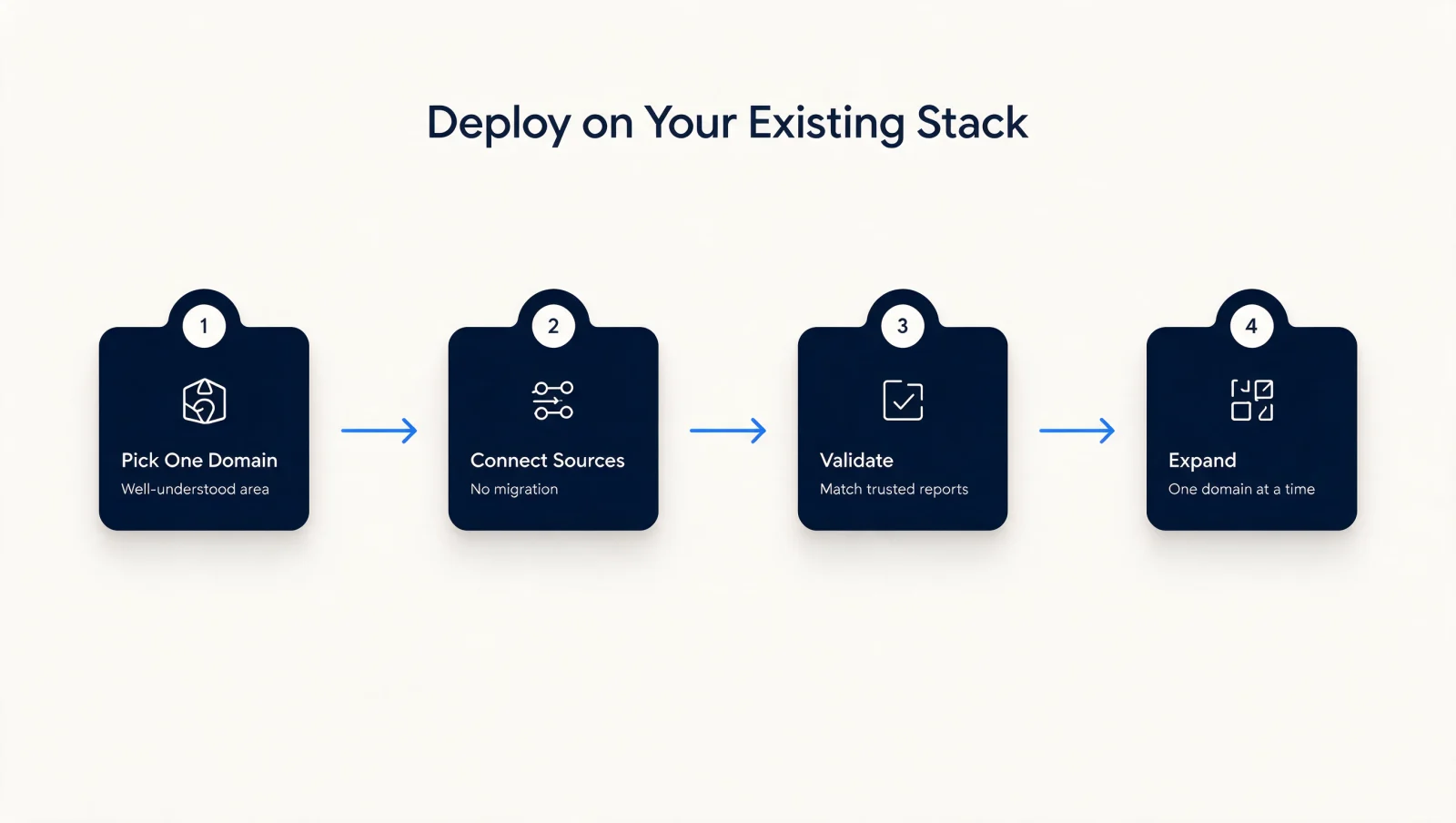
Start narrow. Pick one governed domain, connect its sources, define its metrics, and validate the answers against reports you already trust. Prove it there, then expand one domain at a time.
Start narrow
The reliable rollout is deliberately unglamorous. You choose a single well-understood area, such as sales pipeline or support volume. You connect the sources, define the metrics in the semantic layer, and check the AI's answers against known-good reports until they match every time. A team fielding 30 report requests a week frees roughly 20 analyst hours by routing them here. Then you widen scope. A correct-by-design deployment on a narrow slice earns trust that a broad, half-modeled launch never recovers from.
Add, don't replace
You do not migrate your data or replace your tools. You add an analysis layer on top of the stack you run. The tool choice itself, covered in the best AI tools for data analysis, comes after this, not before.
What Should You Look for in AI Data Analyst Tools?
Governed metric definitions, honesty when it is unsure, auditable answers, and respect for your access controls. Judge AI data analyst tools on reliability, not on how natural the conversation sounds.
| Check | Pass looks like |
|---|---|
| Metric definitions | One governed definition per metric |
| Uncertainty | Clarifies instead of guessing |
| Auditability | Any answer traces to its query |
| Access control | Existing permissions respected |
Auditability is the ability to trace any answer back to the query and rows that produced it. The evaluation checklist is short and strict. Does it enforce one governed definition per metric, or improvise? When a question is ambiguous, does it clarify or guess? Can you trace any answer to the query and the source? Does it honor your existing permissions so people see only what they should? Tools that pass are built on governance. Tools that fail are demos. Reliable answers plugged into solid workflow automation are what turn an AI data analyst from a novelty into part of how the business runs.
Key Takeaways
- An AI data analyst connects to your data, answers plain-language questions, and returns governed results on demand.
- It runs on three pieces: a language model, a governed semantic layer, and live connections to your systems.
- The semantic layer is the hard part; without it the system produces confident, inconsistent answers.
- Deploy it narrow-first on your existing stack, validate against trusted reports, then expand.
Deploying an AI Data Analyst on Your Stack
An AI data analyst is not a product you install. It is an analysis layer built onto the systems you already run, and its value depends entirely on the governance underneath. Done right, anyone in the business gets a trustworthy answer on demand. Done without a semantic layer, it circulates fluent wrong numbers at speed.
See how a B2B SaaS company cut preventable churn 27% with an AI operating layer.
Twelverays connects your data sources, builds the governed semantic layer, and deploys an AI data analyst on the stack you already have. If reporting bottlenecks on a short list of people, book a discovery call and we will scope a narrow-first deployment for your team.


